The 19 Best Utility Lands in Commander (and 2 Overrated Defaults)
Your land slots are losing games you never notice. Here is what goes in them instead.

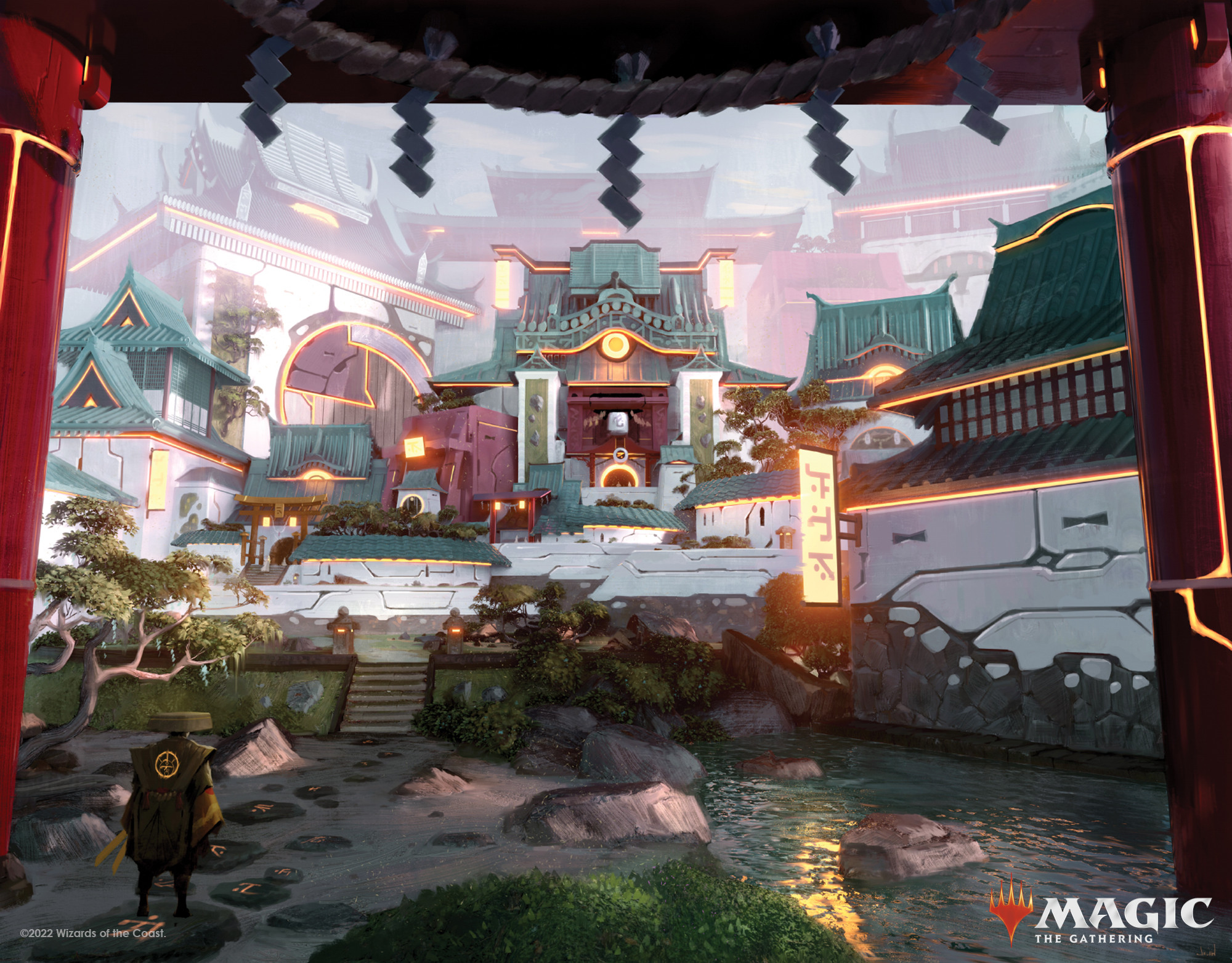
Your land base is undervalued real estate. Most Commander players fill 37 slots with basics and dual lands, then drop Rogue's Passage and Reliquary Tower into slots 38 and 39 because those are the names that appear in their brain when the question comes up. Familiar names. Comfortable names. Names that feel like doing something.
Neither of those lands is doing what you think. Rogue's Passage asks you to tap four mana and then tap the land to make one creature unblockable. That is a five-mana sorcery stapled to a land, and if it were a spell, nobody would run it. That tower taps for colorless and does nothing until your hand already has eight cards, so it is a blank land for roughly sixty percent of the games you play it. You just cannot see the games it lost you, because a land that does nothing fails quietly.
The case here is not that your land base needs to be a spellbook. The case is that the land slot is the single most consistently undervalued real estate in Commander, and the players who treat it carefully have a measurable advantage that never shows up in anyone's post-game conversation. These nineteen lands all produce mana. They all do something else. And the best ones change how the entire table plays around you, even when you never activate them.
One note on what did not make the list and why: Rogue's Passage is the cautionary example this article is built on. It represents every utility land that asks too much for too little, too slowly, in a format where the table will kill your big creature three times before you draw enough mana to make it unblockable. It set the bar, and nineteen lands cleared it.
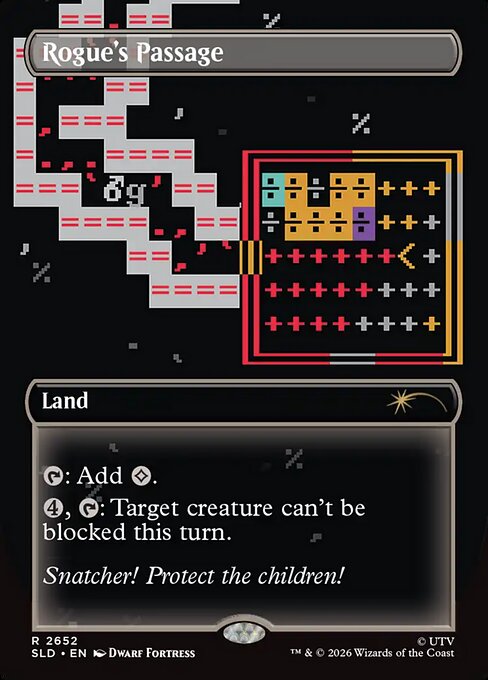
Tower of the Magistrate
Equipment decks have one game plan: put Sword of Fire and Ice on a creature and swing until the math is done. Tower of the Magistrate taps for one mana and makes any creature you name gain protection from artifacts through the end of the turn. The swords fall off. The creature cannot be equipped again this turn. Your opponent spent six turns setting that up.
Almost nobody runs this, which makes it invisible value the first time you use it. It is narrow, yes. But in metas where Voltron decks are regular guests at the table, this is a one-mana answer on a land that your opponent has no way to see coming.
Arena of Glory
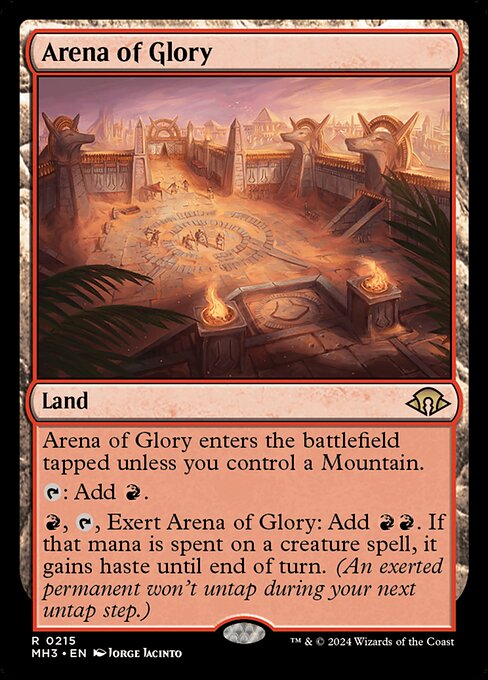
Mono-red gets this for free. It enters untapped if you control a Mountain, costs nothing to include, and the exert activation lets you spike a creature spell with haste in the same breath. The haste matters more than the double red in most situations, but having both on a land with no deckbuilding cost is the whole point. Step outside red-heavy territory, though, and it's just a land that sometimes does nothing, other options on this list are strictly better. If your commander is red and your Mountains are plentiful, you'll never need to think about this card again.
Arcane Lighthouse
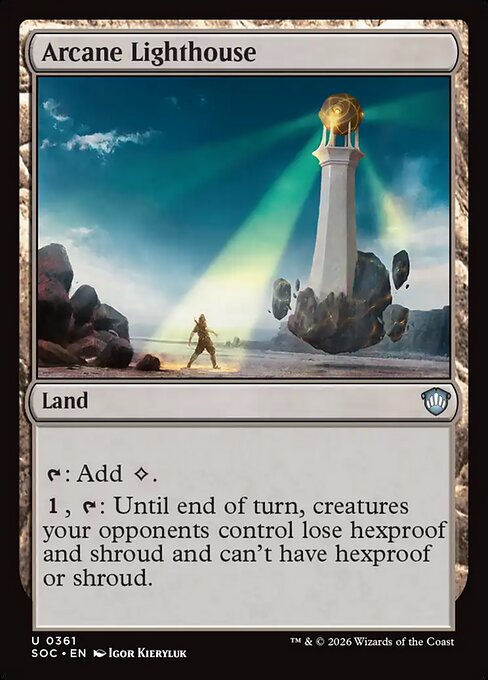
Turn three. The Sigarda player across from you has a commander with hexproof. Your Swords to Plowshares is doing nothing. Your opponent knows this. They know every removal spell in your hand does nothing. They have been building up to this exact position for two games and they are comfortable.
You tap Arcane Lighthouse for one mana. Sigarda loses hexproof for the turn. The room recalibrates.
That is the card. Colorless, any deck, costs one mana to activate. The meta dependency is real: against a table with no hexproof or shroud, this is a glorified colorless land you are running for the vibes. But opponents who know you are running it play differently around it, and that deterrent effect is worth something even at tables where it never fires. Bracket four behavior from a very polite land.
Alchemist's Refuge
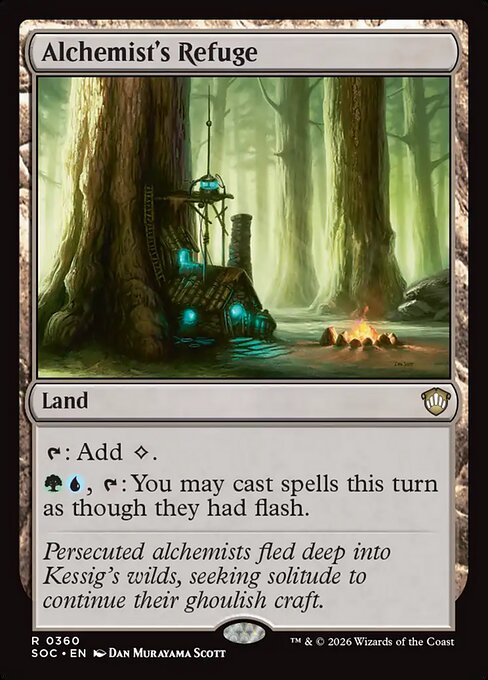
Think of this as Vedalken Orrery on a land that costs nothing extra and activates every turn, except it demands green and blue mana and will never do anything in a mono-red deck. The comparison resolves cleanly once you have it: Alchemist's Refuge is better than Emergence Zone in a long game where you want to hold up interaction every single turn cycle. That other land is better when you need one critical surprise moment and then it has done its job and can go.
For Simic builds, Edric players, Kinnan pilots, anyone who wants to live at instant speed and not sacrifice a land to do it: this is excellent. The activation costs {G}{U} plus a tap, so opponents can see you holding up mana, and that bluff value accumulates. Outside green-blue, look elsewhere.
Hall of Heliod's Generosity
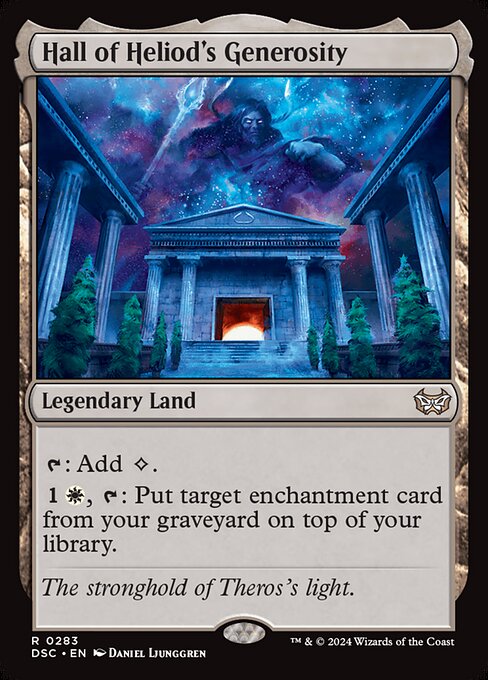
In enchantress decks, auto-include. Everywhere else, a blank white land that does nothing for you.
Legendary white land, pay {1}{W} and tap, return an enchantment from your graveyard to the top of your library. It sits alongside Academy Ruins and Volrath's Stronghold in a cycle where each major card type gets its own recursion land. The "top of library, not hand" detail means you draw it next turn, not immediately, so plan accordingly. In Tuvasa, Sythis, or any enchantress shell, there is no reason to skip this. You get recurring access to your best enchantments out of a single land, and the opportunity cost is a white pip on a legendary land you would run anyway. It disappears into the background of its archetype, quietly doing its job. It does not do that job anywhere else.
Shifting Woodland
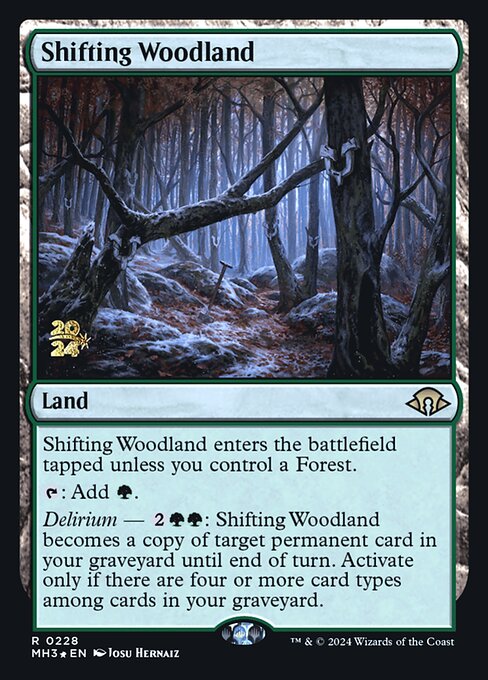
Your board just got wiped. Your Craterhoof Behemoth is in the graveyard. You have delirium. You activate Shifting Woodland for {2}{G}{G} and your land becomes a copy of Craterhoof through end of turn. The five remaining creatures on your board suddenly have enough power and trample to end the game. The person who cast the mass removal is doing math they did not expect to do this turn.
That ceiling is real and it is genuinely sick. The honest cost is that delirium requires four card types in your graveyard, so you need deck architecture that supports it. In green midrange and graveyard builds with lands, creatures, instants, and enchantments flowing through the yard naturally, the condition triggers itself. In casual go-wide decks without graveyard infrastructure, this sits awkwardly. The Forest requirement for entering untapped confirms it as a green-deck card. The payoff, when the condition is met, is cinema-adjacent.
Geier Reach Sanitarium
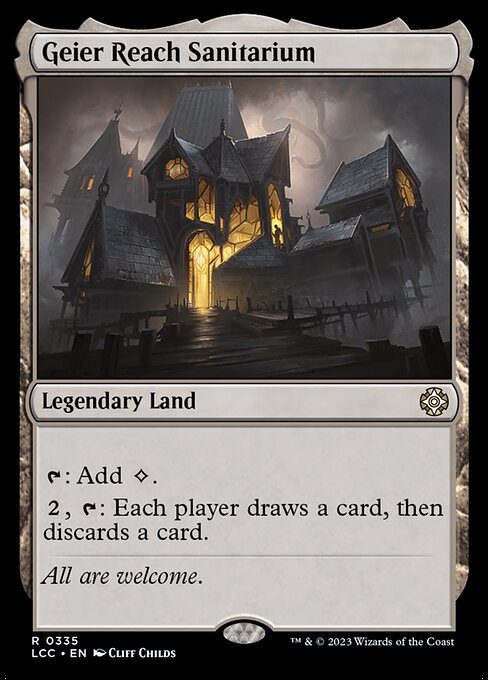
Nobody responds to this card the same way. The Nekusar player uses it and everyone at the table groans because they know the ping is coming. The reanimator player uses it and everyone squints trying to figure out what they are dumping into the yard. The group hug player uses it and three people thank them for the card. Same land. Same activation. Completely different room.
That is what makes Geier Reach Sanitarium interesting rather than merely good: it is a political instrument that transforms based on who is holding it. The base effect is each player draws a card and then discards a card for a colorless activation, which is card selection out of a land slot. In discard-matters decks, wheels builds, Anje Falkenrath madness piles, anything running Nekusar effects: this is active value every turn. Compare to Mikokoro, Center of the Sea, which gives everyone unconditional draws with no discard attached. Mikokoro is friendlier and immediately gets you targeted for being friendly. Sanitarium at least pretends to be reciprocal. At tables where opponents benefit more from drawing than you do, activating it is a normal and bad idea. Know the room before you tap it.
Talon Gates of Madara
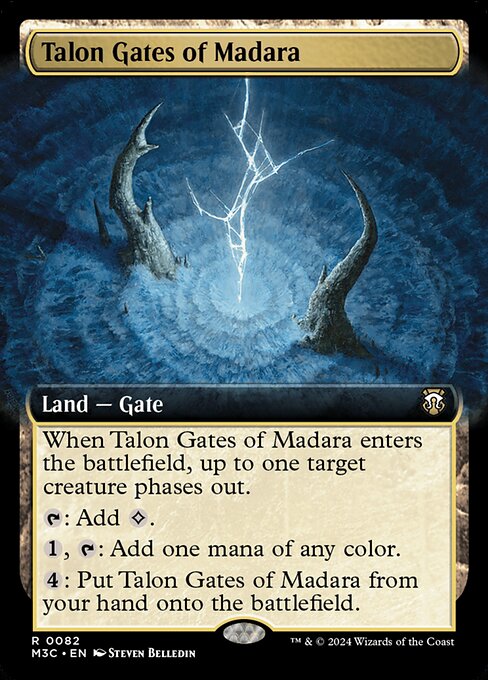
Run this in every colorless-friendly deck immediately. It phases out a creature when it enters the battlefield. Any creature, yours or an opponent's, no targeting restrictions beyond the usual. The phased-out creature returns at the start of that player's next untap step, so it is a clean tempo hit with no permanent exile.
The applications are broad enough to justify near-universal inclusion. Defensively, you phase out your commander before a mass removal spell resolves. Offensively, you blank an attacker mid-combat. Or you park a combo creature for a full turn rotation while the table figures out an answer. And critically: you can put it from your hand directly onto the battlefield for {4} at any point, meaning this is not bound to your land drop. You can deploy it in response to a wrath, or drop it in the middle of someone's attack. It comes in tapped and produces colorless freely, or one mana of any color with a {1} investment. The mana is fine. The effect is the reason you run it. Colorless means any deck qualifies, which puts this squarely in the category of lands that have no excuse not to be in the 99.
Academy Ruins
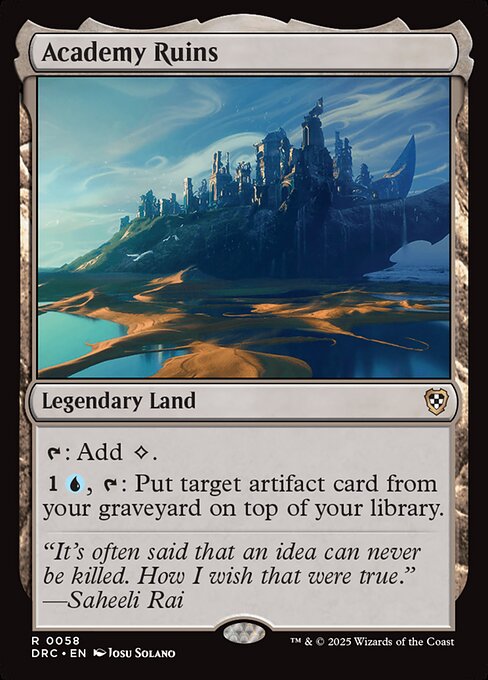
Academy Ruins is to artifacts what Volrath's Stronghold is to creatures and Hall of Heliod's Generosity is to enchantments. It puts artifacts from your graveyard on top of your library for {1}{U} plus a tap. Top of library means you draw it next turn. In a deck that runs powerful artifacts, this is a guaranteed second cast of your best permanent.
Artifacts trend toward the highest individual card quality in Commander, which is exactly why this land wins the recursion cycle outright. Recur a Sol Ring, a combo piece, an indestructible creature that someone worked three turns to kill. The second use case is underappreciated: in artifact decks relying on specific pieces, it doubles as protection against mill effects by cycling key artifacts before drawing them back. Blue restriction is real and legendary means one per deck, but in blue artifact strategies there's no real debate about running it.
Plaza of Heroes
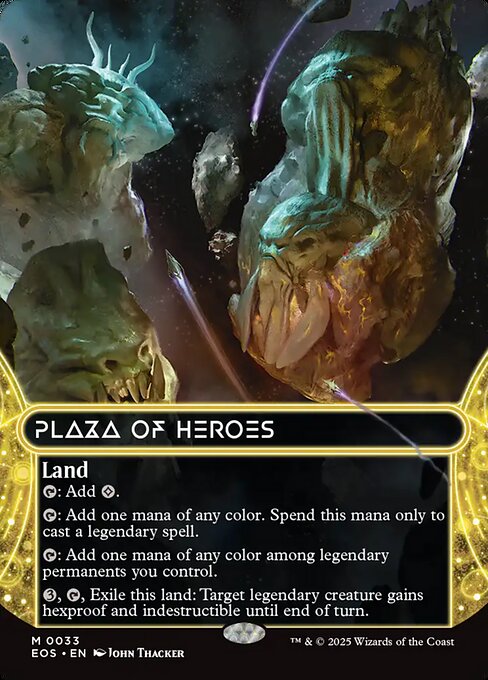
Let's be honest about the awkward part first. If you control no legendary permanents, Plaza of Heroes taps for colorless. One generic mana. The same as a Wastes. Two of its three abilities require your board to already exist before they contribute anything. That is the real ask: Plaza is conditionally powerful rather than unconditionally useful.
Here is the counter, and it is a good one: in Commander, your commander is always a legendary permanent, so the third ability is always live. Exile Plaza to give your commander hexproof and indestructible through the turn, a one-time answer to targeted removal, paid for with a land. Your opponent Vindicates your commander. You tap out, sacrifice Plaza, your commander lives. You used a land to answer a spell. The bones of the card are correct. In legendary tribal builds, Sisay piles, and mono-color commanders who always have that color available through the second ability, Plaza overperforms dramatically. In decks with no legendary theme and a sparse board, the mana production is conditional enough that you should run something else. Ask yourself honestly: do I have three legendary permanents in play by turn five? If yes, run this. If maybe, think carefully. If no, skip it.
Blast Zone
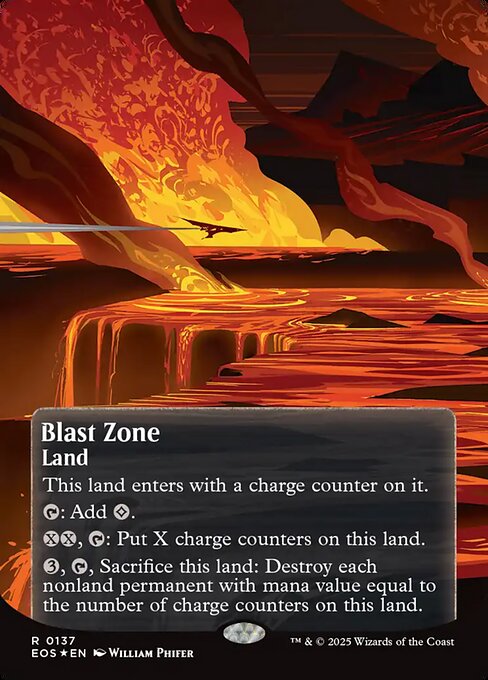
Your opponent has twelve Saproling tokens from the past three turns. They are about to attack with all of them. You have Blast Zone on the battlefield with one counter already on it. Saprolings have mana value zero. You sacrifice it and every mana value zero nonland permanent is gone.
That is the floor. Set the counter count to match whatever threatening category of permanent is dominating the game. Three counters destroys every three-mana value permanent. Five destroys every five. The slow setup is the honest cost: you are telegraphing the target, and opponents watching you add counters have time to respond or play around it. Proliferate strategies can accelerate the clock significantly. The colorless identity means any deck can run it, which puts this card in a rare category: a repeatable, targeted mass removal effect in a land slot with no identity restriction. The table will watch it with appropriate concern once they know it is in your 99. That concern is itself valuable, even turns you never activate it.
Mystic Sanctuary
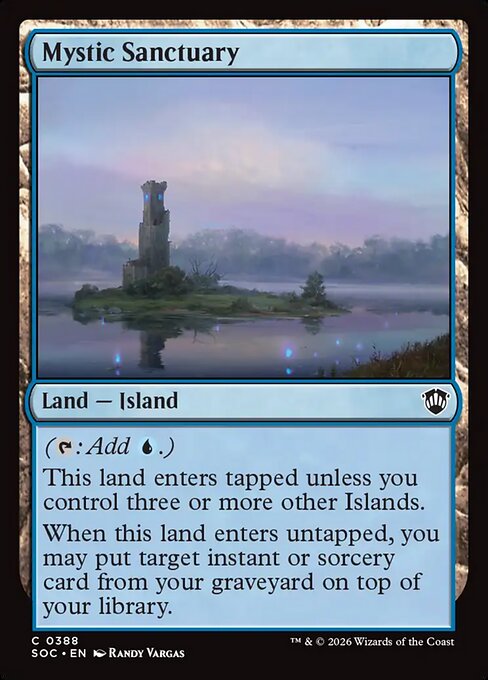
Quick rules trivia before the evaluation: this card is banned in both Modern and Pauper. Not for being loud or splashy. For enabling infinite turn loops so quietly efficient that non-rotating formats had to remove it entirely. Commander does not have that ban, so blue decks get to run something that was too powerful for non-rotating formats, and most players are not treating it with appropriate respect.
The effect: when this enters untapped, return any instant or sorcery from your graveyard to the top of your library. The condition is three or more other Islands in play. In mono-blue and heavy blue builds, that condition is satisfied from the very first time you cast this. You get back your Cyclonic Rift, your best counterspell, your top sorcery. Guaranteed, on your next draw step. It's not hand, there's a one-turn delay, but the recurrence is exact, and exact is doing a lot of work when the alternative is hoping you draw into it again. The ceiling against which all other recursion is measured: this is how you turn a single Time Warp effect into a loop without any other combo pieces. In three-color blue decks running only a handful of Islands, it comes in tapped more often than not and contributes nothing. In decks where Islands flow naturally, it's the format's most efficient spell recursion stapled to a permanent that removal never touches.
Emergence Zone
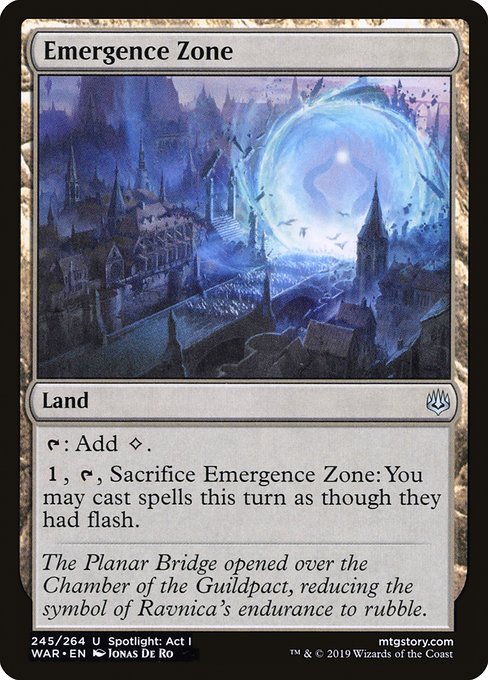
The most underplayed colorless land in Commander. I am not being careful about that claim.
One mana, tap, sacrifice: all your spells gain flash for the rest of that turn. That is Vedalken Orrery for one turn, from a land, in any deck, with no color requirement whatsoever. The community conversation about this card has a recurring problem: people read "sacrifice this land" and feel a cost. They feel a downside. They treat the sacrifice as a reason to hesitate.
The sacrifice is the point. You are paying one land slot for one critical moment: the game state that determines whether you win or lose. You flash in the blocker after the sweeper announcement. You cast your sorcery-speed combo piece on an opponent's end step before they untap. You bluff instant-speed interaction you do not actually have, keeping one mana up with the Zone in play, watching two players decide not to attack you because they are not sure what you are holding. I have watched a four-player pod spend three full turns playing around this land when the player holding it had nothing in hand at all. The bluff value alone is worth the slot.
Alchemist's Refuge is repeatable but asks for specific colors. Vedalken Orrery is repeatable but costs four mana and lands on the stack where it can be countered. Emergence Zone is the surgical version: once, precisely, when it matters. Every deck should consider it. Most of the ones that skip it are wrong.
War Room
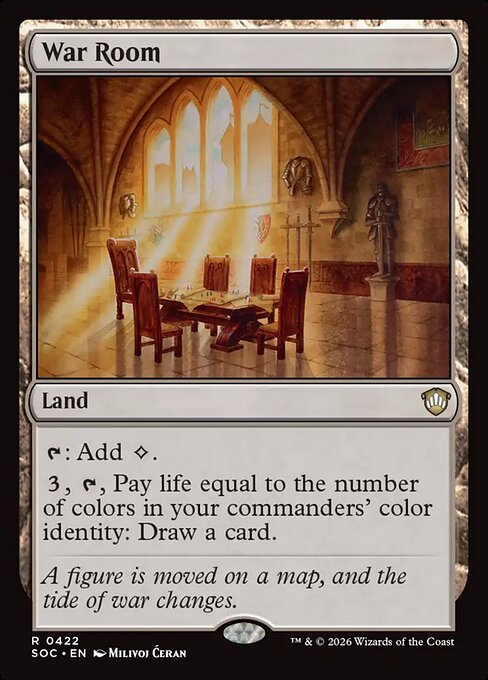
It is turn eight. You are in mono-black. Your hand is empty. You have been gassing out for three turns, drawing one land, watching the Simic player across from you draw three cards per turn off their commander. You look down at your land base and realize you have been running War Room since turn four and never activated it once.
You pay three mana. You tap the land. You pay one life, because your commander is mono-black and the life cost equals the number of colors in your identity. You draw a card. From a land.
One life to draw a card from a land is a rate that most dedicated draw spells cannot match. The "life equal to colors" text sounds like a drawback, and in five-color builds it genuinely is, five life per activation accumulates fast enough to matter. In two-color builds you pay two life per draw, which over a long game adds up to something but rarely costs you the game. In mono-color decks, the cost is so low it barely registers. Compare to Bonders' Enclave, which requires a creature with four or more power and costs the same three mana. War Room works the moment it hits the battlefield. Compare to Mikokoro, Center of the Sea, which gives everyone cards unconditionally and immediately turns you into the table's card-draw provider. War Room is yours and nobody else's. Criminally underplayed in mono-color decks where there is genuinely no argument against running it.
Scavenger Grounds
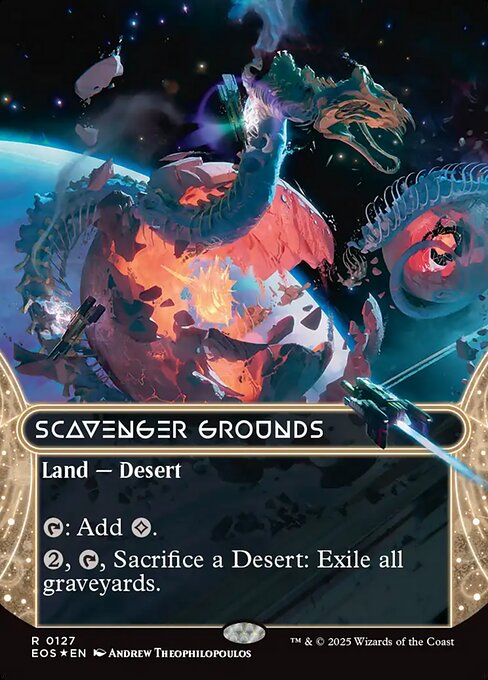
The comparison to Bojuka Bog resolves this way: Bojuka Bog is surgical, targeting one player's graveyard for free as a land drop. Scavenger Grounds is nuclear, exiling every graveyard at the table, including yours, for {2} plus a tap plus the sacrifice of a Desert.
It is itself a Desert, so it can sacrifice itself. No secondary Desert required. You tap two mana, tap it, sacrifice it, and every graveyard in the game disappears at instant speed. The moment to do this is on an opponent's end step, the turn before the reanimation trigger resolves. You are not paying the same cost as Bog, but you are getting an effect that covers every opponent simultaneously, something Bog cannot do. The decision tree is clean: run Bojuka Bog if you are in black and one specific graveyard is the primary threat. Run Scavenger Grounds if your colors don't include black, if three players are running graveyard strategies, or if you need to answer the table at once. Run both if your meta is deep enough in reanimation that a single surgical hit is not enough. In non-black decks, this is the best graveyard hate available from a land, and it is not a close comparison.
Boseiju, Who Endures
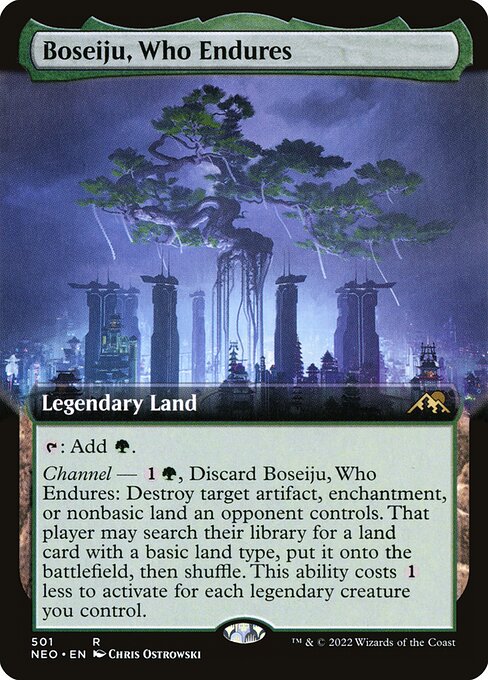
Some players see the opponent search clause and put the card down. The clause reads: when you destroy a nonbasic land with Boseiju, the opponent may search for a basic land with a land type. You give them a replacement. Some players treat that as disqualifying. Those players are overreacting to the fine print.
Here is what Boseiju actually does. You discard it from your hand, not play it as a land. The channel ability goes on the stack as an activated ability, not a spell, so it cannot be countered by Counterspell or any standard interaction. It costs {1}{G} and destroys target artifact, enchantment, or nonbasic land. It costs {1} less for each commander or legendary permanent you control, so in commander-centric builds with even one at the table, this is a one-green-mana instant-speed uncounterable answer to the Rhystic Study that has been draining everyone's will to play for the last four turns.
The opponent getting a basic land back matters less than you think. They lost the nonbasic that was doing work. They gained a Forest that produces generic value. You spent one mana and never telegraphed the interaction. Part of the Kamigawa channel land cycle alongside Otawara, Soaring City, Takenuma, Abandoned Mire, Eiganjo, Seat of the Empire, and Sokenzan, Crucible of Defiance, run whichever match your colors. In green, Boseiju is the broadest removal spell you will ever fit into a land slot, and the opponent's consolation basic is not a reason to skip it.
Otawara, Soaring City
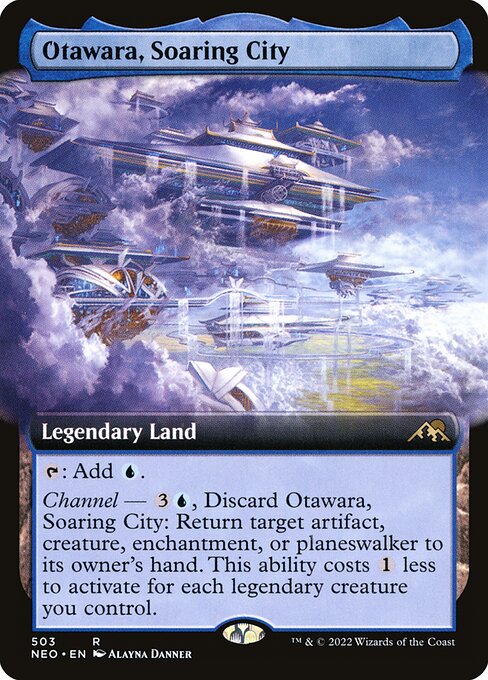
Bounce is the most versatile effect in Commander and most players do not appreciate what "versatile" means here. It ignores indestructible. It ignores hexproof. It ignores protection. When the creature is sitting behind every protection keyword in the format and your removal spells are dead cards, bounce puts it back in the hand and buys the table one more full rotation before the problem resurfaces.
Otawara does this from a land slot, uncounterable, for {3}{U} discarded from hand. It returns any artifact, creature, enchantment, or planeswalker to its owner's hand. Not one of those types. All four. The enchantress that has been generating three cards per upkeep goes back to hand. The combo artifact goes back to hand. The planeswalker that ultimated last turn goes back to hand. The cost drops by {1} for each legendary creature you control, which in most Commander games means this resolves for {1}{U} or just {U} by the mid-game.
Compare to Boseiju, Who Endures: Boseiju destroys, which is permanent but misses indestructible permanents and does not touch creatures. Otawara bounces, which is temporary but hits every card type except lands, ignores every protection keyword, and answers threats that destroy simply cannot. Run Boseiju for the nuclear artifact or enchantment removal. Run Otawara for the indestructible commander that is ending games. Run both if you are in green-blue and do not want to choose. A channel land that answers whichever permanent is most dangerous in any given game, for the cost of a land drop and one or two colored mana, is the kind of card that changes table memory fast.
Bojuka Bog
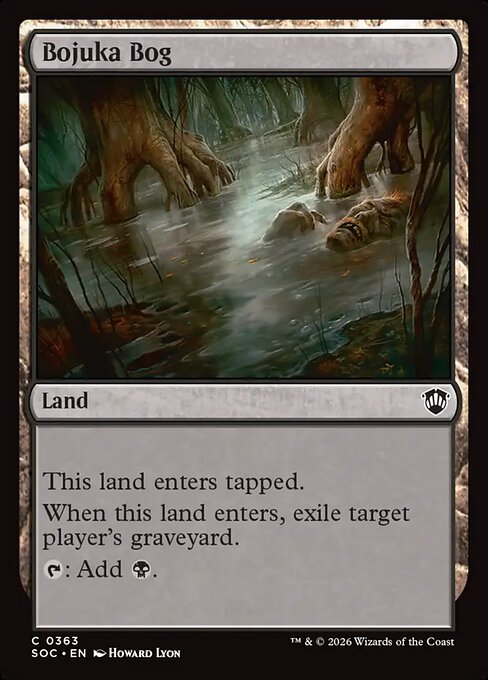
There is a specific social texture to playing this land. You say "land for turn" and put the Bog on the battlefield. An opponent's graveyard, the one they have been carefully assembling since turn three, disappears. They frown. The reanimator pilot who had been smiling at that graveyard like it was a full pantry before a road trip is now looking at an empty shelf. You shrug. "Just playing a land."
The whole apology, if you owe one, is delivered with a straight face, because a land did the work. That is the social physics of the Bog: it punishes the strongest archetypes in Commander, graveyard combo, reanimator, flashback piles, for the cost of one tapped land on the turn you play it. No mana. No spell slot. No line on the stack where it gets countered. The ETB trigger just fires.
The timing ceiling is real and underappreciated. Bojuka Bog triggers on ETB, so you can fetch it with Crop Rotation in response to a reanimation trigger sitting on the stack. Opponent announces Reanimate targeting their Blightsteel. You sacrifice a land, tutor the Bog into play, their graveyard empties, the Reanimate has no target. I have watched this sequence play out at a four-player table and the silence afterward lasted a full five seconds. In black decks, the argument against running this card does not exist. The cost is one tapped land on your second turn and the payoff is a permanent answer to the most consistently dominant archetypes in the format. Scavenger Grounds is the alternative for decks outside black, and both can coexist in the same 99 if your meta demands it.
Reliquary Tower
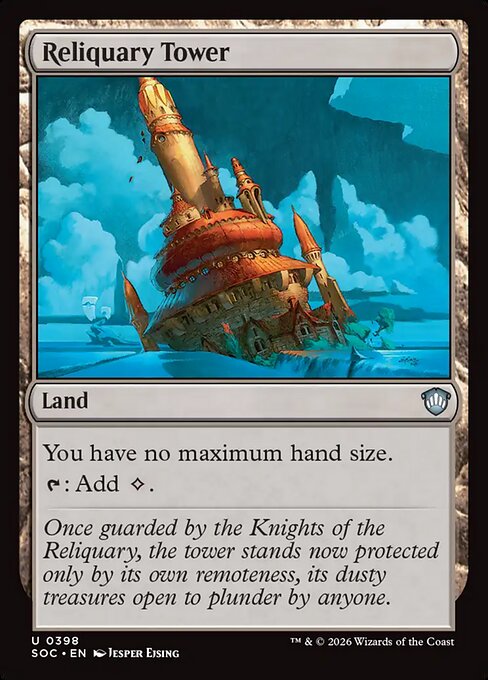
You already knew this was number one. You saw the list title, you scrolled down, you found it. Here is the part where I confirm your expectations and we move on.
Most players deeply misunderstand what Reliquary Tower is. They read "no maximum hand size" and think: safety net. They think: nice to have. They think: auto-include in every deck, never revisit. Correctly understood, it is an infrastructure card that enables a complete style of play. It turns Rhystic Study from "draw two extra cards and discard down" into "run a card advantage engine that builds a thirteen-card hand by turn six." It turns Consecrated Sphinx from "draw four, keep four" into "draw twelve, keep twelve." It turns a wheel into a stockpile rather than a reset. When it is doing its job, you are not using it as a safety net. You are using it as the foundation of a strategy where hand size is a resource you are deliberately accumulating and deploying.
The community does not say this enough: Reliquary Tower in a low-draw deck is worse than a Plains. It taps for colorless, already a concession in a colored deck, and it does nothing, so you are paying a real mana base cost for zero benefit. I have seen this card in decks running eight or fewer draw effects, sitting there tapping for colorless, earning its slot through vibes rather than function. That is a normal and bad idea. The card is not a staple. It is a build-around enabler that tells you exactly what your deck needs to be doing. If your card draw cannot realistically get you past seven cards in hand, this land is asking you to upgrade your draw package, not rewarding you for running it. The players who auto-include it without interrogating that question are making their mana bases quietly worse, one slot at a time, and never noticing in the post-game audit.
New and Worth Watching: The Edge of Eternities Planet Lands
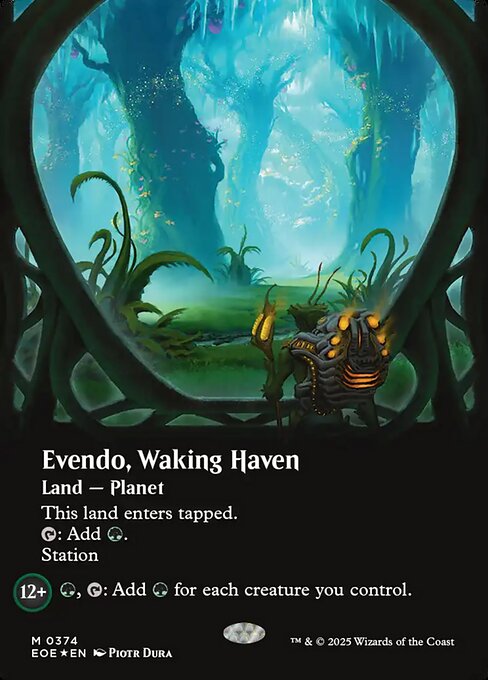
Five new lands from the Edge of Eternities set that are going to matter in Commander faster than people expect. All five enter tapped, tap for their respective color, and run the Station mechanic: tap any creature you control to put charge counters on the Planet equal to that creature's power. Station only as a sorcery. At twelve or more counters, each Planet unlocks a second ability that would be game-warping on a three-mana permanent and is frankly aggressive stapled to a land.
Twelve counters sounds like a long road. A creature with four power stations three counters per activation, so four activations over four turns gets you there. Any creature with six power does it in two. The path to activation is faster than the number looks, and once you are there, it does not go away. It just does this every turn.
Evendo, Waking Haven taps for green mana equal to the number of creatures you control. It is a budget Gaea's Cradle impression in a land slot and does not require legendary-creature scarcity to run. Any creature-heavy green deck wants this. Susur Secundi, Void Altar asks you to pay one black, tap, pay two life, and sacrifice a creature to draw cards equal to that creature's power. In an aristocrats deck sacrificing a six-power creature, that is six cards off a land. The apology rate goes up when this starts firing. Uthros, Titanic Godcore taps for blue mana equal to the number of artifacts you control, in a fully stocked artifact deck that approaches Tolarian Academy numbers. Run this in Urza builds with the appropriate respect and mild embarrassment. Kavaron, Memorial World sacrifices a land to create a 2/2 Robot token and give all your creatures haste and plus one power through the turn's end, closing games in red aggro decks that need exactly that. Adagia, Windswept Bastion creates a legendary token copy of any artifact or enchantment you control for {3}{W} plus a tap, a white value engine that compounds with each activation.
A word of caution: these need deck construction support. A deck with no creatures above two power is not charging these efficiently. But in the right shell, these lands are doing things that most dedicated spells cannot match. Try them before dismissing them on paper.
Stop Wasting Your Land Slots
Reliquary Tower is the most mindlessly auto-included card in Commander. Not the most powerful. Not the most dangerous. The most mindlessly auto-included, which is a different and more specific accusation. It goes in decks where it has no business being, taps for colorless, and tells anyone paying attention that the pilot did not ask "what does this land do in the games I actually play?" It is a blank land wearing the costume of a staple.
The card people overreact to in the opposite direction is Emergence Zone. Players see the sacrifice clause, feel the cost, and hesitate. They run Alchemist's Refuge instead because it is repeatable, even in decks where they activate it once per game and the colors are awkward. The sacrifice is not a downside. It is a precision instrument with exactly one purpose: the moment where tempo matters more than every other consideration. You pay for that moment with one land slot. The math is correct.
The utility lands that earn their place in this format are the ones doing work when you have not activated them yet. Arcane Lighthouse sitting on the battlefield makes hexproof commanders nervous. A single land with one mana open reads as instant-speed interaction whether or not you actually have any. Talon Gates of Madara in your hand is a deployment option your opponents cannot plan around. These lands are political instruments before they are mana producers, and that is the frame missing from most players' land base evaluations.
Ask this about every utility land in your 99: what does it do when you have not activated it? If the answer is "nothing, it just taps for mana," that space in your deck is asking to be replaced. If the answer is "it makes my opponents consider a line of play they otherwise would not," that land is doing its job at the table. Most decks are running two or three lands that fail that test by default. Rogue's Passage is one of them. The Tower in a low-draw deck is another. You know your list. Happy brewing.