MTG Game Changers: The 20 Cards That Bump Your Bracket
One card can silently push a casual deck to bracket 3. Here is every Game Changer ranked by how much it actually warps


What Makes a Card a (And Why It's Not a Ban)
The bracket system gets one thing right before it gets anything wrong: it gives a name to the feeling you get when someone drops Demonic Tutor on turn two out of a deck described as "a fun Esper control build." The table looks at each other. Nobody said anything was wrong, but something is wrong. The s list gives that feeling a mechanism.
A is a card that dramatically warps Commander games through resource runaway, denial of efficient play, or degenerate combo enablement. Critically, the designation does NOT mean banned. Rhystic Study is legal. Thassa's Oracle is legal. Mana Crypt is banned, and that distinction matters enormously, which is why this article has a dedicated section on it. A single in your 99 sets your deck's floor at bracket 3. Four or more puts you at bracket 4. Bracket 5, which is cEDH, is unrestricted. Brackets 1 and 2 are completely off-limits for any card.
The list started around 40 cards in beta in February 2025 and has been actively calibrated since. October 2025 saw a significant wave of removals: Expropriate, Jin-Gitaxias, Core Augur, Sway of the Stars, Vorinclex, Voice of Hunger, Food Chain, Deflecting Swat, and four commanders (Urza, Lord High Artificer, Yuriko, the Tiger's Shadow, Kinnan, Bonder Prodigy, Winota, Joiner of Forces) were all removed. The guiding principle: high-cost cards are allowed to produce high impact. A nine-mana sorcery doing something game-ending is working as designed.
Two things to flag before the rankings. First, Demonic Consultation is not on the s list. It is Thassa's Oracle's go-to combo piece in cEDH. Flagging one half of the format's most common instant-win package while leaving the other untouched is either deliberate restraint or a significant oversight, and this article will argue it's the latter. Second, this ranking is failure-first. Every card gets evaluated by asking: what has to go wrong for this card to be a dead draw? For most entries, the answer is revealing.
This is the current list of 20 s, ranked by how much they actually warp the game, not by popularity.
Grand Arbiter Augustin IV

Grand Arbiter is the most contestable card on this list, and I'll say that plainly. The failure condition is obvious: a 2/3 for four mana dies to Aura Shards, gets hit by Farewell, eats a Lightning Bolt, or folds to any of the seven removal spells your opponents are presumably running at a table where bracket calibration matters. When he's gone by turn four, he changed exactly nothing.
The stax argument has real teeth only in dedicated tax builds where he's the commander, not a 99 piece, and where his effect stacks with Thorn of Amethyst, Sphere of Resistance, and Narset, Parter of Veils. One extra mana per spell compounding across a full game in that specific shell sets back resource development by several turns. But the GC designation applies whether he's leading the deck or riding the bench, and as a 99 inclusion against a table with functioning removal, he's usually dead before he matters.
The distinction the GC list is struggling to draw here is between "annoying" and "warping." Grand Arbiter is annoying. He is not warping in the way Underworld Breach is warping. Lumping them onto the same list isn't a close call, it's the framework's clearest overcorrection.
Narset, Parter of Veils
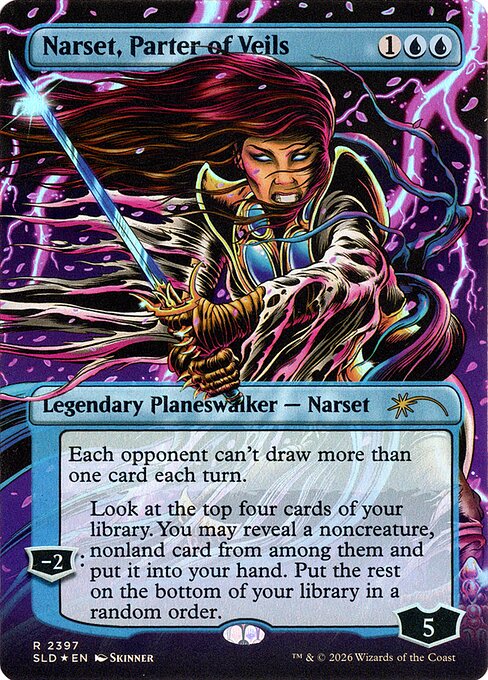
Compare Grand Arbiter and Narset side by side, and the gap in threat level becomes clear immediately. Both are stax-flavored permanents that slow down opponents. Both die to removal. But Narset's failure condition is considerably rarer than Grand Arbiter's, and the reason is structural: her static ability fires the moment she enters the battlefield and requires no attack, no tap, no trigger beyond existing. That's it. No conditions.
Grand Arbiter hits the graveyard to Swords to Plowshares before he produces value. Narset takes the same removal, but she's already done something the instant she resolved, in any draw-heavy blue-leaning pod, she shuts off symmetrical draw effects entirely: wheels, Consecrated Sphinx triggers, Rhystic Study follow-through. The failure condition is creature-heavy pods with minimal spell draw, where she's a 0/3 that doesn't block. But that table profile is not where Narset gets sleeved.
The key comparison isn't Grand Arbiter; it's Notion Thief. Notion Thief does the same job at flash speed but as a triggered replacement effect. Narset is the static version: always on, no timing window needed, cheaper to cast. Her minus ability is genuine card selection on top of the lock effect. Three-mana planeswalkers are inherently resilient in Commander because they require a dedicated answer rather than incidental removal. Narset belongs in her GC placement in a way Grand Arbiter doesn't, and the two cards being treated as equivalent threats on this list represents the framework's least precise calibration.
Gamble
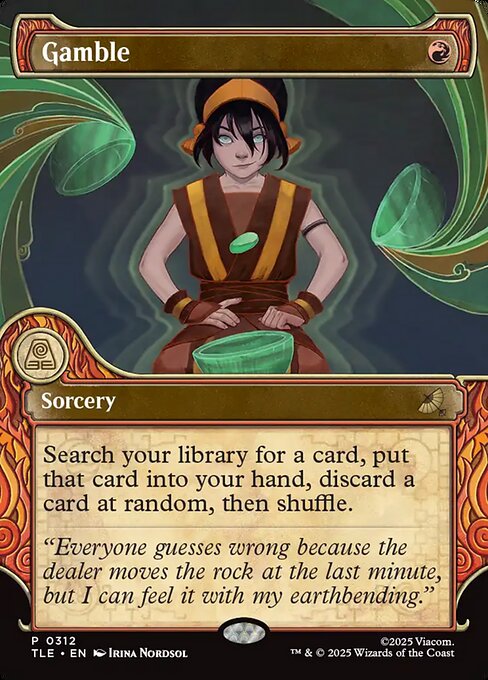
Here is an absurdity that actually makes sense: a tutor that might discard the exact card you just searched for. Red has exactly this problem, and it turns out the format still put Gamble on the list, because even a coin-flip tutor at one mana is too good to ignore.
The failure condition for Gamble is specific and real. If you're holding one card, you search for your wincon, and then you randomly discard it 100% of the time (only card in hand, only target for the discard). If you have a full grip of seven, your target has a one-in-seven chance of hitting the discard. The math improves dramatically with hand size, and the failure condition is the narrow "one card in hand" state. In graveyard strategies, reanimator builds, and any list running Underworld Breach, discarding the target is often the correct outcome anyway, the graveyard is where you wanted it.
Red historically had no access to 1-mana universal tutors. Jeska's Will is exceptional acceleration; it is not a universal search. Gamble is the closest red gets to a black tutor at one mana, which means it does exactly what the GC list targets: it collapses Commander's strategic variance into a deterministic search in a color that was never supposed to have that ability. The bracket impact is real precisely because the tool is so out of place in the color's design space.
Necropotence
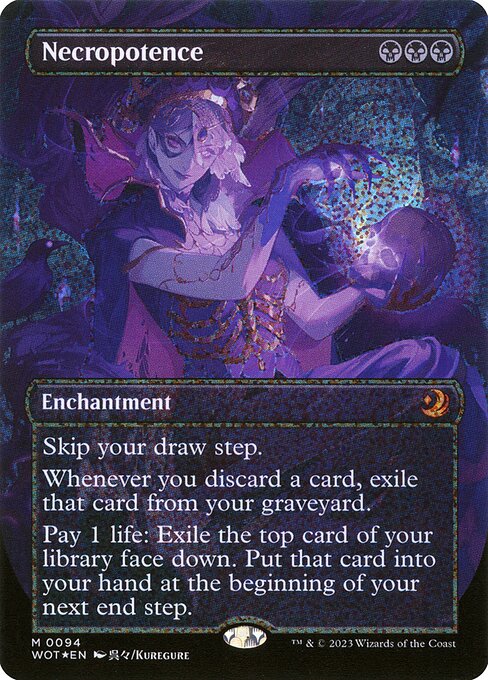
The failure conditions for Necropotence deserve a hard look before the ceiling, because the ceiling produces 5-7 extra cards per turn cycle and the floor gets glossed over.
First: triple black. Necropotence is not splashable. It is not for two-color Golgari goodstuff lists where you have twelve black sources. It demands mono-black or heavily committed black lists with the mana base to guarantee BBB by turn three. Second: you skip your draw step permanently. You are fully all-in on the life payment engine with zero fallback to normal draw. Third, and this one matters for a large portion of the Commander format: discarded cards are exiled, not binned. Necropotence destroys graveyard synergy completely and permanently. Every loot effect, every wheel, every discard outlet becomes a liability. If your deck cares about the graveyard at all, Necropotence is a self-inflicted handicap.
Now invert. In any non-graveyard mono-black list with a life cushion, lifegain commanders, Aetherflux Reservoir builds, anything that incidentally recovers life: Necropotence converts your life total into an unbounded hand with no ceiling other than how much you want to pay. The comparison to Ad Nauseam is instructive. Both spend life for cards, but Necropotence gives you complete control over how much you spend per turn. Ad Nauseam reveals cards and can kill you instantly if your curve is wrong. Necropotence lets you pay one life per card at the end of your turn, drawing into value incrementally and never accidentally killing yourself. Safer than Ad Nauseam in practice, but the power ceiling is lower because the rate is fixed at one card per life rather than potentially unlimited draws in a single spell.
Orcish Bowmasters
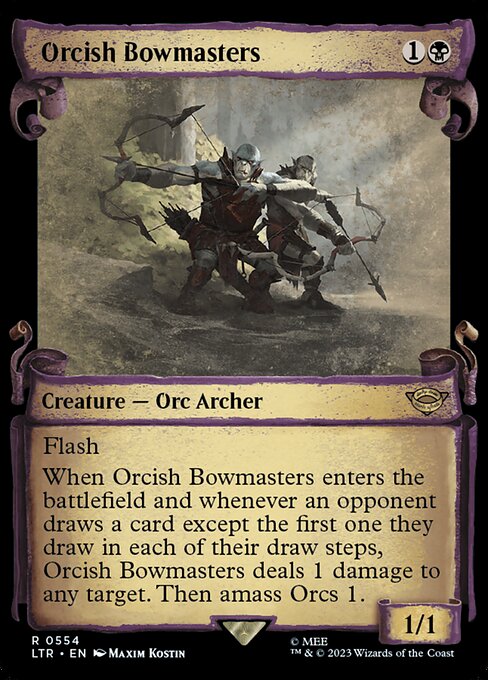
Turn four. You're at a four-player table, there are two blue players, and Rhystic Study has been on the field for three turns. Someone casts a wheel effect to refill their hand, maybe Windfall, maybe their own wheel. You have one black mana up. You flash in Orcish Bowmasters.
Seven cards drawn by one opponent. Seven triggers. Seven damage distributed across creatures and players. An Orc Army sitting at 7/7 on the turn it appeared. The table is looking at you differently now.
That's the play pattern, and it's not hypothetical, it's the reason Orcish Bowmasters went from "interesting Lord of the Rings card" to status at speed. The mechanic to understand is that it fires once per card drawn by opponents, not once per draw spell. The One Ring putting three burden counters on itself draws three triggers. A wheel draws seven. The failure condition is a pod with minimal draw, where a flash 1/1 for two that maybe pings a mana dork is the floor. That floor is genuinely bad. But that's not the pod Bowmasters gets sleeved into.
The interaction with Narset, Parter of Veils is particularly precise: Narset restricts opponents to their first draw. Bowmasters punishes the second. They're targeting the same behavior from complementary angles, one locks the draw count, the other punishes exceeding it. The Orc Army grows as the game does. In a draw-heavy pod, Orcish Bowmasters isn't just interaction: it's a threat that scales directly with how hard your opponents are trying to pull ahead on cards.
Field of the Dead
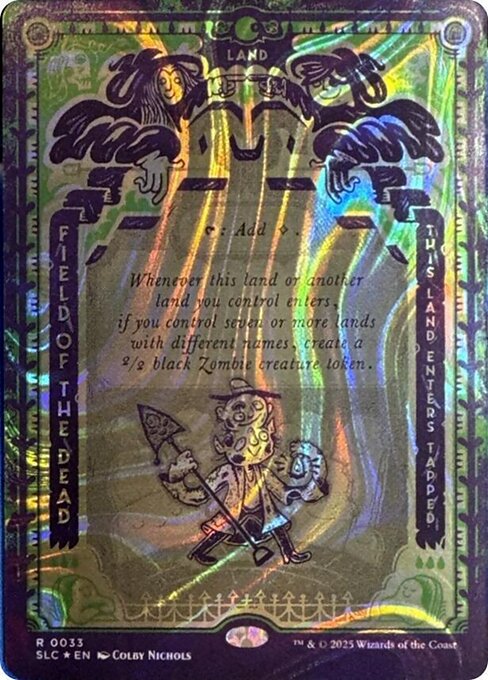
It makes Zombies. That's the whole card. The bracket line is crossed because of how many Zombies it makes and how little you can do about it.
The failure condition is real: you need seven or more differently named lands, which is a mid-game requirement in most builds. Control decks with minimal land fetching hit that threshold slowly or never. But the non-failure condition is the entire Landfall archetype. Aesi, Tatyova, and every land-ramp commander in the format trivially clears seven named lands by turn five. Every land drop from that point generates a 2/2, which means a ten-land play session puts you up seven tokens. That snowball is nearly impossible to race through normal means.
The real bracket problem: you cannot easily interact with a land. Crop Rotation fetches it on demand, at instant speed, for one mana. By the time removal is aimed at the Zombie army, the board is already unmanageable. Slow inevitability is a different kind of warping than explosive combo, but the GC designation is correct here.
Jeska's Will
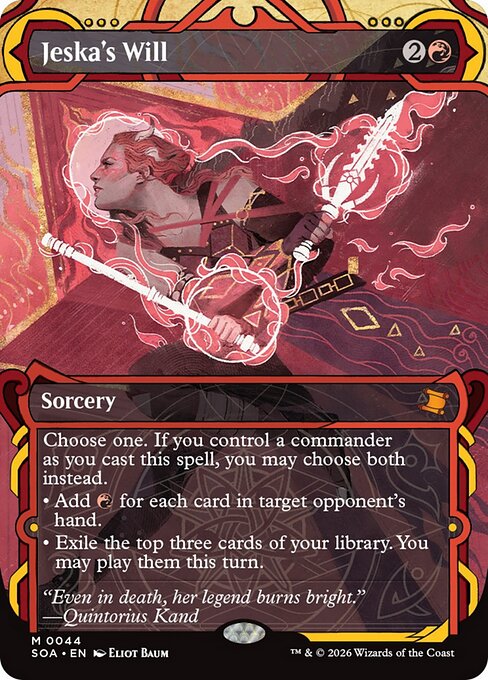
Let's name the failure condition first. Jeska's Will is a dead draw when your opponent emptied their hand the previous turn and your commander is not in play. Two modes, both dependent on external conditions you don't control: no cards in their hand means nothing from mode one, and without a commander you can't choose both. In that specific game state, empty-handed opponent, no commander, you're paying two red mana for three exiled top-of-library cards you may play this turn, which is fine but not material.
Now name how often that failure state occurs at a typical mid-game pod. Almost never. By turn three or four, your commander is in play and your opponent has four to seven cards in hand. Both modes are live simultaneously. The card reads: "Add one mana for each card in an opponent's hand, plus exile the top three cards of your library to play this turn, for two red mana." At a hand count of five, that's eight mana of total production for 2R, which is an asymmetric accelerant of exactly the kind the GC list exists to flag.
The comparison to Gamble clarifies the different tiers of red tutors: Gamble searches but might lose the card; Jeska's Will doesn't search but provides explosive mana and card access in one package. Red's inability to keep up with blue and black in Commander was a real problem before this card existed. Jeska's Will closed that gap, and the bracket designation is the format's acknowledgment of that. Any red deck at bracket 2 running Jeska's Will is misrepresenting its strength to everyone else at the table.
Gaea's Cradle
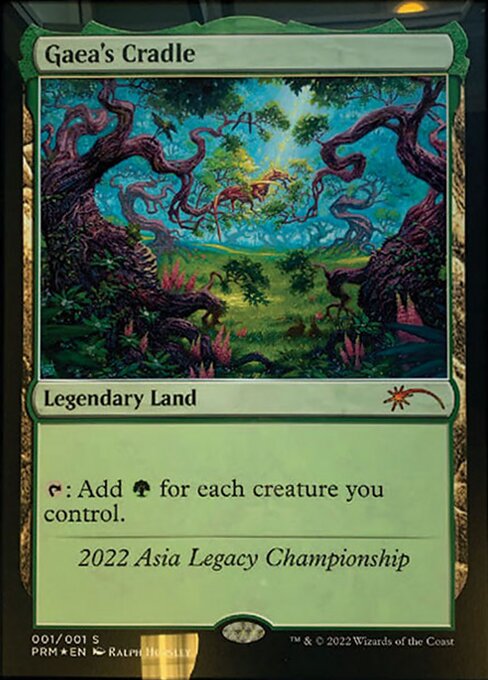
You've seen the moment. Someone taps Gaea's Cradle with eight creatures in play on turn four. There's a beat of silence. Someone across the table quietly counts the tokens on the battlefield and does the math. The "is that legal at this table?" conversation starts before anyone has taken their next turn.
That silence is the designation made visceral. This land produces more mana from a single permanent than anything else in Commander in creature-heavy strategies. Five creatures is five green mana from a land slot with no spell investment. Eight creatures is eight. In Elf decks and token builds, the threshold is hit by turn three or four through normal game development, not through any special setup. The land does not require a tap ability beyond what every land already does.
The failure condition is genuine: a Cyclonic Rift or board wipe before the untap step turns it into a tapped land that produces nothing for a full turn cycle. That failure state can be engineered. It just requires holding up seven mana or a board wipe, which is its own cost.
Crop Rotation fetches it on your opponent's end step for one mana, which means the real cost is two cards rather than one, and that two-card line is how dedicated token and elf builds go from "competitive" to "a problem." The price point (well over $200 in paper) is also worth naming: this is the most economically exclusionary card on the list, and that fact alone creates a table equity question separate from the bracket designation. The card warps Commander at two levels simultaneously: raw ceiling and access.
Ancient Tomb
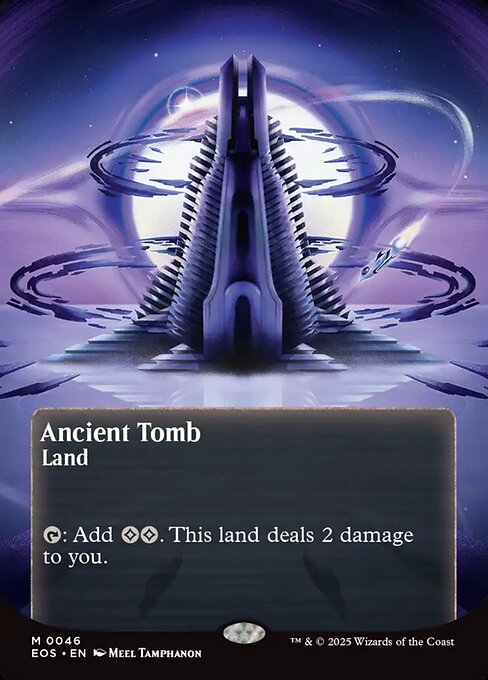
Sol Ring is not on this list. Ancient Tomb is. Hold those two facts together and you understand exactly what the GC framework is measuring.
Sol Ring produces two colorless mana for one mana on turn one and draws answers from artifact removal. The Tomb produces two colorless mana for free and costs two life per activation, and it's a land, which means it occupies a different slot entirely and is categorically harder to interact with than an artifact. The comparison reveals the GC list's organizing principle: it's not raw power, it's format distortion. This card goes into every single colorless-using deck regardless of strategy because free mana from a land slot has no deckbuilding cost. You never have to ask "should I run this over something else?" The answer is always yes.
Mana Vault and Grim Monolith sit in the same accelerant tier and earn their GC placements for the same reason: nothing or near-nothing invested for three colorless produced compresses the game arc in ways that normal two-for-one acceleration doesn't. The Vault costs one mana for three colorless with a punishing untap structure. Monolith costs two for three colorless with a steep untap tax. Both are draft-or-never inclusions in decks where colorless acceleration matters, which is essentially every deck.
The failure condition for Ancient Tomb is nearly nonexistent in the early game. You lose two life per activation in a 40-life format, and the cumulative damage over a long game is real, but you're getting the mana on turns one through three when it matters most. Its GC placement is among the list's most defensible, and it belongs higher in these rankings than almost any card in the stax category.
Opposition Agent
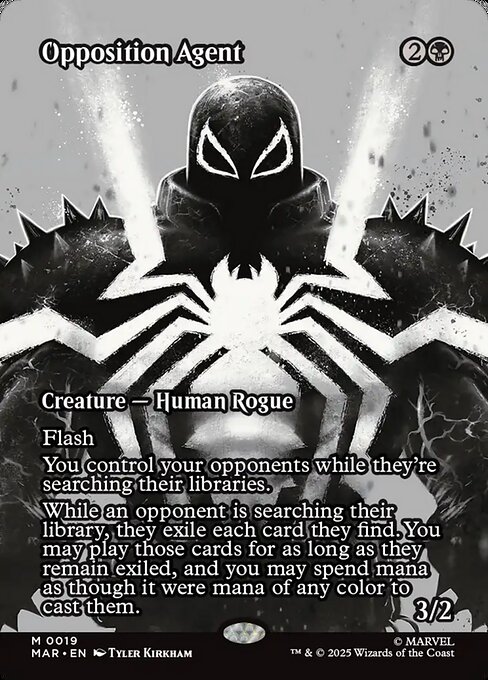
Your opponent casts Demonic Tutor on their main phase. You have two black mana up and Opposition Agent in hand. You flash it in.
They now search their library, but you control them during the search. Every card they find is exiled. They find their wincon. It goes to exile under your control, castable with any color of mana. They don't get the card. You do. The tutor they spent two mana on has just handed you their best card and given you information about everything else they were looking for.
That's the play pattern that gets the GC designation, and it's surgical in a way most hate pieces aren't. The Agent doesn't just punish one search, it changes the threat calculus for every search effect at the table for the rest of the game. Vampiric Tutor becomes dangerous to resolve. Crop Rotation becomes dangerous. Natural Order becomes dangerous. Worldly Tutor, fetchlands, Cultivate, Kodama's Reach, any effect with the word "search" on it is suddenly a liability while this 3/2 is in play.
The flash mode is what separates it from symmetrical hate pieces: you hold up interaction mana, wait for the search trigger, and surprise anyone who dares tutor with an effect they didn't plan for. The political ripple crosses the whole table even when you don't have it in hand. Players who know it's in your deck will hesitate on tutors, which is itself a form of game warping.
The failure condition is real and worth naming: in a pod with zero search effects, this is a 3/2 flash for 2B. Medium-statted creature, nothing more. The GC placement assumes a table where searching happens, which covers most pods built around anything from this article's top twenty. Correctly flagged, but contextually narrow, it warps tutor-dense games heavily and does nearly nothing in creature-combat pods where nobody searches for anything.
Bolas's Citadel
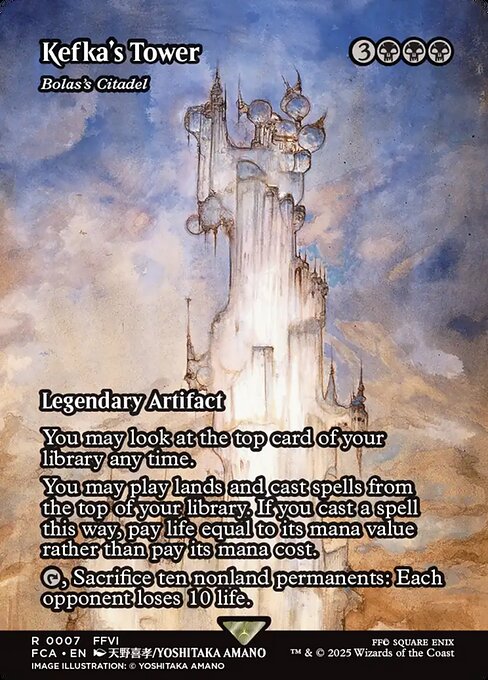
Six mana triple black for a legendary artifact. That's the entry cost, and it is steep. By the time the Citadel resolves, games are often already decided. That's the honest failure condition at the top: in fast pods where the game is finishing on turns four through six, a six-mana do-nothing-until-it-resolves artifact is too slow to matter. The political reality compounds this: every opponent at the table knows exactly what the card does the moment it hits the battlefield, and removal comes immediately. It draws hate the instant it resolves.
Now invert. In the games where it resolves and you have a healthy life total, Bolas's Citadel converts your library into free spells paid in life. On the turn it resolves, you might play five to eight cards off the top for nothing beyond their life costs. Ramp for two life. Tutor for three life. A board wipe for four life. The throughput in a single turn is explosive in a way Necropotence isn't. Necropotence is incremental; the Citadel is a burst. The Sensei's Divining Top interaction is the combo that makes it genuinely dangerous: Top lets you filter your library, ensuring each Citadel activation hits a useful card and not a land, and with a free sacrifice outlet the loop becomes an infinite draw-and-cast engine. Two individually powerful cards that happen to close games together.
The comparison to Ad Nauseam is imperfect but instructive. Ad Nauseam is faster and can kill you instantly in high-curve decks. The Citadel gives you control over the rate but requires surviving to six mana and a clean resolution. Both spend life for cards, but this card is the slower, more powerful version for decks built to support it. That framing tells you exactly where it belongs: black midrange and combo lists with the redundancy to protect it, and almost nowhere else.
Teferi's Protection
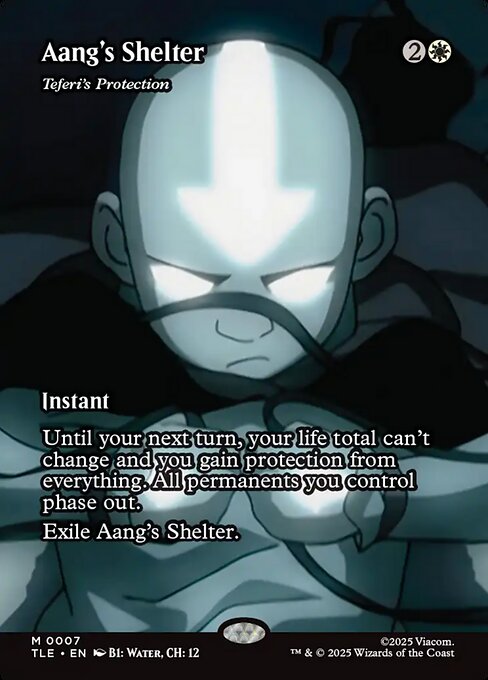
Three mana, you survive everything until your next turn. Your life total can't change. You have protection from everything. All your permanents phase out.
There is no failure condition for Teferi's Protection in hand. That sentence is the entire evaluation. The only way this card is "wrong" to have is if you never face a threat, and in the bracket range where this card gets played, threats are constant. It answers Cyclonic Rift. It answers board wipes. It answers infect damage, combat damage, and targeted removal simultaneously. It phases out your permanents so they return untouched on your next upkeep.
The reason it ranks here rather than higher is purely reactive nature. Teferi's Protection generates no resources, draws no cards, and wins no games by itself. It buys exactly one turn. That turn is often decisive, but "often decisive" is different from "warps the game regardless of context." It is a reactive tool at its ceiling, whereas everything ranked above it is proactive at its floor.
The bracket implication is clear: a deck with Teferi's Protection in the 99 cannot claim bracket 2. This is a dedicated defensive tool that exists specifically to survive threats that bracket 1 and 2 tables aren't supposed to be applying. If you need this card, your table is playing at a level the card requires, and that level is bracket 3.
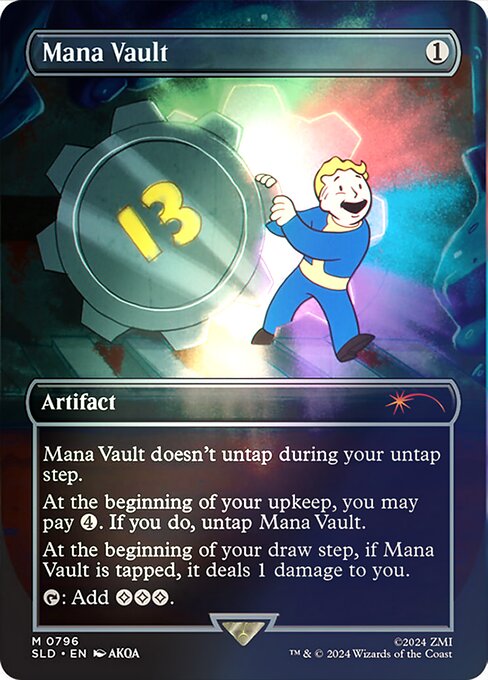
Mana Vault
First, let's clear up the confusion this section exists to address. Mana Crypt is banned in Commander. Not a guideline. Banned. Jeweled Lotus is banned. Dockside Extortionist is banned. These three cards are not on the GC list because you cannot legally play them at any competitive pod regardless of bracket. Calling Mana Crypt a "guideline" is a factual error, and plenty of outdated content online makes exactly that error. The banned list and the GC list are distinct documents with distinct consequences.
Mana Vault is the fast mana representative in this slot. One mana for three colorless, doesn't untap automatically, deals one damage per upkeep if tapped, costs four to untap manually. The comparison to the banned artifact is instructive about what the GC list is measuring: Vault is clearly the inferior card, but its power profile, near-zero mana investment for three colorless, puts it in the same category as Ancient Tomb. The colorless production means it goes into every deck regardless of color identity. There is no build where "one mana for three colorless with some maintenance cost" is wrong to include.
Grim Monolith follows the same logic at two mana for three colorless with a four-mana untap tax. Mox Diamond is free mana if you discard a land. Chrome Mox is free mana if you exile a card from hand. All of these belong to the same tier of acceleration that represents the GC list's most defensible philosophical ground: cards that compress the game arc in ways that cannot be hedged against with normal deckbuilding. Fast mana is correctly flagged as a category, even when individual entries within it vary significantly in raw strength.
Fierce Guardianship
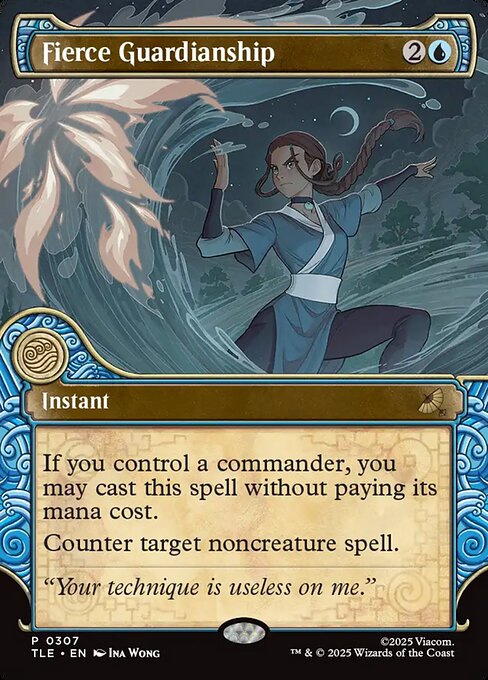
Someone has been developing for six turns. They have their combo assembled. No one has meaningful interaction up, the mana is either committed to their own plans or they're out of cards. The win is about to happen. You have two blue mana and a commander in play. You cast Fierce Guardianship for free and counter the win.
You spent nothing. You created a two-for-one in tempo. The game continues.
The failure condition is a dead or tucked commander, at which point it costs 2U to counter a noncreature spell. Three mana for a narrow counter is a medium counterspell. Without a commander, the card is castable but not efficient. With a commander in play, it's free interaction with no deckbuilding cost beyond including blue in your color identity. The free casting clause is the entire reason you never have to ask "can I afford to counter this?" The answer is always yes while your commander is alive.
Deflecting Swat was removed from the GC list in October 2025; the "free with commander" mechanic was deemed acceptable for redirection effects. Fierce Guardianship remained, which signals the format's view that free countermagic is categorically more warping than free redirection. That call is correct. Redirection requires a target. Counterspells require nothing. The GC placement reflects something real about the interaction asymmetry this card creates between blue commanders and every other color identity.
Thassa's Oracle
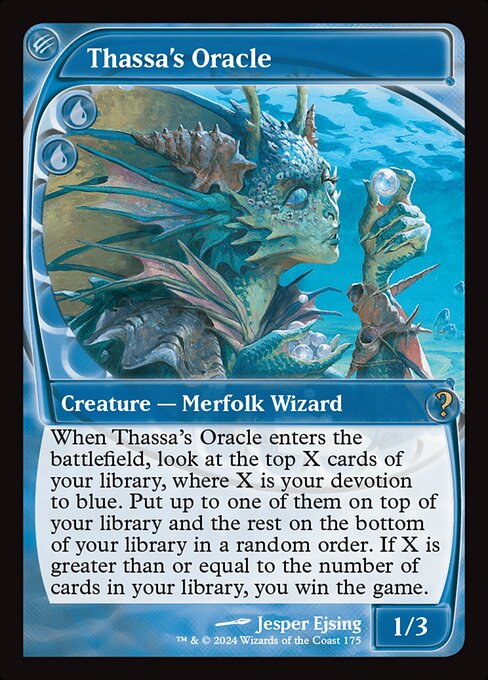
Let's name the failure condition first, because the failure-inversion framework applies here at its clearest. Thassa's Oracle is a dead draw if you cast it and your library is not empty. In which deck deliberately built to win with Oracle does that happen? Almost never, because if your deck runs it, you assembled a way to empty your library first: Underworld Breach loop, Hermit Druid, Leveler, or the specific partner I'll name in a moment. The card is a two-mana closer whose failure condition requires you to fail at the one thing you've built your deck to accomplish.
The 2/1 body is irrelevant. This card is never cast for combat value. The ETB that lets you look at the top X cards and rearrange them is a secondary ability that disguises the card's actual function. Oracle is a payoff that turns "empty library" into "win the game" for the minimum possible mana. Two mana. That's the price for ending a Commander game flat.
Here is the omission worth stating directly: Demonic Consultation is not on the list. It's Oracle's main combo partner in competitive and near-competitive Commander builds. You name a card you don't own, exile the top six, reveal until you hit it, or intentionally name a card you don't run to exile your entire library. Cast Oracle. Win. One half of this two-card combination is flagged as a bracket-warping card. The other half is unaddressed by the GC mechanism entirely. That gap is the most obvious structural weakness in the current framework, and flagging Oracle without Consultation means the combo is monitored but not actually constrained by the tier classifications. Any deck built around this line is playing bracket 3+ for Oracle's inclusion, but retains free access to its most efficient enabler. The format will need to close this gap.
Vampiric Tutor
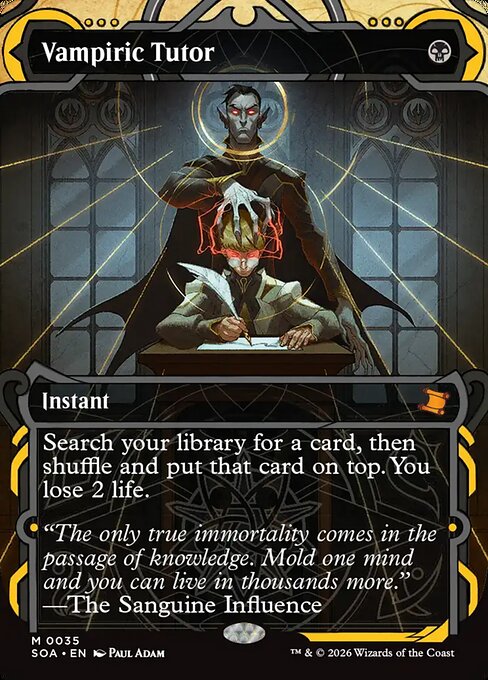
Compare Vampiric Tutor and Demonic Tutor directly, because this is exactly the kind of named comparison that separates real analysis from generic praise.
Both cost one black mana plus one additional mana. Demonic is one black and one generic, sorcery speed, puts the card in your hand. Vampiric is one black and zero generic, just one black total, puts the card on top of your library, costs two life. Vampiric is cheaper in absolute mana but costs card disadvantage: the card is on top, not in hand, so you must draw it next turn. Demonic puts it directly in your hand for immediate use but can only be cast during your main phase.
The best mode for Vampiric: end of your opponent's last turn before your untap, tutoring for a finisher you'll draw and cast on your next turn. No telegraphing, no opponent responses between search and draw. The worst mode: tutoring when you need the card immediately, you found it, but it's sitting on top and you won't draw it until next turn. Demonic wins that scenario cleanly.
Imperial Seal belongs in this conversation: a sorcery-speed Vampiric at the same cost. Strictly worse on timing, strictly identical on effect. It's the fourth-best black tutor after Demonic, Vampiric, and this entry. Mystical Tutor and Enlightened Tutor occupy narrower niches, instants and sorceries, artifacts and enchantments, but at one mana and on the opponent's end step, the narrower restriction barely matters in combo-oriented builds.
The shared problem for the entire tutor category: a one-mana search-your-library effect converts 99-card variance into deterministic play. Commander's deck-building appeal rests on the 99-card pool creating different games. Tutors collapse that variance into "what is the best card in my deck right now?" and fetch it. Every tutor on the GC list is correctly flagged for this reason, and the question is only about relative power within the category.
Underworld Breach
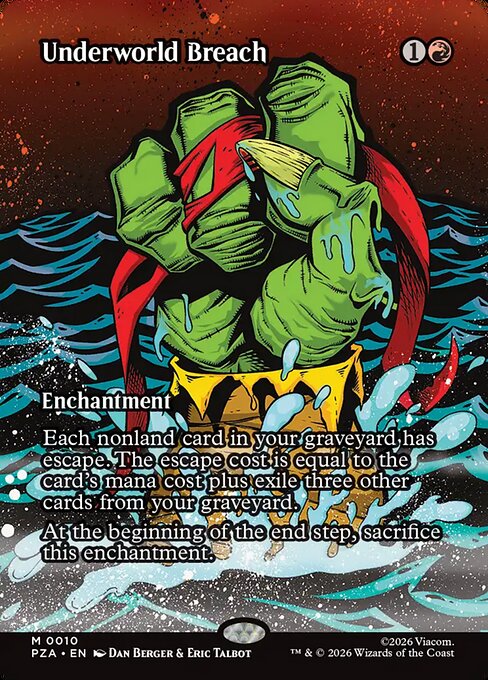
The failure conditions are real and worth stating first. This card does literally nothing if your graveyard is empty: it's a two-mana enchantment that sits in play generating zero value until you've milled cards into the bin. The escape cost is cumulative, too. Each activation exiles three other graveyard cards as payment, so your graveyard is a finite resource that drains as you loop. A graveyard with six non-land cards fuels at most two escape activations for a typical two-mana card before the bin is empty. If you resolve it without setup, you might get two spells back and then your enchantment is a blank.
The ceiling, in a deck built around it, is a loop most competitive tables recognize on sight. Lion's Eye Diamond interacts with Breach in a way that produces an infinite storm loop. LED activates as an instant: sacrifice it, discard your hand, add three mana of any color. Cast a draw spell for less than three mana. Use LED mana to escape LED from the graveyard (exile three other cards, cast LED again). Discard your hand again, draw again, repeat. The graveyard fuels itself as long as you have enough non-land cards to exile, and with Wheel of Fortune or similar effects filling the bin, the fuel problem is solved. The loop generates infinite storm count and infinite draws. Cast Thassa's Oracle with an empty library. Game over.
Two mana for that ceiling is what makes this obscene. You're not paying six mana for a finisher. Everything else is either already in the graveyard or can be put there cheaply, which means the combo enabler with the highest ceiling-to-cost ratio on this list belongs at bracket 4 with any meaningful supporting package around it.
Demonic Tutor
I want to take a brief detour into design history before the ranking argument, because this placement is actually the ending of a long story.
Demonic Tutor was banned from Standard and restricted in Vintage before Commander was a format. "Search your library for any card and put it in your hand" was considered too powerful for formats with competitive stakes. Commander was, for a long time, the format where it was technically legal but socially scrutinized. Now it's officially flagged. The arc of that journey, from early 1990s design to a casual format's bracket designation in 2025, tells you something about how long it took the community to name what everyone already knew: two mana to find anything in a 99-card deck is too good at casual tables.
The failure condition here is this: you draw it and have literally nothing to search for because your library is empty or your deck has no purposeful construction. That failure state does not exist in a 99-card deck with any coherent game plan. There is always a best card to find. In a tempo situation, it finds a counterspell. In a resource-starved situation, it finds a draw engine. In a winning position, it finds the piece that locks the win. The floor on this card is the highest floor of any card on this list, because the floor is "any card in my 99 that is correct for this game state."
Vampiric Tutor is the natural comparison and establishes the reference benchmark: Demonic is better at main-phase resolution and immediate use, Vampiric is better at end-of-turn setup. Opposition Agent is also worth naming here: it specifically punishes tutor resolutions, which means the two cards are in direct opposition, and naming both together clarifies what searches cost at higher-bracket tables.
Tutors undermine Commander's core appeal. The format is interesting because 99-card decks diverge wildly in what they draw, when they draw it, and how they sequence their game plan. Demonic Tutor converts that variance into a decision tree: "what is the one card I need most right now?" and then fetches it. That's not a Commander experience. That's a deterministic solution engine. The GC designation is the format acknowledging, somewhat belatedly, that a card banned from every other format probably warps casual Commander too.
Smothering Tithe
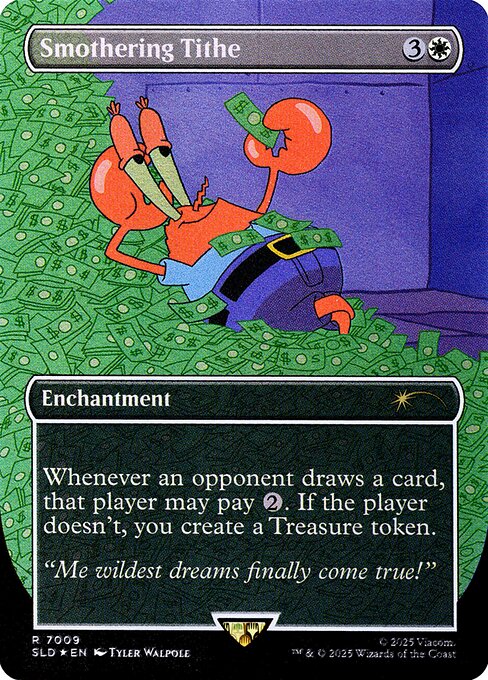
You've been there. Smothering Tithe resolves on turn four. The next player draws a card and the table goes quiet for a moment. Do they pay two? They don't pay. You create a Treasure. The next player draws. Do they pay? They look at their hand, look at the Treasure you already have, and decide to pay this time. The player after them draws and decides not to pay. Another Treasure. By the end of the first rotation, you have four Treasures and the table has had six separate political conversations about a three-mana enchantment.
Turn eight. You have seventeen Treasures. The mana advantage is structurally uncloseable. The game ended when Smothering Tithe resolved; the table just hasn't finished playing yet.
The failure condition is real: fast pods where games end on turns four through five don't generate