20 Power-Crept Commander Staples to Reconsider
The format runs faster now. These cards haven't kept up, and your deck is paying the tempo cost.

The format that exists now is faster, more redundant, and more punishing of slow-payoff cards than it was five years ago. The average mid-power game that ran to turn 9 or 10 then now ends on turn 5 or 6 at a competent table. That compression matters enormously for how you evaluate cards, because a card's value isn't fixed. It changes as the format's speed changes.
This article is not about bad cards. Every card on this list has done real work in real games. The honest question is: what is the opportunity cost of this slot in 2026? A card that needed four turns to recoup its mana investment was defensible when games ran long. When the format's clock has tightened by two turns, that same card is operating outside its payoff window half the time it's cast.
Three categories dominate this list. Ramp creatures whose combined casting and activation costs have been undercut by cheaper alternatives. Three-mana mana rocks that cost an entire turn of tempo with no board impact. And slow value engines that draw one card per turn when you need two cards right now.
The failure condition isn't that these cards are unplayable. It's that their floor has dropped as the format's baseline speed has risen. Name the failure condition first, then build back to when the card is still correct. That's the framework. Let's go.
Skullclamp
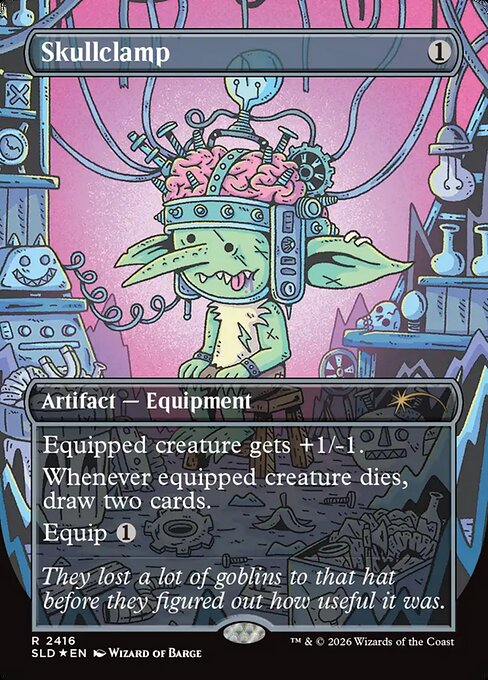
This card is here as the baseline. Skullclamp has not been power-crept. One mana, equip for one, draw two cards whenever the equipped creature dies. The failure condition is "you have no creatures dying," which in a dedicated token deck is essentially never. Everything else on this list gets evaluated against how efficiently it performs relative to this benchmark. If your draw engine can't justify itself in the same sentence as a 1-mana equipment that draws two cards off a dying 1/1, that's the point.
Farseek
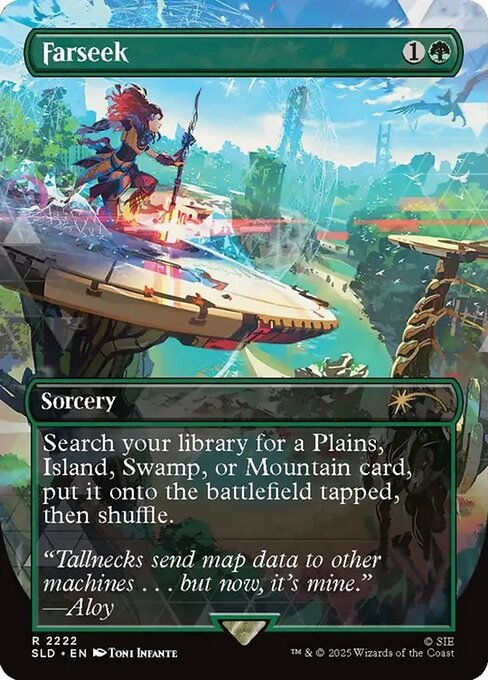
Also not power-crept. Farseek at {1}{G} finds a Plains, Island, Swamp, Mountain, or Forest card and puts it onto the battlefield tapped. The relevant competition is Nature's Lore and Three Visits: both cost {1}{G}, both find a Forest-typed land, and both put it onto the battlefield untapped. The verdict changes based on one condition: if your mana base runs shock duals with Forest typing (Breeding Pool, Stomping Ground), Nature's Lore and Three Visits deliver an untapped land, which is meaningfully faster. In a monocolor or two-color green deck without those duals, Farseek holds its own. The floor stays positive either way. This means Farseek belongs on a short watchlist for upgrading, not on the cut list.
Farewell
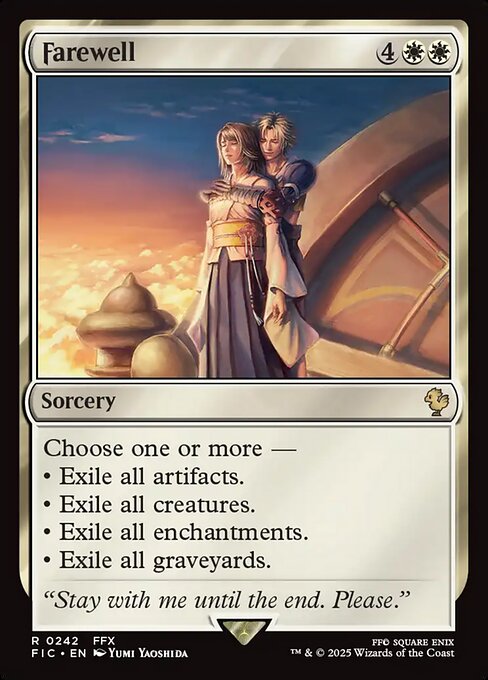
Still correct. The failure condition for Farewell is that you're holding it when you need interaction on turn 4 and you can't cast it yet. That's the entire verdict in faster metas: six mana is a genuine ask. But the exile clause is what makes Farewell elite in the contexts where it belongs. It answers indestructible creatures, graveyard recursion, artifact combos, and enchantment value engines in a single card. Generous Gift and Beast Within are surgical, instant-speed answers at three mana. They don't replace Farewell. They fill a different slot. The deckbuilding error isn't running Farewell. It's running it as your only interaction and drawing it while you're dying on turn 5. Heavy control, enchantress, and stax builds are where this card operates at ceiling. In aggro or midrange decks whose curve tops at five, it's a dead draw most of the games that matter.
Kodama's Reach
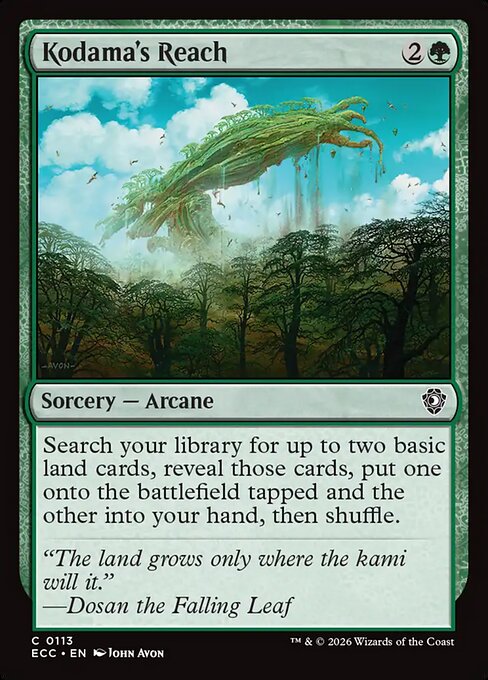
Think of this as the baseline entry for the entire green ramp conversation. Kodama's Reach and Cultivate are functionally identical: {2}{G}, one basic enters tapped, one goes to your hand, shuffle. They've been format cornerstones for fifteen years and they're still fine, especially in budget builds and landfall-heavy strategies where hitting every land drop is the whole game plan.
The verdict hinges on one specific contrast: Kodama's Reach versus Farseek plus Nature's Lore as two cards. Two 2-mana options together deliver the same land count with more flexibility. You can cast one on turn two and one on turn three. A single 3-mana spell passed on turn three leaves your board exactly where it was on turn two. In a table where turn four is when games are often decided, that tempo concession is real.
The failure condition: on turn three, this card puts you on turn-five magic in a turn-four format. It's still correct in monocolor green, landfall builds, and anywhere budget is a constraint. The evaluation isn't "cut it everywhere." It's "figure out whether your deck actually wants the mana on turn three or whether the flexibility of two earlier pieces matters more."
Topiary Stomper
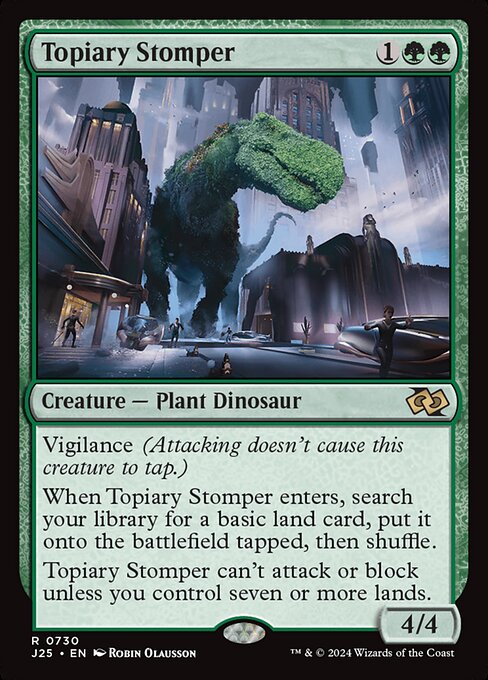
Yes, it costs three mana. Yes, it's a 4/4 with vigilance. The restriction is the entire story here: Topiary Stomper can't attack or block unless you control seven or more lands. On turn three in an aggressive meta, you've just deployed a 4/4 that does nothing except sit there while your opponents attack you.
Work backward to when this card is actually correct. In a ramp-heavy green deck already gunning for seven-plus lands, the restriction disappears naturally around turn six or seven. That's exactly the deck that wants this card anyway. The ETB effect puts a tapped basic into play, making it a direct comparison to Solemn Simulacrum: Stomper costs three mana versus the sad robot's four, and delivers a 4/4 body instead of a 2/2. The ceiling is meaningfully higher. What Solemn Simulacrum has that Stomper doesn't is a card draw trigger on death, and Stomper carries a blanket attack restriction until you clear the land threshold.
The failure condition is specific and real: cast this into an aggressive board where you need a blocker, and you have a 4/4 decoration. In a dedicated ramp shell running thirty or more lands, that scenario occurs rarely. The floor there is acceptable. Stomper belongs in green ramp and landfall decks that will hit seven lands anyway, keep it out of midrange decks that need every creature to contribute immediately.
Vito, Thorn of the Dusk Rose
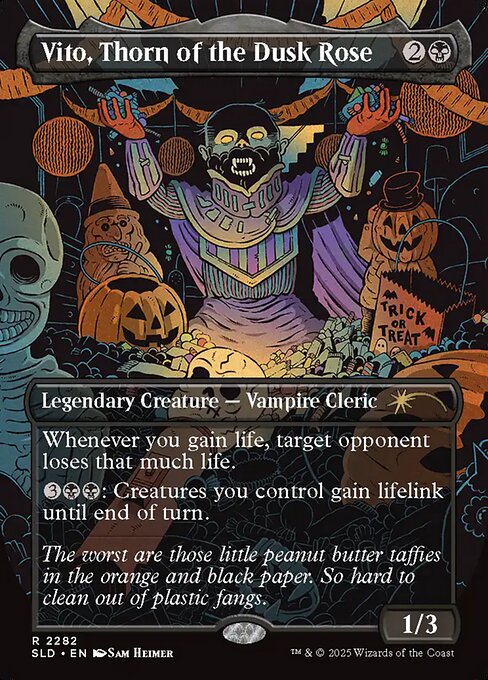
Compare Sanguine Bond to Vito, Thorn of the Dusk Rose directly: same trigger, same drain effect, Vito costs three mana versus Bond's five. Two mana cheaper in a format where two mana is often an entire turn of acceleration. That gap matters enormously in faster metas where getting the drain effect in play on turn three versus turn five changes how much value it generates before the game ends.
The tradeoff has a clean inversion. Vito wins when the game is fast and the two-mana discount translates to actual extra turns of drain triggers. Bond wins when your meta is removal-heavy and creature wraths are common. Vito dies to Swords to Plowshares. The enchantment version ignores the same removal spell. In a table running three or more board wipes per game, that resilience is worth the premium.
The lifelink activation is a genuine secondary function: it turns any combat step where your creatures deal damage into a mass drain event. That's not a corner case in a dedicated lifegain deck. It's a standalone win condition.
Running both is the correct call in dedicated lifegain combo shells. Exquisite Blood forms a two-card infinite with either one, and redundancy on the combo piece matters when someone might have the counterspell or the exile effect for whichever copy you play first. The power-crept question isn't Vito versus Bond. It's whether your deck needs one or both.
Grave Pact
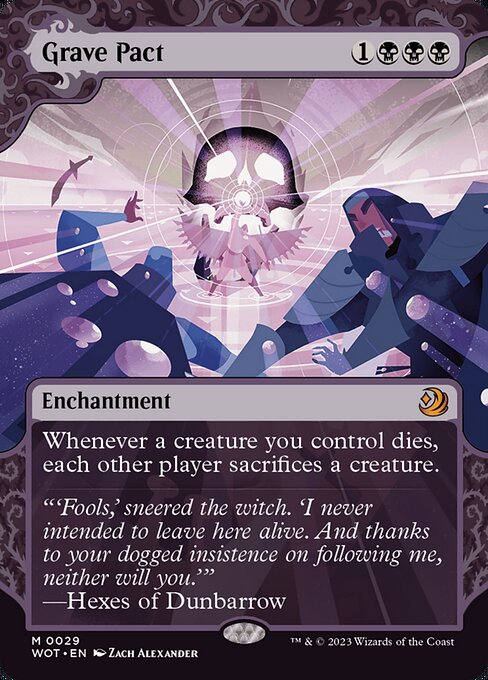
Here's a claim the MTG community throws around constantly: "strictly better." It almost never actually applies. Two cards can have two mana cheaper or offer flash timing windows, color requirements, or marginal effects that only matter in specific board positions. Then you get to Dictate of Erebos versus Grave Pact, and the "strictly better" instinct fires again, and this time it's almost right.
The direct comparison: Grave Pact costs {1}{B}{B}{B} and lands at sorcery speed. Dictate costs {3}{B}{B} and has flash. Those are different cards. Sandbagging Dictate until an opponent attacks into you, then casting it at instant speed so that when your blockers die the trigger fires immediately, is a different play pattern than resolving the enchantment on your main phase and hoping it survives to the next combat. Flash lets you have it in play precisely when your creatures die, without telegraphing it an entire turn cycle in advance.
The card's legitimate advantage: the mana cost is heavy on black pips, not generic mana. In a three-color deck that stretches to cast {3}{B}{B}, the {1}{B}{B}{B} version may actually be easier to produce in the right configurations. Neither card has been power-crept into obsolescence. The question is whether a five-mana enchantment is worth the slot in a format that has gotten faster. In dedicated aristocrats or sacrifice builds where creatures are dying constantly, yes. In a deck that incidentally kills creatures, both are dead draws. Audit your creature death count before you sleeve either one.
Mind Stone
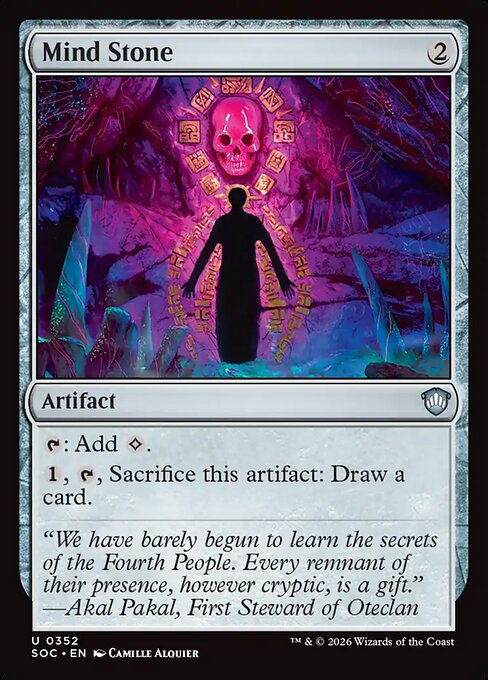
The floor on Mind Stone is still positive. Two mana, taps for one colorless, and the sacrifice-plus-{1}-mana mode draws a card in the late game when you'd otherwise be topdecking. The failure condition is "you need colored mana and this only produces colorless," which in a four-color deck is every time you need to activate your commander's ability.
Arcane Signet produces colored mana in your commander's identity and can never draw a card. Mind Stone produces only colorless and can. The verdict is clean: in Eldrazi builds or artifact decks with heavy generic costs, Mind Stone is better. In everything else, Arcane Signet is the correct default. The draw mode requires three mana invested across the stone's entire lifespan to actually draw that card: two to cast it, one to activate. That's real value, but it's not free, which is why it belongs in the 99 of specific archetypes rather than as a generic inclusion in any Commander deck.
Worn Powerstone
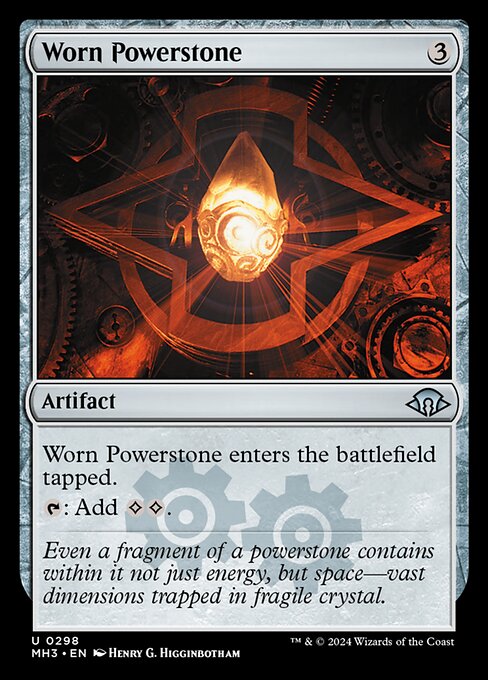
Enters tapped. Let that sit for a moment. Worn Powerstone costs three mana on turn three and produces exactly zero mana that turn. You've spent three mana on a card that does nothing until turn four, at which point it taps for two colorless mana.
Work backward to when this is defensible. Eldrazi decks that need the second colorless pip to cast their spells. Karn-style artifact builds running several generic-heavy activated abilities where CC is the exact symbol they need. Outside those configurations, the justification evaporates. Arcane Signet is one mana cheaper, produces colored mana for your commander's identity, and doesn't enter tapped. Mind Stone is also one mana cheaper and gives you a draw option. This rock is slower than both and less flexible than either.
The gap versus Arcane Signet isn't subtle. Signet curves out on turn two. The Powerstone costs you an entire turn of mana production for a rock that enters doing nothing. That makes it correct only in near-colorless or fully colorless builds where the double-colorless output is exactly what the deck needs. In anything else, it's a trap.
Thran Dynamo
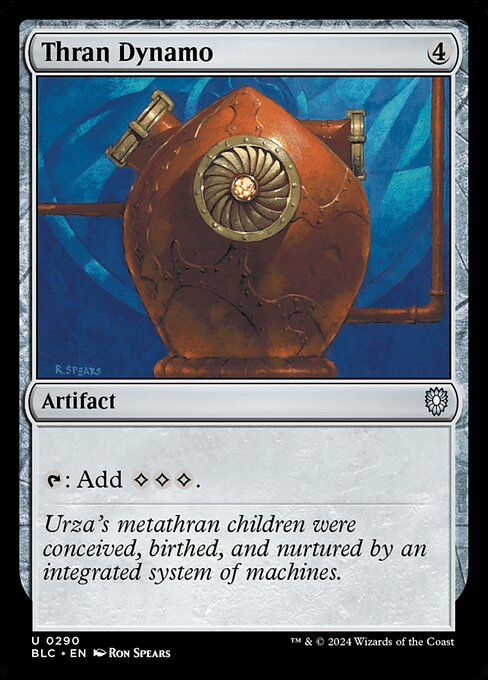
Turn four. You're sitting across from three players who developed their boards on turns two and three. You tap out to cast Thran Dynamo. Turn five, you cast your seven-drop commander. That used to feel like a powerful line. A few years ago, landing your seven-drop on turn five was meaningful acceleration.
The failure condition now: that line puts you an entire turn behind fast combo and barely ahead of decks that just played efficient three and four drops. You've spent your turn four on a mana rock and your opponents spent their turn four threatening lethal. The math on Thran Dynamo is real: four mana for three colorless, netting you roughly three to four mana advantage depending on when you drew it. The colorless restriction is where it falls apart. Most commanders today demand two or more colored mana pips to cast or activate their key abilities. Three colorless mana doesn't help you cast Atraxa on turn five.
Dynamo versus Gilded Lotus: Lotus costs one more mana but produces three mana of any single color. In most decks, that one-mana premium is worth the colored flexibility. The correct use case for Dynamo is tight: colorless commanders (Karn, artifact-matters builds running eight or more generic-cost spells), where producing colorless is actually useful. Outside that context, you're paying four mana to accelerate into things you can't cast with the mana you're producing. Dynamo belongs in a narrow archetype, and if you're running it in a four-color midrange deck, it's doing less than Arcane Signet would do for three fewer mana.
Gilded Lotus
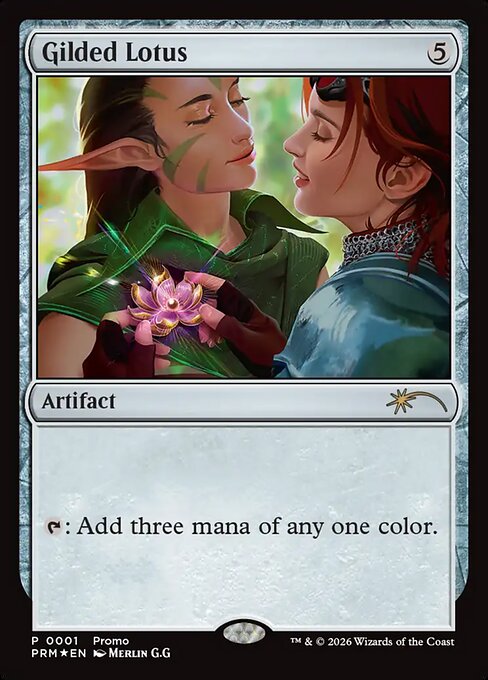
There's a specific feeling of staring at Gilded Lotus in your opening hand on turn two and knowing you can't cast it yet. It sits there, taking up space, as your opponents develop their boards and your early turns produce nothing. You finally resolve it on turn five and feel behind. That's the floor experience on this card, and if you've played Commander for more than two years, you've been there.
The failure condition is drawing it as your fifth land when you need interaction, not more mana. In those spots, it's a dead draw holding the slot that could have been a two-mana answer.
Here's when it's still the correct card: mono-color decks running eight to ten high-mana-value spells, superfriends builds that need three planeswalker activations per turn, and any strategy with a genuine eight-drop finisher that needs the full three-of-any-color output. The production mode is specific: three colored mana off one artifact is something Arcane Signet cannot replicate. In decks built around that gap, Lotus fills a role nothing else does.
The direct comparison: Arcane Signet arrives three turns earlier and produces colored mana. Lotus produces three times the colored mana at five mana. These are different tools for different positions on the curve. In a four-color midrange deck whose curve tops at six, Lotus is the wrong choice. Audit your curve before sleeving it: if you don't have a specific six-plus-mana payoff that needs the three-colored-pip output, this card is going to spend most of its games drawing sympathy.
Cathars' Crusade
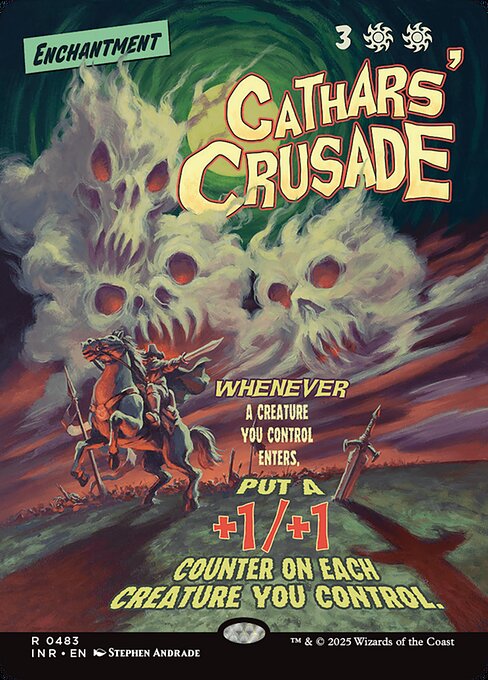
You know the groan. Someone resolves Cathars' Crusade with a token engine on board, and before they've even taken another action, everyone at the table has already started recalculating how long this is going to take. Not how long until they lose. How long until they can play Magic again. That's a specific table experience, and it's worth naming honestly.
The card is powerful. Five mana, and every creature entering your battlefield puts a +1/+1 counter on each creature you control. With ten creatures on board and a token doubler in play, resolving a single ETB trigger means individually adjusting counters on eleven permanents, each of which may have different counter totals from previous triggers. This is not a rules problem. It's a practical problem that makes games take forty minutes longer than they need to and frequently causes tracking errors that affect outcomes.
Community consensus has arrived at a real conclusion here: bookkeeping intensity is a legitimate reason to cut a card, separate from power level. This enchantment is not underpowered. It's a friction generator that compresses everyone's enjoyment.
The token-strategy slot comparison: Anointed Procession versus the Crusade. Different effects, same strategic territory. Procession doubles your tokens on creation: one trigger, no tracking, enables explosive go-wide finishes without adding complexity to your board state. That's the upgrade in decks that want token quantity over individual size.
Inspiring Call sits in a different lane: in dedicated +1/+1 counter builds, it draws a card for each creature you control with a +1/+1 counter on it and grants those same creatures indestructible until end of turn. That's both card draw and protection, and it's actually better than Cathars' Crusade in decks that want to protect a developed counter board rather than accumulate more counters.
The card is still correct in dedicated Atraxa or Hamza-style counter synergy builds where the counters are enabling other effects. Cut it everywhere else. If your deck doesn't have three or four cards that specifically care about +1/+1 counters existing on your creatures, you're generating complexity for no structural benefit.
Exquisite Blood
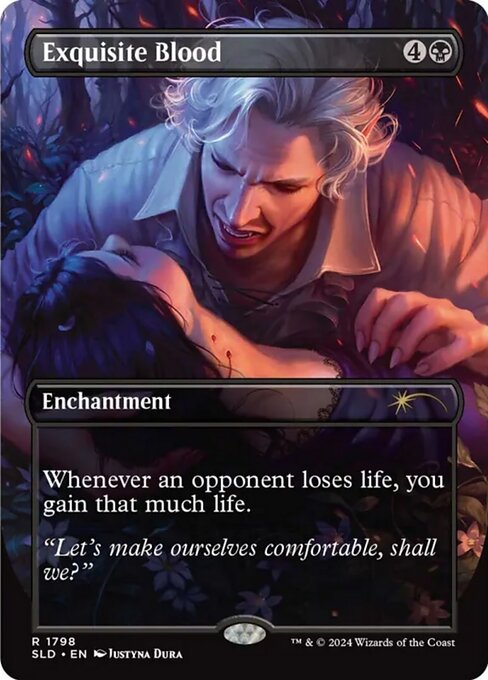
The price tag first, because it's real: Exquisite Blood currently runs over thirty dollars for an enchantment that does nothing proactive. Five mana for an effect that requires opponents to lose life before it triggers. In a vacuum, you've spent a turn-five play to set up a card that waits for things to happen around it.
Work backward to when it's correct. Exquisite Blood forms a two-card infinite with Sanguine Bond and independently with Vito, Thorn of the Dusk Rose: when any life loss triggers Exquisite Blood, you gain that life, which triggers Sanguine Bond or Vito, which causes opponents to lose life, which re-triggers Exquisite Blood. The loop resolves until a player wins or someone takes action to break it. That combo is real and game-winning.
The failure condition is drawing Exquisite Blood in a game where you're behind, haven't assembled the second piece, and need to do anything except wait. At that point it's a thirty-dollar dead draw. Consider the direct contrast: Exquisite Blood versus a tutor targeting Sanguine Bond or Vito. If you're building around the infinite, a tutor that finds whichever half you're missing is more flexible than a fifth piece that only functions as the second half of a different combination. Tutors are sleevable in the same slot and improve consistency on the primary payoff.
Exquisite Blood belongs exclusively in dedicated lifegain combo shells building specifically toward the infinite. In lifegain decks that aren't built around that combo, it's win-more. You've already gained the life and drained your opponents. What Exquisite Blood adds to a board that's already tilted in your favor isn't enough to justify five mana and thirty dollars on its own.
Sanguine Bond
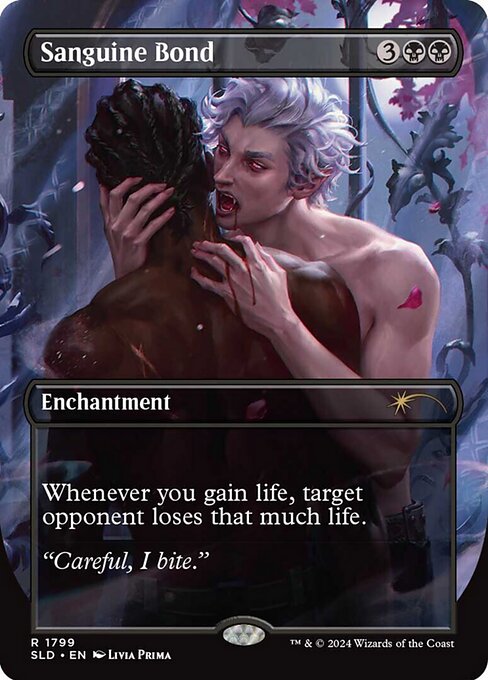
Vito, Thorn of the Dusk Rose does exactly what Sanguine Bond does at three mana versus five. That's the entire power-crept case. Two mana cheaper in a format where two mana is a turn of development. Over the course of an average game, that gap translates to one or two additional drain triggers before the game ends.
The failure inversion: the failure condition for Vito is a removal spell. Creatures die. The enchantment doesn't die to creature removal. In a meta running three or more board wipes per game, or at a table that lights up any meaningful creature threat on sight, Bond's enchantment typing is worth the full two-mana premium. You can build toward the drain trigger and trust that it will survive long enough to matter.
Vito wins when the game is fast and the two-mana gap materializes as real tempo. Sanguine Bond wins when your meta is removal-heavy and the question isn't whether the effect fires but whether the card survives to fire it repeatedly. Both cards set up the same infinite with Exquisite Blood, which means the correct build in a dedicated lifegain combo deck is both in the 99. Redundancy on the primary win condition matters more than the two-mana efficiency argument when someone is holding the counterspell or the exile effect for your first copy.
Commander's Sphere
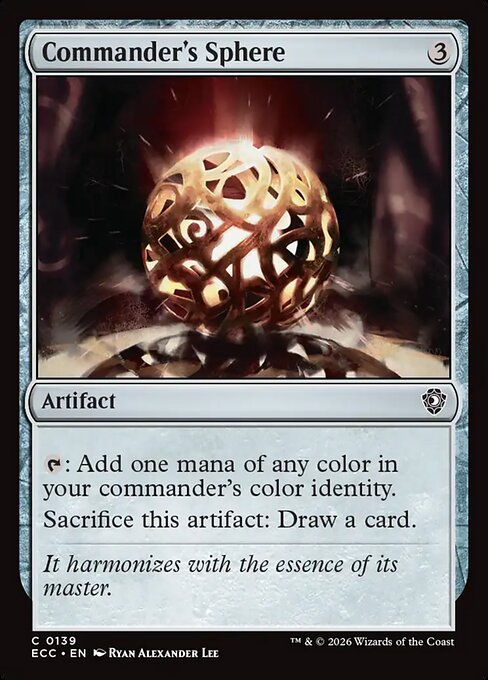
Picture the deckbuilding moment. You're sleeving a new four-color deck, you've got 99 slots to fill, and you reach for Commander's Sphere out of pure habit. It's been in every precon. It's been in your last four decks. It's fine.
Then you notice Arcane Signet sitting in the same pile. Two mana, taps for one colored mana in your commander's identity. No entering tapped, no sacrifice cost, just two mana for colored mana production. The Sphere does the same thing for three mana and adds a sacrifice-to-draw mode. That sacrifice mode is real value in the late game. But it costs an additional mana on top of the Sphere itself to activate, so the draw isn't free.
The one-mana gap between these two cards is a complete turn of tempo. Signet on turn two puts you casting your three-mana plays on turn three. The Sphere on turn three pushes those same plays to turn four. In a format where turns three and four are when boards get established, that's not a marginal difference.
The Talisman cycle (the relevant ones for your color identity: Talisman of Progress, Talisman of Dominance, Talisman of Impulse) all cost two mana, produce colored mana, and deal one life as the downside. One life per tap is irrelevant at Commander life totals. These are the Sphere at a one-mana discount. Mind Stone belongs in the same conversation, drawing a card when you sacrifice it.
Commander's Sphere is correct in two specific situations: budget decks where Arcane Signet and the Talisman cycle aren't accessible, and high-mana-value decks where you specifically plan to sacrifice it for a card in the late game and the tempo cost is acceptable given your deck's development speed. For every other deck running it, that's inertia masquerading as deckbuilding.
Explosive Vegetation / Skyshroud Claim
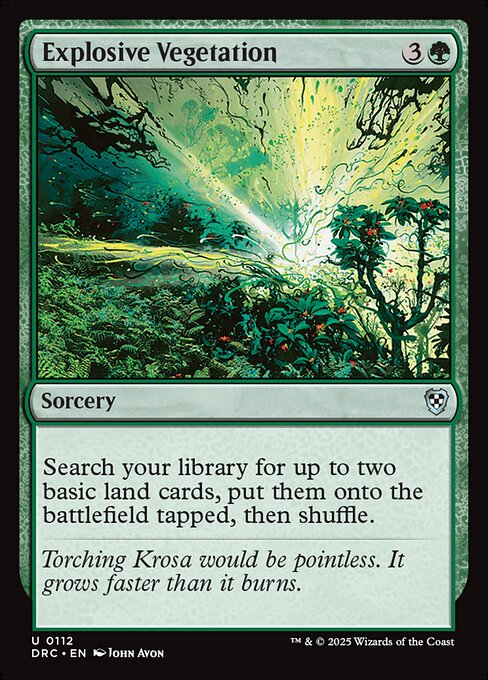
These cards cost the same mana and deliver meaningfully different outputs. Getting the comparison right is the entire evaluation.
Explosive Vegetation: four mana, finds two forests, both enter tapped. No upside, no flexibility.
Skyshroud Claim: four mana, finds any two Forest-typed lands, both enter untapped. Forest-typed includes Breeding Pool, Stomping Ground, and every other dual land printed with a Forest subtype. If your mana base runs those, Skyshroud Claim puts two untapped dual lands into play. That's colored mana production on the same turn you cast it. Vegetation puts two tapped lands into play, contributing nothing until your next turn.
If your mana base has any Forest-typed dual lands, Vegetation is the wrong card. The untapped clause on Claim isn't a minor upside, it changes the math on what you can cast the turn you play it.
Migration Path fills a third lane: same output as Explosive Vegetation, but cycling for {2} gives you an escape valve when you're ahead on lands and need a different card. That flexibility is real in low-land-count decks or builds that want to sculpt their hand in the late game.
The broader question this framework demands: are two 2-mana accelerants (say, Farseek plus Nature's Lore) better than one 4-mana ramp spell? In faster metas, yes. Two cheaper spells let you ramp on turn two and again on turn three, while a 4-mana spell has you passing turn four with your board frozen. If your deck has any 2-mana options available in its color identity, the 4-mana family should be your second wave, not your first.
Phyrexian Arena
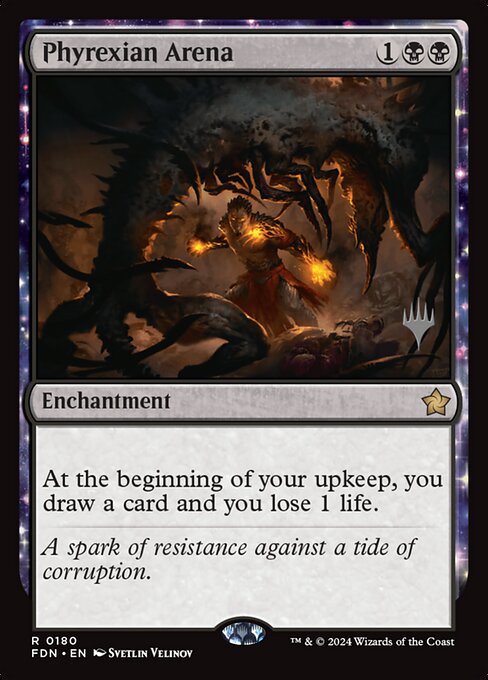
This is the most contested entry on this list and the one the community has gotten the most wrong. Not wrong in the "Arena is still busted" direction, wrong in the overcorrection. Let's name the failure condition first and then do the honest math.
Phyrexian Arena costs {1}{B}{B} and draws one card per upkeep starting the turn after you cast it. At {1}{B}{B}, it costs effectively two and a half cards of investment (a card and three mana). To break even on card advantage over the simplest alternative, you need it in play and ticking for multiple turns.
The floor case: Arena versus Night's Whisper. Night's Whisper costs {1}{B}, draws two cards immediately, and costs two life. You've drawn your cards on the turn you cast it. Arena needs to survive three upkeeps to produce three extra draws, the point where it's outpaced the total output of Night's Whisper at roughly the same life loss. If the game ends before turn seven, Night's Whisper was the correct card.
Named comparison: Arena versus Sign in Blood. Sign in Blood costs {B}{B}, draws two cards, loses two life, and can target an opponent as a finishing blow at low life totals. That political kill mode is a real upside Arena never provides. In tables where "target opponent, you draw two cards and lose two life" can close a game, Sign in Blood has a ceiling the enchantment doesn't reach.
Arena versus Read the Bones is the quality argument. Read the Bones costs {2}{B} and scries two before drawing two cards. In a deck that wants specific cards at specific times, that filtering adds real value. Arena draws the top card of your library and you take it; Read the Bones lets you reject the top two first.
The ceiling for black card draw is Necropotence: {B}{B}{B}, skip your draw step, pay one life to exile the top card of your library face down and put it into your hand at the beginning of your next end step. Necropotence lets you sculpt your hand at will limited only by your life total. The two cards aren't in the same conversation for raw power. But Necropotence requires dedicated life-gain support and a specific build philosophy; it's not a drop-in for any black deck.
Greed sits nearby at {3}{B} with a {B}-plus-two-life repeatable activation. It's slower than Arena but gives you control over when the draw happens.
Here's where the community has overcorrected: slow black control decks still exist. Aristocrats, life-drain, and grind-focused black strategies still run games to turn nine or ten. In those builds, Arena is correct. The format speeding up doesn't eliminate every long game. It just means Arena is narrower than it used to be. Audit your game plan first: if your deck wins on turn five through six, cut Arena. If your deck regularly plays games past turn eight, keep it.
Burnished Hart
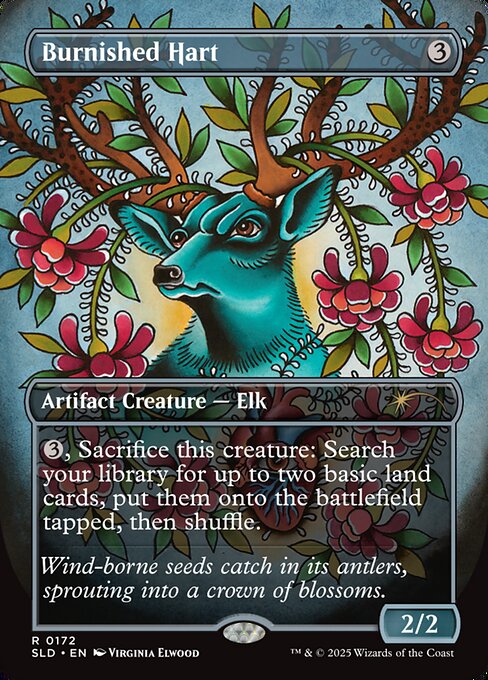
Here's the two-turn investment in full. Turn three: tap three mana, cast Burnished Hart, get a 2/2 artifact creature that can't ramp you yet. Now you wait. You need three more mana available while keeping the Hart alive. Turn six at the earliest (assuming you hit your land drops and have the mana free): pay three, sacrifice it, find two basic lands, put them onto the battlefield tapped. Six mana across two turns. Output: two tapped lands entering play simultaneously and a dead 2/2.
The failure condition is everything that can happen between turn three and turn six. A board wipe exiles the Hart before you activate it. An opponent bounces it, costing you the three mana you already spent. The game ends. Any of these outcomes means you spent three mana on a 2/2 that contributed nothing. The activation window is the liability.
Against Cultivate: Cultivate resolves immediately, puts one basic land tapped onto the battlefield and one into your hand. One card, three mana, no waiting, no activation window to protect. The Hart "advantage" is that both lands go directly onto the battlefield, but that distinction only matters if the Hart survives long enough to use. Cultivate also requires green, which is the relevant constraint. Outside green, the Hart is one of the few creature-based ramp options available, and that's the only context where the comparison even becomes interesting.
Against Solemn Simulacrum: both are artifact ramp creatures for decks without green. Sad Robot finds one land on ETB and draws a card when it dies. The Hart costs more mana spread across two turns for one additional land, with more vulnerability in between and no card draw ever. The math doesn't favor it. If you're in a deck where both are options, you're almost certainly better served by the Robot.
The one context where the Hart is defensible: artifact-matters builds, Esper, Breya-style lists, decks where land-based ramp is genuinely limited and Farseek or Cultivate aren't available. Cut it from any green deck. Cut it from any deck with better colorless ramp options. That narrows the field considerably, which means most of the decks currently running it are doing so out of habit, not necessity.
Pilgrim's Eye
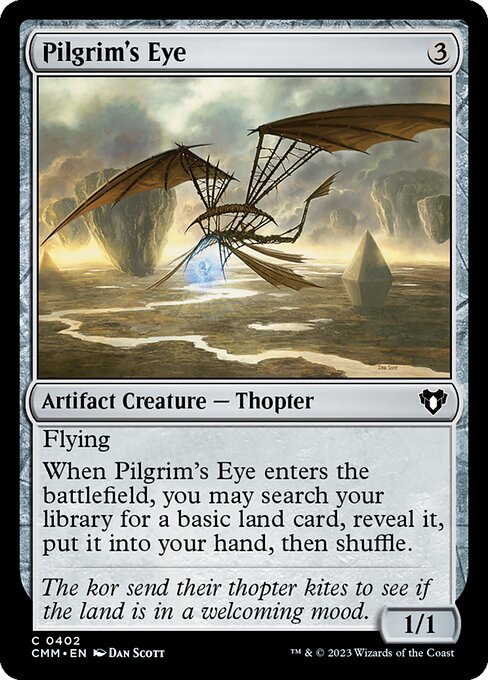
Three mana for a 1/1 flyer that, when it enters, searches your library for a basic land card and puts it into your hand. Not onto the battlefield. Into your hand. The land still needs to be played as a land drop on a future turn to actually reach play.
The floor here is almost impressively low. You've spent three mana, a card, and a turn to move a land from your library to your hand. It doesn't accelerate you by any amount on the turn you cast it. The 1/1 body is effectively irrelevant as a blocker or attacker. The flying is the one legitimate upside in a format where evasion occasionally matters on a utility creature.
Put it next to Burnished Hart. Hart at least puts two lands directly onto the battlefield when you activate it, generating real mana. Pilgrim's Eye puts one into your hand. Even with the activation cost problem Hart carries, the actual mana production outcome is meaningfully ahead.
Against Solemn Simulacrum, the gap is worse. The sad robot costs four mana and finds a land that immediately enters play, tapped. Eye costs three mana and finds one that still needs a land drop to contribute anything. In decks outside green that are evaluating the ramp-creature slot, that card is doing materially more work despite costing one more mana.
The failure condition for Pilgrim's Eye isn't unusual. It's the default situation: you're on turn three, you cast this, and your mana development is the same on turn four as it would have been without it. The card is correct almost nowhere. If you're running it out of habit or familiarity, cut it before you even reach the Burnished Hart conversation.
Solemn Simulacrum
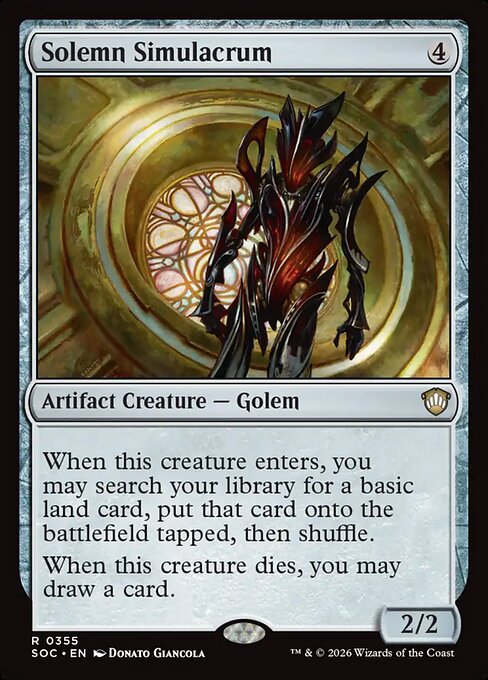
I'll be honest: this entry is the hardest one to write. Not because the evaluation is complicated, but because Sad Robot has been in the format longer than most of the people reading this article have been playing it. It was in every precon. It was the first ETB value creature that made new players feel like they understood Commander. Someone in your pod has feelings about this card. You might have feelings about this card.
Here's the failure condition, stated plainly: you cast a 4-mana 2/2 in a format where turn four is when games are often decided. It enters, finds a tapped land, and then waits. It waits to be blocked. It waits to be removed. It waits for someone to cast a board wipe. The card draw when it dies is real value. It also fires after the wrath on turn five before you've had a chance to recoup anything from the board state.
Take Topiary Stomper as a direct benchmark. Stomper costs three mana, enters finding a basic, and is a 4/4 with vigilance. That body matters in a format where blockers and combat presence matter. The tradeoff is the attack restriction until seven lands and no draw on death. Sad Robot is a 2/2 with no evasion that requires dying to generate value beyond the land drop. In a dedicated ramp deck already gunning for seven-plus lands, Stomper's ceiling is higher. Where the on-death draw matters more than the body, the Robot has an argument.
The more relevant matchup for decks outside green: Solemn Simulacrum versus Burnished Hart. They're competing for the same slot. Hart finds two lands across two turns at six invested mana. The Robot finds one land at four mana with a draw trigger attached. On raw efficiency, the Robot wins: one land, four mana, immediate battlefield permanent, a card when it dies. Hart's two-land payoff requires surviving the activation window, which is a real ask at tables with any removal. For that creature-based acceleration slot in artifact or non-green strategies, the Robot is the right call.
Two legitimate defenses. First: in blink decks built around repeated ETB triggers, casting Solemn Simulacrum once and blinking it four times means four basics and a board presence that compounds with each flicker. That's where the four-mana investment pays off faster than any sorcery could, and the failure condition barely applies because it's never just entering once. Second: the draw on death is a return that Cultivate and Farseek never provide. In fair games without blink, that trigger generates genuine card advantage that pure acceleration spells don't offer.
Here's the problem: over a million decks are running this card. The blink decks, the ETB decks, the artifact builds outside green where it's genuinely correct, those represent a fraction of that number. The majority are running it because it was in the precon and it feels good. In those decks, the floor is a 4-mana 2/2 that finds a tapped land and waits to die. The format has faster options for every job this card does. If your deck isn't a blink or repeated-ETB strategy