The 20 Best TMNT Cards for Commander
Irma is a blue staple hiding in a precon. Splinter is more broken than the ninja-tribal crowd admits. Here's the real

The TMNT set's best cards have nothing to do with tribal. They're sneaking into competitive lists on pure mechanics, and a few are worth real money. Two mechanics define how the set plays: Sneak, a ninjutsu variant that lets you return an unblocked attacker to hand as an additional cost to cast any spell at a reduced rate, and Disappear, which fires whenever a permanent you control leaves the battlefield. Those aren't gimmicks. They're architecturally interesting keywords that open actual deckbuilding lines.
The Mutagen token runs through most of the set's best cards like connective tissue. These colorless artifact tokens do one thing: pay a mana, tap, sacrifice, put a +1/+1 counter on any creature. Sorcery speed, but recursive. Every time you make three of them and cash them in, you've basically generated three future counters from nothing. That economy is powerful in a format where incremental advantage compounds.
This list covers both the main TMNT set (TMT) and the Turtle Power precon (TMC). The ranking weighs cross-archetype usability, price-to-power ratio, and mechanical novelty over raw popularity. Cards like The Ooze and Irma, Part-Time Mutant sit near the top because they belong in decks that have nothing to do with the IP. Super Shredder sits at #5 specifically because its $32 price tag limits the field of players who can actually run it. Great card, but the list rewards accessibility.
Krang, Utrom Warlord
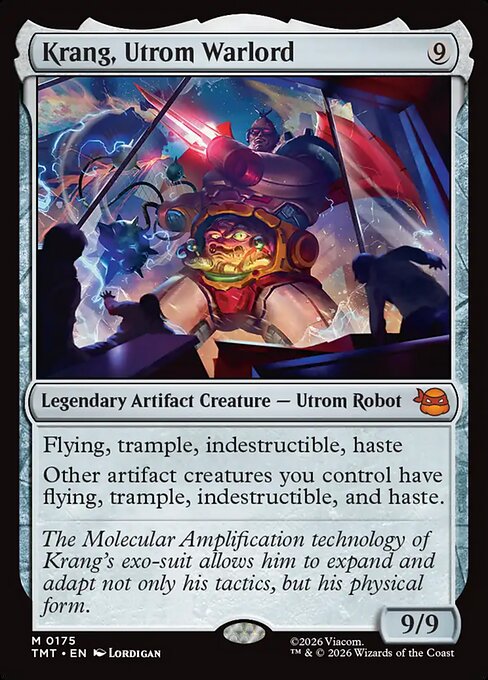
Nine colorless mana for a 9/9 with flying, trample, indestructible, and haste that grants those same four keywords to every other artifact creature on your board. In a dedicated artifact-creature shell with a cheat plan, that's a one-card army. It is also a brick in hand for most of the game unless you're running Krang, Utrom Warlord in exactly that context. Breya or Urtet can abuse this. Everyone else is just paying nine mana for a fat body with great abilities and no immediate board leverage. The colorless identity means it technically fits anywhere, which is the only reason it's on this list at all.
Raphael, the Nightwatcher

Think of this as a Godo, Bandit Warlord for attacking decks instead of equipment decks, a mono-red legend whose entire value proposition is what it does during your attack phase. Godo gives you an extra combat; Raphael gives every attacking creature double strike for four mana. That's a different kind of explosive. Raphael, the Nightwatcher's Sneak mode lets you cast him mid-combat at 1RR after you've already declared attackers, entering tapped and attacking the identical target. Your 1/1 tokens suddenly become 1/1 double strikers with no warning, and opponents who didn't block aggressively enough eat a brutal second hit. The restriction is real: mono-red color identity means no multicolor builds. But in any red deck that's already going wide, Raphael turns a mediocre swing into a game-threatening one.
Big Mother Mouser
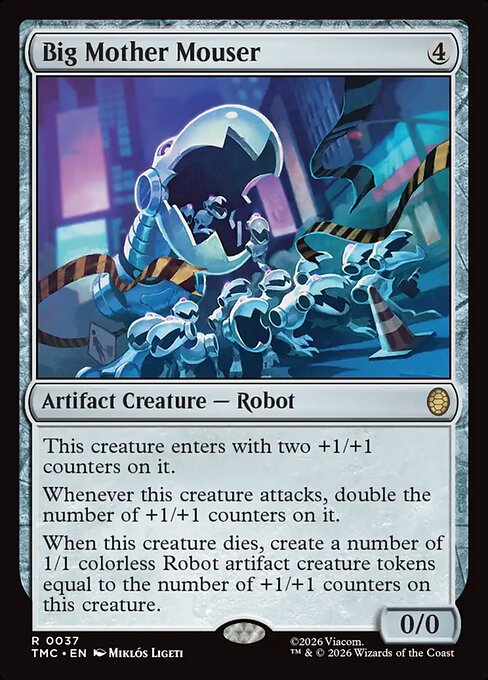
Picture this: turn four, you drop a 0/0 artifact creature that enters with two counters. Opponents barely glance at it. Then it attacks. Both doublers stack, the first trigger takes it from two counters to four, the second fires and takes it from four to eight. Your opponents now see an 8/8 attacking on turn four with zero colored mana investment. Next attack, if it's still alive, that's 8 to 16 to 32. When it dies, you get Robot tokens equal to however many counters it had. Eight tokens. Sixteen tokens. However many you let pile up.
The colorless identity is the key unlock. This goes in literally any Commander deck. Pair it with a sacrifice outlet and you control exactly when the token flood arrives. Combine it with Level Up or Michelangelo, Weirdness to 11 and the counter scaling becomes absurd in two or three attacks. The "dies to removal" objection is backwards here: you want it to die with counters on it. That's the whole plan.
Shark Shredder, Killer Clone
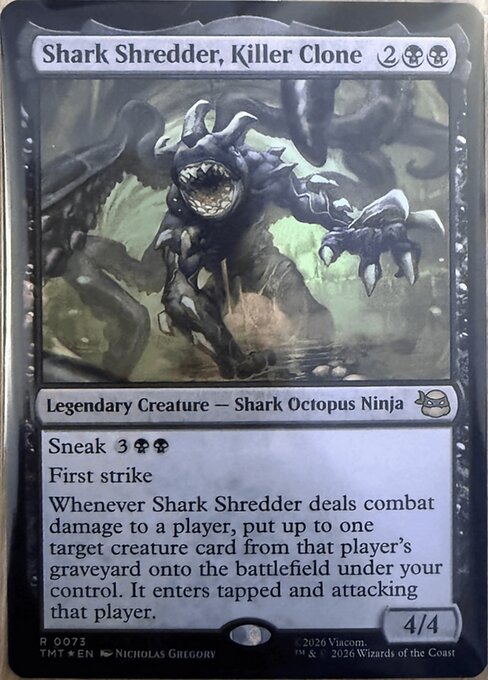
Shark Shredder is a strong card that's too situational to rank higher, and that's the honest verdict. A 4/4 first striker for 2BB that steals a creature from the damaged player's graveyard, putting it onto the battlefield tapped and attacking that player, is a legitimately terrifying combat threat. First strike makes it almost impossible to trade with in combat, and the reanimation trigger punishes opponents for having good graveyard fodder.
The Sneak cost is 3BB instead of the base 2BB, one extra generic mana for the timing advantage of casting it during the declare blockers step mid-combat. That timing matters for setting up the first strike damage trigger, but don't treat the Sneak cost as a discount. Where Shark Shredder falls short is the narrow black identity and the fact that its floor is "just a 4/4 first striker" when opponents have empty graveyards. In dedicated black graveyard-hate builds it's excellent. Everywhere else, stronger options exist at this cost.
Dark Leo & Shredder

The flavor of a card that fuses a heroic Turtle hero with his arch-nemesis on the same permanent is doing something genuinely strange, it implies a timeline dark enough that Leo and Shredder have merged into one entity, and the card text reflects that duality with a martial efficiency that's almost uncomfortable. But then you read the stats and realize this is actually just a disgustingly good ninja payoff crammed into a 2-mana white/black body.
A 1/3 with Sneak at WB costs almost nothing to drop. All attacking ninjas gain deathtouch, which means even your 1/1 Ninja tokens become lethal to anything they trade with. When Dark Leo & Shredder deals combat damage, you create a 1/1 Ninja token, and if you control five or more ninjas at that moment, the damaged player loses half their life total, rounded up.
Five ninjas is attainable, not trivial. The deathtouch distribution and token generation help build toward it naturally. Where this gets broken is with Splinter, Radical Rat: Splinter doubles all triggered abilities of Ninja creatures you control, meaning Dark Leo's half-life ability goes off twice. Pair that with Blood Letter of Aclazotz, which doubles life loss opponents suffer, and a single hit closes out a player entirely. At 2 mana in the command zone, this builds toward that line with minimal setup.
Mikey & Leo, Chaos & Order

The closest comparison is Tekuthal, Inquiry Dominus, a two-mana legendary that converts an existing strategy into a card-draw engine through a once-per-turn restriction that feels tighter than it actually is. Tekuthal doubles your proliferate; Mikey & Leo draws you a card whenever you put a counter on any creature, once per turn. At 4 mana, Tekuthal is fine. At 2 mana in GW colors that naturally overflow with counter-heavy synergies, Mikey & Leo, Chaos & Order is something closer to outrageous value.
The "once each turn" clause saves this from being broken. But in any deck built around Hardened Scales, Doubling Season, or a modest proliferate package, you're putting counters on creatures constantly, on your turn and on opponents' turns through end-step abilities and triggered effects. Each of those events is a potential draw trigger. Over the course of a game, this generates four to eight extra cards off a two-mana investment. At roughly two and a half dollars, it's one of the best-underpriced legends in the set. Put it in the 99 instead of the command zone: as a commander the once-per-turn cap limits the payoff, but buried in a counters deck, it quietly draws the game out in your favor.
Ninja Teen
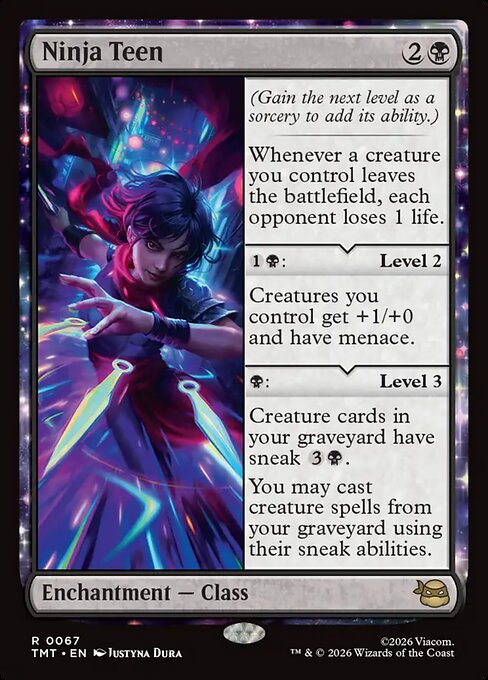
Three levels of a Class enchantment requires three separate mana investments across multiple turns, and in Commander, that's a legitimate criticism. You're spending resources in a format where opponents are frequently developing more threatening boards in that same timeframe. That cost acknowledged, every level of Ninja Teen does something real.
Level 1 makes each opponent lose 1 life whenever a creature you control leaves the battlefield. In aristocrats, that ability triggers constantly: every sacrifice, every death in combat, every token you feed to an outlet. The drain adds up fast in a multiplayer pod where you're regularly cycling five to ten creatures per turn cycle.
Level 2 at 1B gives all your creatures +1/+0 and menace. Level 3 at just B gives creature cards in your graveyard a Sneak ability and lets you cast them from the graveyard using it. This opens new design space: Sneak from the graveyard is not flashback, not unearth, not escape. You return a creature that connects unblocked, cast it from the graveyard at the Sneak cost, and it enters tapped and attacking. Suddenly expensive ninjas like Shredder, Shadow Master cost a fraction of their base rate from the bin. That's worth the investment in any black deck that both attacks and sacrifices.
Cool but Rude
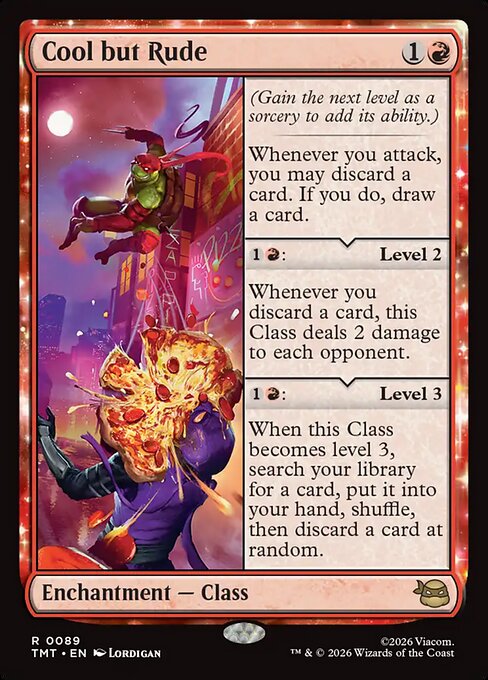
The moment someone hits Level 2 on this card in a wheel deck, the whole table does the math simultaneously. Level 2 reads: whenever you discard a card, this deals 2 damage to each opponent. Level 1 already lets you discard a card to draw a card whenever you attack. Stack those two and every attack cycle, if you choose to loot, you're pinging every player across the table for 2. In a four-player pod, that's 6 damage per attack minimum. Do that three turns in a row and you've dealt 18 across the table without a single creature connecting.
Level 3 tutors any card to your hand and then discards at random, which is genuinely chaotic and occasionally devastating. Fetch a wheel spell, discard something you don't mind losing, wheel the table. The random discard is a real liability though. If you hit something critical, you're paying the cost on an effect that should feel controlled. The Level 3 upgrade costs just 1R, so reaching it is cheap, but lean on it carefully in combo-oriented builds.
Cool but Rude is the premier inclusion in any build around Rielle, the Everwise, Glint-Horn Buccaneer, or Archfiend of Ifnir. Rielle means every discard replaces itself and then some. Glint-Horn already pings on discard; combined with Level 2, every discard deals 3 total damage to all opponents. The synergy density in red discard-matters strategies makes this a quiet build-around instead of just a support piece.
Splinter's Technique
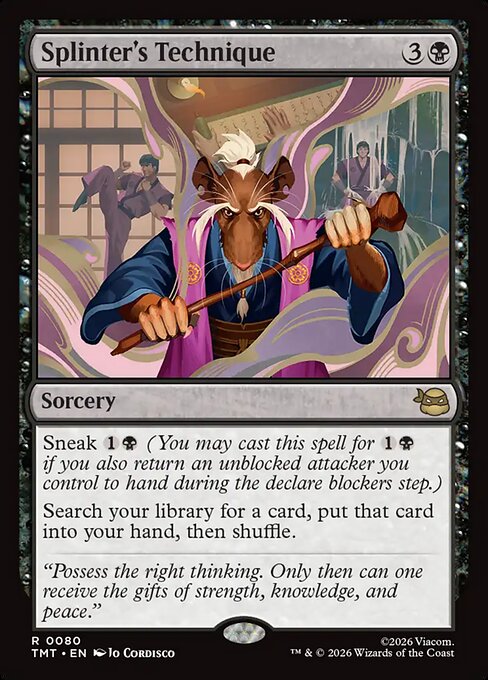
One-mana unconditional tutor, in the right deck. The base mode is 3B: search your library for any card, put it in your hand. That's Diabolic Tutor, exactly, no restrictions, no hoops, identical rate. Fine. Good, even. But the sneak mode is what makes this worth discussing: 1B if you return an unblocked attacker to hand during the declare blockers step. In any black deck that's already attacking every turn, that condition is trivially met. A single mana to tutor any card out of your library reaches Entomb rates in the right shell, and the only reason this isn't higher on the list is that hitting that rate requires an attack and a creature that gets through, which isn't always available in the late game when tutors matter most.
The returned attacker isn't lost either. You get it back to hand and replay it next turn. No card disadvantage. In ninja decks, the returned creature is usually something you wanted to bounce anyway. In aggressive black builds, this is regularly a two-mana setup that enables a single-mana tutor the following turn. Better than Diabolic Tutor in any deck that attacks, and it's not close.
Splinter, Radical Rat

This is Panharmonicon for ninja abilities, and it's not even close. Splinter, Radical Rat is a 1WB/WB 2/4 in Esper colors whose static ability fires every ninja triggered ability twice. Every combat damage trigger, every ninjutsu ETB, every "when this deals combat damage" effect, all doubled. Then it has a built-in 1U activation: target ninja can't be blocked this turn. A one-mana way to guarantee your key ninja connects whenever you need the combo effect is worth more than it looks on the card.
The practical ceiling here is high. Yuriko, the Tiger's Shadow already defines the ninja archetype by forcing opponents to deal with mill-life-drain every attack. With Splinter in play, each Yuriko effect resolves twice, doubling the damage and the card selection. Dark Leo & Shredder's half-life drain becomes a two-trigger sequence, and paired with Blood Letter of Aclazotz (which doubles life loss opponents suffer), one attack with Dark Leo produces a lethal chain against one player. That's a three-card instant-win package with no extra mana required once all three are in play.
Only 3,682 decks are running this at the time of writing, which is a genuine blind spot in the community. Players are reading "if an ability of a Ninja creature you control triggers, that ability triggers an additional time" and dismissing it as narrow tribal support. It's not. It's a three-mana Esper Panharmonicon for one of the most well-supported creature types in Commander, with a built-in unblockable activation. Yuriko commanders who are tired of being archenemy from turn three should seriously consider swapping to Splinter as the general and running Yuriko in the 99. You get most of the power at a fraction of the table threat.
Michelangelo, Weirdness to 11 and High Score
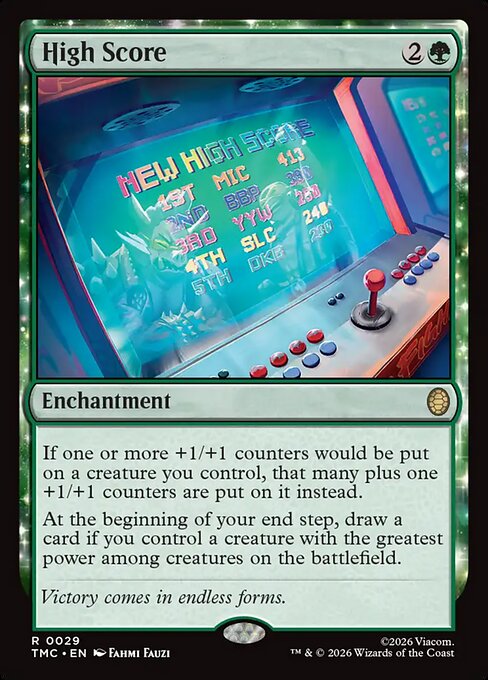
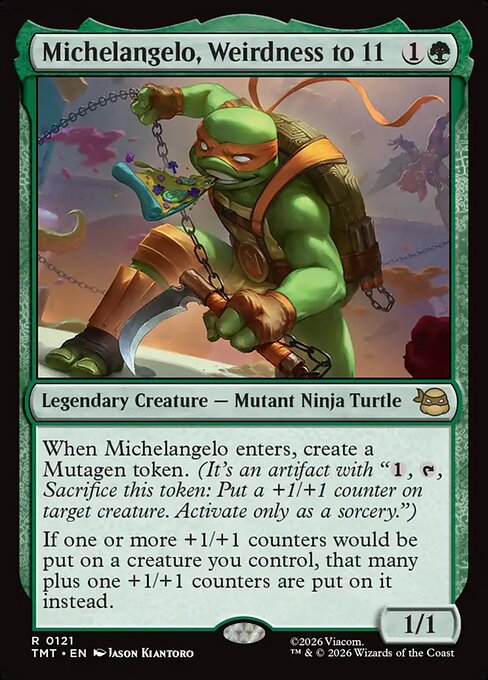
Run both. That's the verdict. These two cards do the identical core job, they're each a Hardened Scales effect that adds one additional +1/+1 counter to every increment, but they're distinct enough that stacking them creates a multiplicative engine rather than redundancy.
Michelangelo, Weirdness to 11 is the 2-mana green creature version. He enters with a Mutagen token ETB, so he pays for himself immediately in Mutagen economy, and then his passive doubles every counter increment for as long as he lives. The body is fragile at 1/1, but the ETB alone justifies the slot in Mutagen-heavy builds even if he dies immediately.
High Score is the 2G enchantment version. Same doubling effect, plus a conditional end-step draw: draw a card if you control the creature with the greatest power on the battlefield. In any +1/+1 counter strategy, you're regularly running creatures with inflated power totals that dwarf anything opponents are playing. That draw condition fires almost every turn. Enchantments are harder to remove than creatures, which makes High Score the more reliable of the two, but Michelangelo's creature body and that token on entry make him the better value when he resolves.
Two doublers in play means every triggered counter addition generates two extra counters instead of one. Add the original Hardened Scales itself and you're putting three additional counters on every single trigger. With Doubling Season also in the mix, the stacking becomes a number your table won't have a calculator for. These are the hidden infrastructure of the set's best counter-based strategies.
Turtle Lair
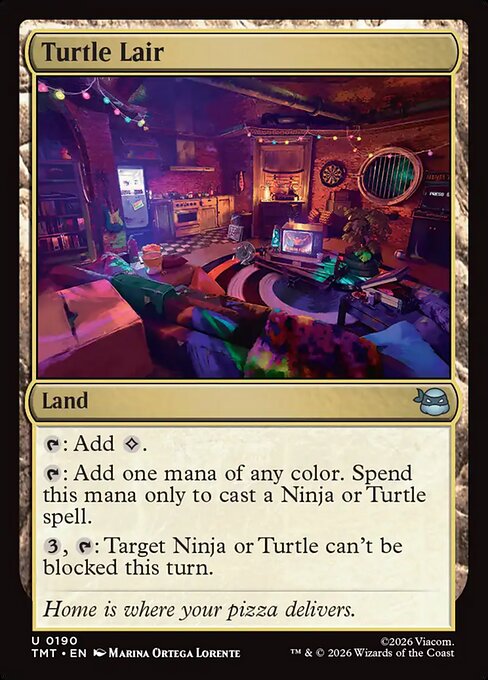
No entry cost, no enters-tapped penalty, no life loss. Turtle Lair taps for colorless normally and taps for any color exclusively to cast Ninja or Turtle spells. In the decks where you're casting Ninja and Turtle spells constantly, it's functionally a five-color land with no drawback. The 3-mana activation, target Ninja or Turtle can't be blocked for the rest of the turn, is what elevates it from "fine tribal land" to genuine inclusion. Guaranteeing that your Yuriko or your Dark Leo connects on demand, without spending cards, at instant speed, is worth a land slot even in non-tribal builds that run a handful of ninjas. In a dedicated ninja shell, this card enables combat sequences that Wastes and basic Forests simply cannot match.
Level Up
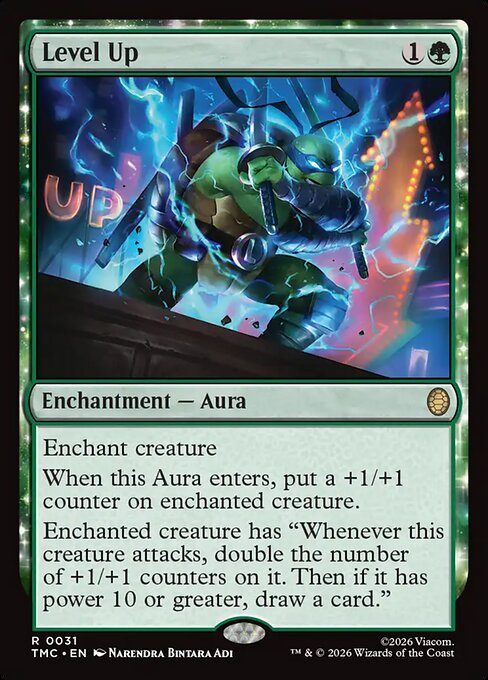
Turn five. You enchant a creature that already has four counters. It attacks. The first doubling trigger fires, four counters become eight. Then the second resolves, eight become sixteen. Your creature is now a 16/16-plus. If it had ten or more power before either trigger resolved, you drew a card. Next attack, 16 becomes 64 if both triggers resolve again. At some point the table starts asking what exactly is happening.
Level Up is a 1G Aura that puts a single +1/+1 counter on the enchanted creature when it enters, then grants it "whenever this creature attacks, double the number of +1/+1 counters on it, then if power 10 or greater, draw a card." The growth is exponential in the mathematical sense, not the colloquial one. A creature starting at two counters hits eight after one attack (two doublings: 2 to 4, then 4 to 8). That's enough to threaten commander damage or one-shot players with trample within a few attacks.
The aura risk is real. Two-for-ones from targeted removal are the natural predator here. The correct home for Level Up is on a commander with hexproof or shroud, or on a creature with built-in protection, something like a regenerating or indestructible body. Slamming it on Big Mother Mouser is particularly nasty: Mouser already doubles counters when it attacks, so Level Up adds a second doubling trigger during that attack. Two doublings from a 2-counter base gives you 8 after the first attack, 32 after the second.
Continue?
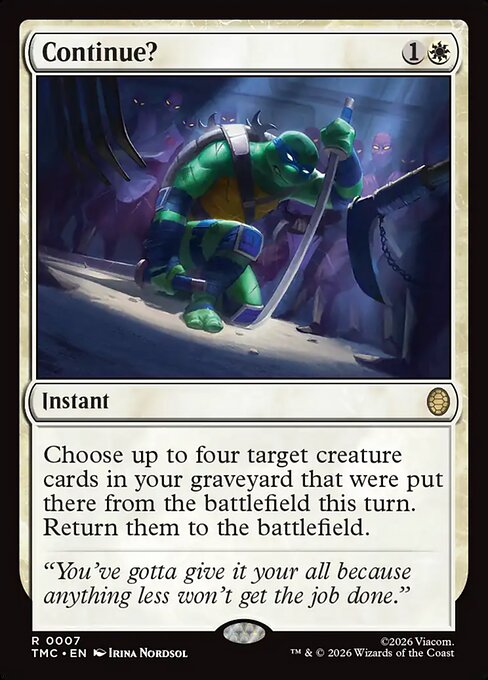
Living Death is the gold standard for mass graveyard-to-battlefield effects, but it's symmetrical, it costs five mana, and it requires both an established graveyard and tolerance for giving opponents their creatures back too. Continue? does something structurally different: it's a 1W instant that returns up to four creature cards from your graveyard to the battlefield, but only creatures that were put there from the battlefield on that same turn.
That restriction is actually a feature in sacrifice-heavy strategies. Sac four creatures into a free outlet on your turn, float the mana, cast Continue? at the end of your turn or end of an opponent's turn, your board is fully restored at instant speed for two mana. Against a sweeper, the timing is even more punishing: your opponents spend four to six mana destroying your board, and you spend two mana in their end step to get it all back. They wasted their turn. You spent almost nothing.
The key constraint is the "same turn" clause. You can't set this up in advance with old graveyard creatures. It rewards reactive play and white decks that either sacrifice creatures aggressively or frequently eat board wipes. In any white list running eight or more creatures, this is one of the best recovery tools printed in the past several years, and the fact that it's not more widespread is a collective deckbuilding oversight the format hasn't caught up to yet.
Endless Foot Assault
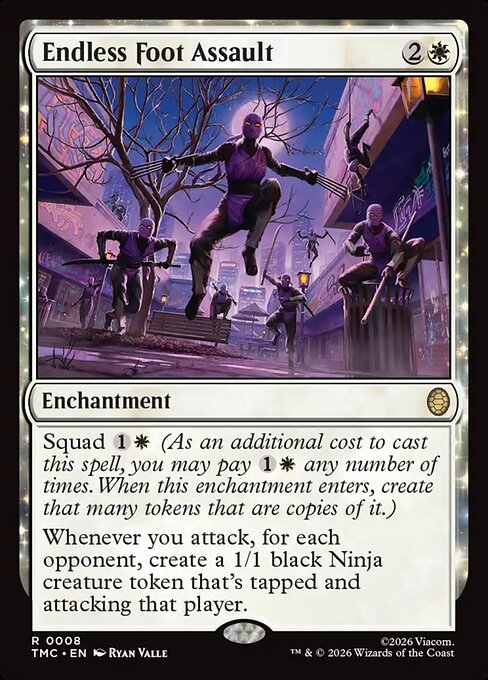
Adeline, Resplendent Cathar is one of the most played token generators in Commander because she creates attacking tokens for each opponent whenever you attack. That's the effect. Endless Foot Assault is that effect as an enchantment: whenever you attack, create a 1/1 black Ninja creature token tapped and attacking for each opponent. In a typical four-player game, every attack step creates three tokens before a single creature connects. That's the floor.
The Squad mechanic is what breaks this. Pay 1W additional times at cast to immediately create that many token copies of the enchantment itself. Two copies of Endless Foot Assault in play means two attack triggers, six tokens per attack across a full table, every single turn cycle. Three copies is nine tokens. The enchantment type makes them meaningfully harder to remove than Adeline's creature body: she dies to creature removal, to combat, to board wipes of the wrong type. Foot Assault needs enchantment removal, and having two or three copies in play means opponents need multiple removal spells before the engine stops.
The tokens being Ninjas is not incidental. They fuel Dark Leo & Shredder's five-ninja threshold, they get deathtouch from Dark Leo's static ability when attacking, and they interact with Turtle Lair's unblockable activation. In a dedicated ninja build, Endless Foot Assault functions as a token generator, a tribal enabler, and a board-state multiplier simultaneously. Outside tribal, it still belongs in any white aggressive deck that can reliably attack: three free 1/1 attackers per combat is a rate that compounds faster than most tables can answer.
Super Shredder

The moment someone resolves this on turn two, everyone at the table starts mentally cataloging their permanents. Every fetch land activation. Every treasure sacrificed for mana. Every creature that dies in combat. Every Food token cracked for three life. Every Clue sacrificed to draw a card. All of it. Every permanent that leaves the battlefield under any player's control puts a +1/+1 counter on Super Shredder. That's not "whenever a creature you control dies", that's the universe of permanents, all players, all causes, all the time.
In a typical pod with fetch land users, players cracking treasures, and normal combat attrition, Super Shredder regularly accumulates eight to twelve counters before reaching midgame. At that point, a 1B 1/1 that landed on turn two has become a 12/12 or 13/13 with menace. Menace means it requires two blockers, and if no one has dealt with it by the time it's large, they often can't profitably block it at all.
The elimination ruling is the real nuclear option. Per the rules, when a player leaves the game, every permanent they controlled simultaneously leaves the battlefield, and Super Shredder gets a counter for each one. I've watched a table opponent get eliminated while Super Shredder was sitting at six counters, and after the dust settled, the count was at twenty-four because the eliminated player had four lands, five creatures, three enchantments, and a handful of artifacts. In one event, a manageable threat became a one-shot machine.
All of that justifies the $32 price tag from a pure power standpoint. But that price also limits who gets to run this card. The cross-format demand is real, aggressive decks outside Commander want this as a growth threat too, and the universal trigger condition means it belongs in nearly any Commander shell that isn't explicitly combo or control. Aristocrats, Jund value, Hapatra, stax builds where opponents are constantly sacrificing into your tax effects: Super Shredder is the payoff creature those strategies have been missing.
The Ooze

First impression: a two-mana colorless legendary artifact that sits there doing nothing. It doesn't attack. It doesn't block. It taps to exile a card from a graveyard and makes a Mutagen token. That sounds like a defensive utility piece you run in one specific graveyard-hate deck and forget about everywhere else.
Then you read the other ability. Whenever a creature you control with a +1/+1 counter on it leaves the battlefield, you create a Mutagen token for each +1/+1 counter on it. Not one token. One per counter. A creature with eight counters that dies or gets sacrificed creates eight of them, each of which converts back into a future +1/+1 counter on any creature for a single mana. That's an engine, not a triggered ability.
The tap ability is pure value: exile a card from any graveyard, yours or an opponent's, and generate one of these tokens as a bonus. Graveyard hate that pays for itself. In a format where graveyard strategies are universal, an always-available exile effect that simultaneously fuels your counter economy means The Ooze never draws a dead turn.
The counter doubling package elsewhere on this list, Michelangelo, Weirdness to 11, High Score, Hardened Scales, feeds directly into The Ooze's payout. A creature that starts at two counters, gets doubled twice to eight, then dies while The Ooze is in play generates eight tokens worth eight future counters. Redistribute those through the Mutagen activation, put all eight on one creature, and The Ooze has turned one death into eight additional counters for a token's worth of mana apiece. Zero colored mana required, fits in any Commander deck, and 17,000-plus builds are running it across the format. One of the best two-drop artifacts printed in this set.
Hidden Hideout
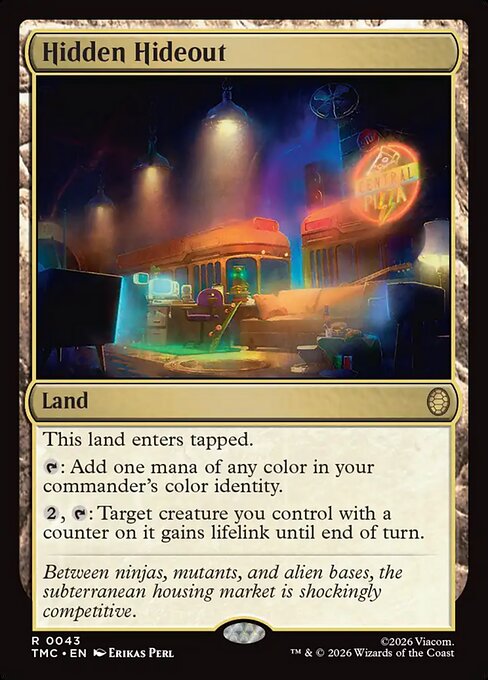
This land does not make the cut in every deck, and it doesn't need to. In any four- or five-color Commander build, Hidden Hideout enters tapped and taps for one mana of any color in your commander's color identity. That's a Command Tower variation with no life payment, no drawback beyond the tap-in, and an additional ability: pay 2 mana, tap, and give a creature you control with a counter on it lifelink until end of turn.
The lifelink activation is modest but not trivial. In a counters deck where your attackers are regularly 8/8 or 12/12, a single swing with lifelink can represent 20-plus life in one attack. That's a meaningful swing in racing scenarios or against burn-heavy decks. It's not the reason you include the land, you include it because five-color decks need color fixing and this provides it free of charge beyond the tempo loss of entering tapped. The ability is a bonus that occasionally does real work.
In three-color counter strategies specifically, anything with white, black, or green running a +1/+1 counter theme, Hidden Hideout offers both fixing and a combat-phase tool. Under $3, which makes it trivially cheap to include in any multicolor build where it qualifies. If you're running four or more colors, you almost certainly want this over a basic.
Mutagen Man, Living Ooze

Mutagen Man, Living Ooze is one of those cards that gets dismissed as a worse version of The Ooze, which is fair if you're only running one of them. But Mutagen Man does something the Ooze doesn't: he enters the battlefield with X Mutagen tokens, where X is the additional green mana you paid at cast. Cast him for 2GG and he enters as a 2/3 with 0 tokens. Cast him for 5GG and he enters as a 2/3 with 3 tokens. Pay enough mana and you've immediately seeded a large batch of them that starts generating counters on the same turn.
The cost reduction on his triggered output is the hidden upside. Mutagen Man makes all activated abilities of artifact tokens cost one less, which means those tokens go from "pay a mana plus tap plus sacrifice" to "tap plus sacrifice." Free counters, in effect, on any turn where you have them sitting in play. Combined with The Ooze's passive generation and Michelangelo, Weirdness to 11's doubling effect, Mutagen Man turns the whole counter-generation apparatus from a slow drip into a flooding current. He's also a legend with trample, which gives him nominal offensive capability when counters stack up.
The case for running him alongside The Ooze instead of cutting one for the other: they fill different roles. The Ooze generates tokens reactively off creature deaths and graveyard hate. Mutagen Man generates them proactively at cast and then reduces the ongoing overhead of keeping the engine fed. Together, they create a self-sustaining loop that funds your counter strategy with minimal additional investment.
Irma, Part-Time Mutant
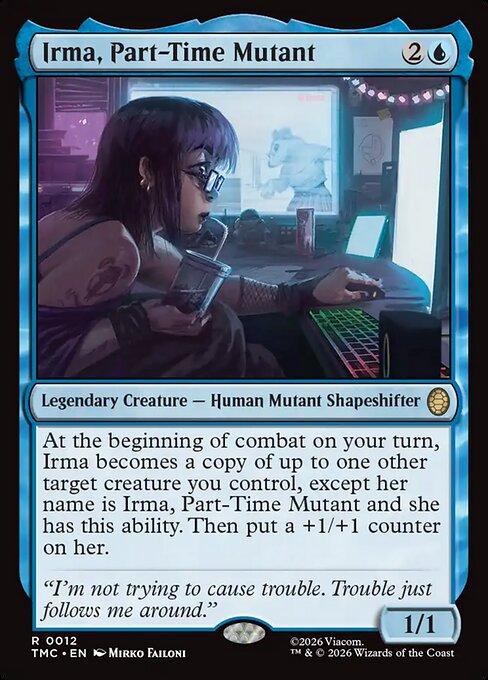
Irma is the best card in this set for Commander, and it's not particularly close. A 2U 1/1 that at the beginning of every combat becomes a copy of any other creature you control, retaining her own name and this ability, then gets a +1/+1 counter added on top. Every single combat. Fresh copy every time.
Let's be precise about what she does and doesn't do, because the distinction matters. She becomes a copy of the creature through a continuous effect while already on the battlefield. She does not enter the battlefield, so she does not trigger ETB abilities of the copied creature. What she does gain is everything copiable: the power, toughness, all abilities other than ETB triggers, static effects, anything that fires when she attacks. Copy a creature with "whenever this creature attacks" triggers and those fire. Copy something with an activated ability and you have it. Copy a creature with a static pump effect and you have the pump. She grows with a +1/+1 counter every combat regardless of what she becomes, stacking size on top of whatever the copied creature's base stats are.
The legendary rule is not an issue. She keeps her own name, Irma, Part-Time Mutant, regardless of what she copies. You can copy your legendary commander without triggering the legend rule. This is the part players miss. Most clone effects either keep the copied name, triggering the legend rule on your commander, or are worse in other ways. Irma sidesteps the issue entirely.
She's different from static copy effects like Sakashima of a Thousand Faces. Sakashima permanently copies one target. Irma re-evaluates every attack step, copying whatever is currently your best threat on the battlefield. Your threats evolve through the game; Irma evolves with them. Turn five she copies your biggest creature. Turn eight, when you've deployed something more threatening, she copies that instead. The flexibility is impossible to overstate in a format where board states shift every three minutes.
Twenty thousand decks and rising is a lot. But given that she's an uncommon in a precon, and that her effect competes with blue staples printed at rare or mythic over the past five years, she's still underrated at that number. Players instinctively devalue uncommon precon cards. Irma is not precon filler. She's a generational blue utility creature that belongs in any strategy running two or more bomb creatures and blue mana, which covers roughly half of Commander.
The Rest of the Field
- Ninja Pizza: Converts your Food tokens into one mana of any color and generates a free Food each second main phase, serviceable mana smoothing in green but lacks the ceiling to compete for a ranked slot.
- Continue?: Mass instant-speed reanimation at 1W for creatures that died this turn, it's worth testing in any sacrifice-heavy or creature-dense white build, and arguably should rank higher in dedicated aristocrats lists.
- Shredder, Shadow Master: A 5BB 5/5 that copies itself onto every opponent as a tapped attacking token when it attacks, then drains half a player's life when it connects, flavorful and powerful but expensive and mono-black, limiting where it fits.
- Coin of Mastery: Creates a Treasure and gives creatures +1/+1 counters for each mana you spent from artifact sources to cast them, narrow but potentially backbreaking in dedicated artifact mana builds like Breya or Goldfisher shells.
- Lessons from Life: Draws three cards and puts a land into play tapped for 3GU, matching the cost of Urban Evolution, which already saw play, except this version actually puts the land onto the battlefield instead of just letting you play an extra one. Worth including in Simic value shells.
- Mona Lisa, Science Geek: A 1/3 reach mana dork that taps for X mana of one color where X equals her power, in counter-heavy green builds where she regularly reaches 5 or 6 power, she's among the most efficient mana producers available.
- Lita, Little Orphan Amphibian: A 2/1 for 1W with an Alliance trigger that once per turn lets you pick a fresh mode among counter, Food token, or Scry 1, flexible and synergistic but not ceiling-high enough to warrant individual analysis.
- Slash, Reptile Rampager: A 7/5 for 3RR with an Alliance trigger that pings every opponent for 2 whenever another creature enters, a solid go-wide payoff in red token decks but competes with better-known options at an identical cost.
- April O'Neil, Live on the Scene: A 2/1 for 1U with Partner that investigates whenever any Mutant, Ninja, or Turtle enters. In the right shell she draws two or three cards per turn cycle without much effort, and as a commander alongside any of the Partner TMNT legends she's the engine the deck runs on.
New and Worth Watching
A few cards from the set haven't found their homes yet but show real potential as players optimize around them.
South Wind Avatar is a 3/4 deathtouch for 3B that gains you life equal to a dying creature's toughness whenever another creature you control dies, then pings every opponent for 1 life each time you gain life. The ping is once per life-gain event regardless of amount, so volume of death triggers matters more than creature size. In high-frequency sacrifice aristocrats builds, this is a budget drain engine worth monitoring.
Arcade Cabinet enters and puts a +1/+1 counter on each of up to four target creatures, and then pays 2 mana plus tapping plus sacrificing a token to double all counters on any creature. In counter-doubling strategies that also generate surplus tokens, this becomes a recursive engine with real upside once players start building around it intentionally.
The card most likely to quietly rise in competitive Simic lists is Lessons from Life. Putting the land directly onto the battlefield (tapped, but on the battlefield) instead of just letting you play an extra land is a meaningful functional difference from Urban Evolution, and as players optimize their Simic draw-ramp suites, that distinction registers.
Coin of Mastery deserves a second look in dedicated artifact-mana lists. Most decks don't run enough artifact mana sources to trigger its counter bonus reliably, but in a fully optimized Breya or Urtet build where nearly every mana source is an artifact, the counter scaling on entry becomes meaningful every cast cycle.
The Verdict: What the TMNT Set Actually Delivered
Super Shredder is this set's worst offender in the price-versus-table-experience calculation. The card is genuinely powerful, the trigger breadth is real, the menace clock is real, and the elimination-event ruling makes it one of the most explosive threats in Commander when an opponent folds. But at $32, it's approaching territory where you start asking whether the card belongs at the same table as Jeweled Lotus: technically legal, frequently generating a miserable experience when it's the only card of its type in a pod that can't interact with it. If you can afford it and your pod plays at the power level where it fits, run it. Everyone else is paying a premium for a card that creates the kind of game states that erode player goodwill over time.
Splinter, Radical Rat is the card players are wrong about. The community read "ninja triggered abilities" and decided it requires complete ninja tribal devotion. It doesn't. You need five ninjas in your deck to start reliably doubling those effects, Yuriko alone plus four supporting ninjas does it, and the Esper color identity gives you access to enough quality ninjas that the threshold is easily met without dedicating your entire 99 to the type. Splinter is underplayed because the tribal framing scared people off. That's a real opportunity.
And then there's Irma, Part-Time Mutant. Twenty thousand decks is a high adoption number by any measure, but she still isn't getting full credit because she's an uncommon in a precon. That psychological discount is working against players. Her repeatable, flexible, growing copy effect rivals blue staples printed at rare or mythic over the last three years, she belongs in the conversation with the best blue utility creatures in the format's history, not filed under "decent precon uncommon."
The counter engine built around The Ooze, Michelangelo, Weirdness to