Mardu Surge Upgrade Guide: Fix Zurgo Stormrender Fast
The precon collapses when Viscera Seer dies. Here is the $25 fix that makes that failure condition irrelevant.

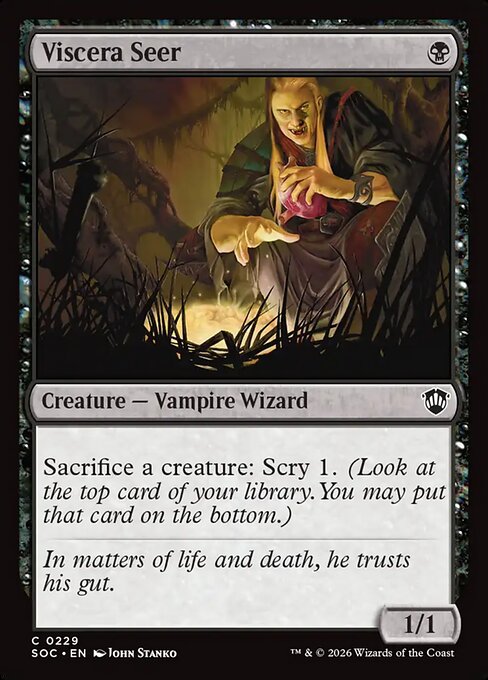
Viscera Seer dies, and the deck collapses with it. Someone at the table reads a 1/1 Vampire Wizard next to a Zurgo Stormrender in the command zone and makes the correct tactical decision. The Seer is gone by turn four, and suddenly the half of Zurgo's card text that shaves life totals goes dark. You are left with a commander that refills your hand when tokens die in combat and does nothing the rest of the time, because you have no way to cash in the tokens that survive.
Here is the inversion: that vulnerability is almost entirely solved by $25-30 of surgical adds. Zurgo Stormrender is one of the most structurally coherent precon commanders in recent memory. A dual-mode engine that simultaneously draws cards and bleeds your opponents from the same creature deaths achieves its two-in-one card text at a playable cost, and the bones of the precon list support both upgrade paths at once. The free-sac package is thin, the token producers run expensive, and two lands enter tapped every time they could be untapped. Fix those three problems and the deck goes from a functional 5/10 consistency to an 8/10 without a rebuild. The upgrades below do exactly that, in order of priority.
Mardu Surge: Honest Assessment
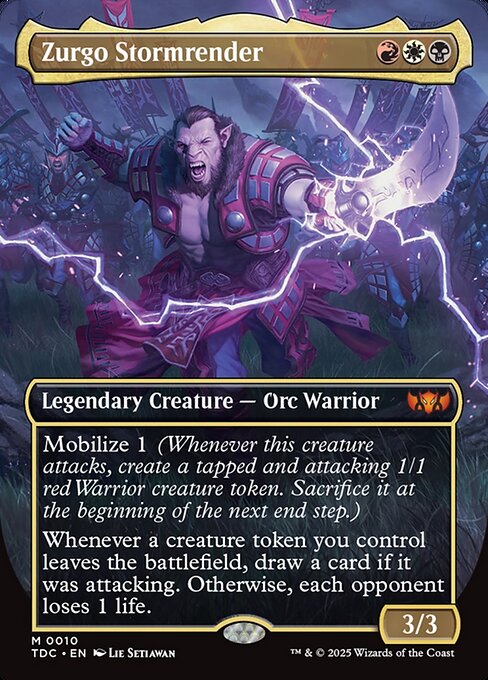
Let's name the ceiling before we name the problems, because the ceiling is genuinely high. Zurgo Stormrender costs three mana and does two things simultaneously: whenever his mobilize token attacks and then leaves the battlefield, you draw a card. Whenever a token leaves the battlefield without having attacked, each opponent loses 1 life. In a game where you are generating tokens constantly, those two triggers fire every single combat without additional investment. That is unusual value for a 3-mana commander.
The precon's sleeper mechanic is myriad. Goldlust Triad has myriad natively. Ironwill Forger's Lieutenant ability grants myriad to any non-legendary attacker at the beginning of combat, provided you control your commander. A myriad creature attacking three opponents generates three token copies that are exiled at end of combat. Each of those exiled tokens was attacking when it left, so each one draws you a card off Zurgo. Goldlust Triad itself can deal combat damage to multiple players through those copies, generating Treasure tokens wherever it connects. In a four-player game, one swing with a myriad creature draws you three cards on top of whatever damage you dealt. That is the highest-ceiling engine the precon ships with out of the box.
Ironwill Forger targets one non-legendary creature and grants myriad only until end of turn, and only while you control your commander. Legion Loyalty gives every creature myriad permanently, so the scope is narrower, but the effect on one attacker per combat is where this deck lives anyway. The upgrade case is real; the comparison to Legion Loyalty flatters it more than it should.
The weak point is Viscera Seer. Remove it and you lose your only free way to proactively drain opponents outside of combat. A table that correctly identifies what the Seer is doing will answer it on turn three or four without fail. Secondary problem: Myr Battlesphere at seven mana to create four tokens is a rate this deck cannot afford. You are never casting it on the turn it matters. Out-of-box rating: functional 7/10, consistent 5/10. The gap is the target.
The Keepers: Don't Touch These
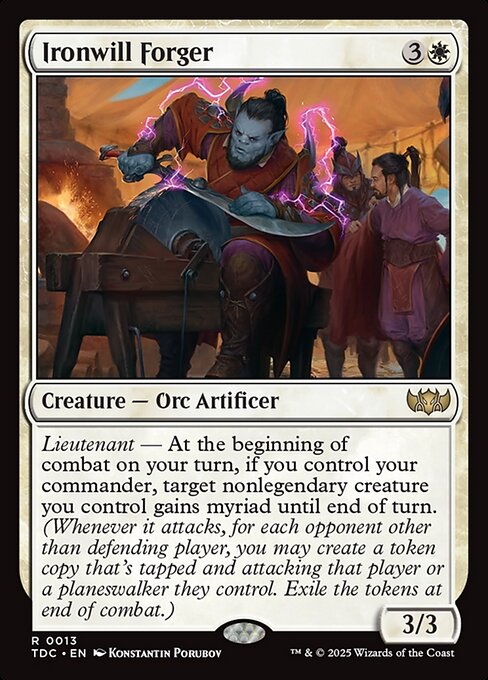
Ironwill Forger is the best card in the precon. Legion Loyalty costs eight mana and gives every creature you control myriad permanently; Ironwill Forger costs four and targets one non-legendary creature per combat, which is a narrower effect but arrives four turns earlier and at instant relevance. Grant myriad to a non-legendary token producer and you get the copies swinging each opponent, then draw triggers firing for each one exiled at end of combat. That is a multi-opponent token avalanche off a single swing.
Adeline, Resplendent Cathar pairs with Ironwill Forger as well as anything else in the list, though she can't receive myriad herself since the ability only targets non-legendary creatures. Power equal to creatures you control means she regularly swings as a 6 or 7 power creature while generating tokens that make her bigger. Keep her unconditionally.
Ainok Strike Leader does two real jobs on a single card: creates Goblin tokens for each opponent when it attacks, then grants board-wide indestructible when it sacrifices itself. That second mode is what Grand Crescendo charges you mana for as a reactive protection tool, except here you're also flooding the board with tokens rather than just shielding what's already there.
Skullclamp on a 1/1 token draws two cards the moment that token dies. The ceiling in a deck that routinely runs eight to twelve 1/1s into a combat step is, charitably, absurd.
Also keep: Thalisse, Reverent Medium (creates Spirit tokens at end step, feeding Zurgo draw triggers and providing a differently-named token for Neriv, Crackling Vanguard builds), Neyali, Suns' Vanguard (double strike on all creatures swinging at opponents plus impulse draw is the deck's most explosive combat ceiling), Reconnaissance (lets you swing everything, trigger all attack abilities, then remove creatures from combat before damage, pseudo-vigilance on the whole board), Will of the Mardu (instant-speed removal plus a wave of tokens in one card), Sol Ring, and Command Tower.
What's Holding the Deck Back
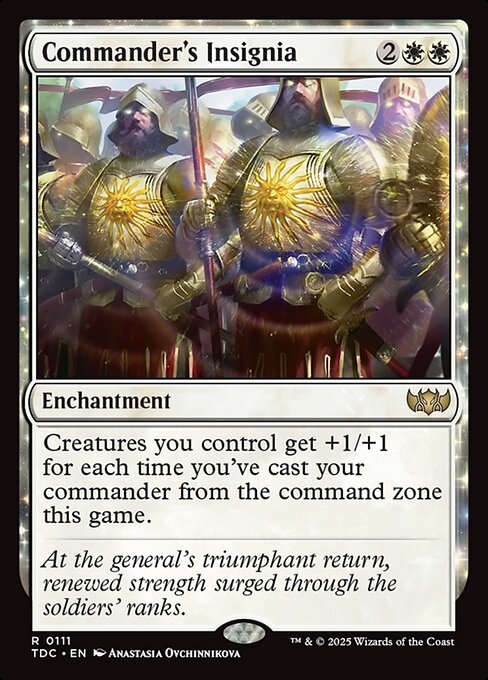
Commander's Insignia is the clearest auto-cut. It occupies the same cost slot as Warleader's Call, gives you zero bonus the first time Zurgo hits the table, and only scales if you are already recasting him repeatedly from his starting zone. That scenario means you are spending two to four extra mana per recast on command tax, which means you are behind and losing tempo. Warleader's Call applies immediately, pumps every creature you control by one, and deals damage on every ETB. The weak point for Commander's Insignia is game one, cast one. Cut it.
Legion Loyalty at eight mana is too slow for a deck that wants to be attacking by turn three. Giving all creatures myriad is a spectacular effect. Paying eight mana sorcery-speed in a deck that does not ramp aggressively means you are casting it into a board wipe magnet on your most telegraphed turn of the game. Cut it for any of the sac outlet adds below.
The token production rate problem is real. Myr Battlesphere costs seven mana and creates four tokens. Beetleback Chief costs four mana and creates two tokens on a 2/2. Siege-Gang Commander costs five mana and creates three tokens on a 2/2. The math: Zurgo costs three. Adeline, Resplendent Cathar costs three. Ainok Strike Leader costs two. When your premium token producers cost two to three mana, a seven-mana option that arrives too late to attack the turn it lands is dead weight in a curve that peaks at four or five. Cut all three.
Temple of Silence and Temple of Triumph both enter tapped unconditionally. A deck that wants to attack on turn three or four and recur its commander cannot absorb enters-tapped lands on curve. Replace both with basics or any budget dual that enters untapped.
Two additional cuts: Elspeth, Storm Slayer rewards attacking alone with +2/+2 and flying, which is precisely the wrong incentive structure for a go-wide token deck where attacking alone is a wasted opportunity. And Infantry Shield, menace and mobilize X on an equipped creature sounds good until you notice it costs two to equip and requires the creature to attack before the mobilize tokens arrive. There are better ways to spend those slots.
One editorial override: every aggregate ranking flags Goldlust Triad as a cut for cost reasons. Keep it. A 4/3 flier with myriad is a reasonable rate, the token copies that successfully deal combat damage to players create Treasure tokens, and those tokens plus the draw Zurgo triggers when the copies are exiled at end of combat add up to genuine value off one swing. The cost concern is real but not disqualifying here.
Sacrifice Outlet Upgrades: Fix the Engine First
The free-sac package is where the deck's reliability lives or dies. In that game state where Viscera Seer dies on turn three or four with nothing to replace it, you have a commander that refills your hand when tokens die in combat and does essentially nothing otherwise, because you have no way to trigger the drain half of his text. The fix is redundancy: three to four ways to sacrifice creatures instead of one, each costing less mana than the tokens themselves. This is the section that moves the deck's reliability from 5/10 to 8/10. Everything else is polish.
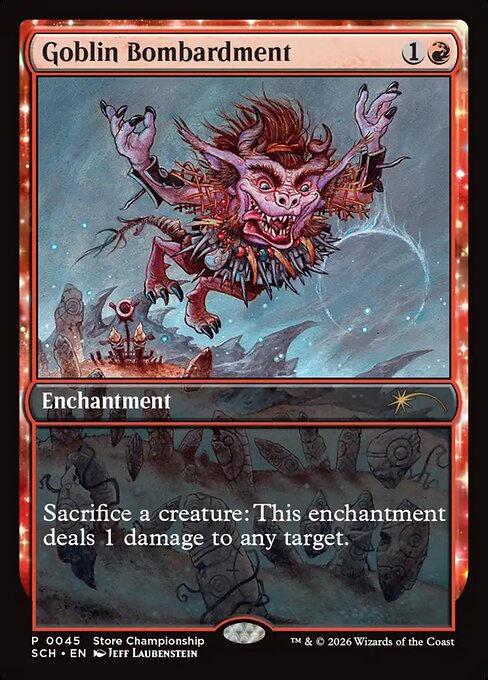
Goblin Bombardment is the first add. The vulnerability here is nearly impossible to construct: you need zero tokens and zero ways to generate them, at which point the game is already over. On a board of eight tokens swinging through post-combat, that is eight damage to any target before Zurgo's triggers even resolve, plus eight draw triggers from the combat exits. It does what Viscera Seer does but trades scry for direct damage. In a deck that wants to drain the table, redirecting damage is strictly better value. Roughly five dollars. Add it immediately.
Ashnod's Altar turns dying tokens into mana. Sacrifice four creatures after combat and you have eight colorless mana available for your next spell. The floor is still positive in almost every game state: even two sacrificed tokens generate four mana off permanents that were already leaving the battlefield anyway. The Altar asks nothing from you that the deck was not already doing. Roughly four to six dollars.
One mana, sacrifice a token, draw a card. That is Hardened Tactician, which the precon inexplicably ships without. The ceiling in a turn where you generate eight tokens after combat is drawing four cards for four mana across a single end step. When the primary vulnerability of this strategy is running out of gas after two attacks, that kind of card advantage is exactly what the engine needs. Currently around one dollar.
Pitiless Plunderer and Mahadi, Emporium Master form the ramp layer that scales with creature death volume. The Plunderer creates a Treasure immediately when each creature dies, so a combat step with six myriad tokens expiring nets you six Treasures at the moment of each death. Mahadi generates Treasures in a lump sum at your end step, counting all creatures that died that turn. They both benefit from the same deaths, just at different points in the turn. Stack them together and one combat step funds your next two or three casts.
Under $2: Hardened Tactician, Mahadi, Emporium Master. Under $10: Goblin Bombardment, Pitiless Plunderer, Ashnod's Altar. This entire package costs less than a booster pack and eliminates the single most punishing break point the deck has.
ETB Damage and Death Trigger Upgrades
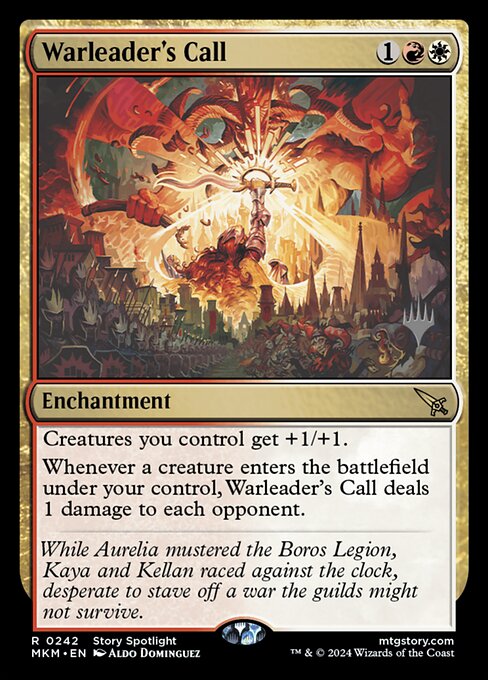
Warleader's Call versus Impact Tremors: this comparison comes up in every Mardu token discussion and the answer is not actually close. Warleader's Call costs one more mana and does two things: gives every creature you control +1/+1, and deals 1 damage to each opponent on each ETB. Impact Tremors only deals the 1 damage. In a deck running twelve to sixteen 1/1 tokens, the +1/+1 from Warleader's Call doubles the combat damage output of your entire board. That is the difference between threatening 12 damage and threatening 24 damage in the same attack step. Run Warleader's Call first. If budget allows, run the tremors enchantment too, at one dollar, the floor is still one damage per Zurgo mobilize trigger every single combat.
Impact Tremors specifically creates immediate value once Ironwill Forger comes online. A non-legendary creature granted myriad that attacks three opponents generates three tokens entering play, three myriad copy triggers, and three Impact Tremors pings. One attack step with Ironwill Forger and a wide board can deal six to eight damage off Impact Tremors alone before combat damage resolves.
The drain package: Blood Artist, Zulaport Cutthroat, Elas il-Kor, Sadistic Pilgrim, Mirkwood Bats, pick two or three. The weak point of running all four is slot cost and diminishing returns: after the second drain-on-death effect, you are getting marginal value from the third and fourth. Breakdown: Blood Artist triggers on any creature death, including opponents' creatures, making it the broadest coverage. Zulaport Cutthroat hits only your creatures but drains all opponents simultaneously rather than one target. Mirkwood Bats triggers on token production rather than death, which makes it the best pick for the token flood path, it starts draining the moment Zurgo's mobilize trigger fires, before the tokens even reach combat. Pick the two that match your play pattern and move on.
Caesar, Legion's Emperor is the single highest-value add in this section. On attack, Caesar sacrifices a creature, creates two 1/1 tokens that enter attacking, then lets you either draw a card and lose 1 life or deal damage to each opponent equal to your token count. He covers every role the deck needs from one permanent and generates the raw material for every other payoff in the list. If you are spending $50 on upgrades, Caesar is in that $50.
Budget breakdown: Impact Tremors, Zulaport Cutthroat, Blood Artist, and Elas il-Kor, Sadistic Pilgrim all sit under $2. Warleader's Call runs around $3 and Caesar around $4. Splurge tier: Isshin, Two Heavens as One (~$8-10) doubles every combat trigger the deck runs, and the number of those triggers in this list is significant enough that Isshin warrants its own section.
Attack Trigger Amplifiers and Evasion

Turn four. You have Zurgo in the command zone, Adeline, Resplendent Cathar on the board, and Isshin, Two Heavens as One in play. You attack. Adeline's trigger fires twice, two tokens per opponent instead of one, so six tokens total in a four-player game. Zurgo's mobilize fires twice, two Warrior tokens instead of one. Every one of those tokens is attacking. The table stares at a board that went from five creatures to fifteen in a single declare-attackers step, and three players are doing threat math they were not prepared to do. That is Isshin's floor in this deck. Not the ceiling. The floor.
Isshin doubles "whenever this creature attacks" triggers: Zurgo's mobilize, Adeline's token output, the myriad trigger on any non-legendary creature that received myriad from Ironwill Forger, and Caesar's sacrifice-and-create sequence. Ironwill Forger's Lieutenant ability fires at the beginning of combat rather than on attack declaration, so Isshin does not double the ability that grants myriad. What Isshin does double is the myriad trigger on the creature that received it, meaning when that creature attacks, you get twice as many tokens from myriad. The practical result: dramatically more tokens in one combat phase. Isshin is the highest-ceiling add in the deck. Spend the $8-10 and do not look back.
Garna, Bloodfist of Keld costs one dollar and functions as a second Zurgo in the 99. Haste means she attacks the turn she enters, and whenever any other creature you control dies, you choose to draw a card or deal 1 damage to each opponent. She serves both upgrade paths simultaneously, and in a deck that generates tokens every combat, the condition almost never fails to pay off. This is a banger at one dollar in this specific archetype, and every deck I have tested it in has validated that read.
Teysa Karlov doubles death triggers and belongs in the aristocrats-heavy build. The scope here is narrower than it looks: her doubling applies only to creatures that are sacrificed and die, not to tokens exiled at end of combat from myriad. When you are feeding tokens to Goblin Bombardment or Ashnod's Altar, Teysa doubles Zurgo's drain trigger on each of those deaths. Run four or five ways to sacrifice your board and she earns her place. In a build that relies primarily on myriad for token exits, she is the weakest of the combat-trigger adds and you should probably cut her.
Reconnaissance is already in the precon and is one of the ten best Commander enchantments ever printed. Tap everything, trigger all attack abilities, then remove non-essential creatures from combat before damage is assigned. Your tokens collected their triggers. Your vulnerable creatures are now safe. Your Zurgo drew his cards. Nobody blocked. For go-wide token decks, Reconnaissance functions as free vigilance on the entire board, and it cost one mana. Keep it. If you want redundancy, Dolmen Gate prevents all combat damage to your attacking creatures entirely, no removal required. At roughly six to eight dollars, it is the splurge evasion add that makes your attack steps nearly consequence-free.
Under $2: Garna, Bloodfist of Keld, Teysa Karlov. Under $10: Isshin, Two Heavens as One. Splurge: Dolmen Gate.
Upgrade Path by Budget
The $25 tier fixes the only vulnerability that actually matters: the sacrifice outlet collapse. Pick up Goblin Bombardment, Ashnod's Altar, Hardened Tactician, Pitiless Plunderer, and Mahadi, Emporium Master. Together they cost under $15. Spend the remaining $10 on cutting Temple of Silence, Temple of Triumph, Commander's Insignia, and Myr Battlesphere, and replacing them with Garna, Bloodfist of Keld, Blood Artist, Zulaport Cutthroat, and a basic land or two. After this tier, the deck's reliability moves from 5/10 to 8/10. You now have four ways to sacrifice into instead of one, a Treasure ramp layer that scales with creature deaths, and two redundant drain effects that fire on every creature death. This is where to stop if budget is the hard constraint.
The $50 tier adds the ETB damage layer. Include Warleader's Call (~$3), Impact Tremors (~$1), and Caesar, Legion's Emperor (~$4). Cut Beetleback Chief, Siege-Gang Commander, and Elspeth, Storm Slayer. Caesar is simultaneously a free sacrifice outlet, a token generator, and a drain engine on a single four-mana card: his draw mode costs you a life, and his damage mode hits each opponent for your token count. The deck now punishes opponents when tokens enter, when they die, and in combat simultaneously. One attack step with Zurgo, Impact Tremors, and Warleader's Call in play deals more incidental damage than most decks deal in two full turns. At this tier the deck is a credible threat at bracket 2-3 tables and will regularly steal wins against pods that do not expect that drain volume.
The $100 tier is where the deck becomes a competitive casual powerhouse. Add Isshin, Two Heavens as One (~$8-10), Teysa Karlov (~$2-3), Cathars' Crusade (~$3-4), and Ruinous Ultimatum as the nuclear reset when a board state gets out of hand. Cathars' Crusade turns every token ETB into a permanent power boost for the whole board. In a deck that creates eight to twelve tokens per combat step, the board goes from 1/1s to 3/3s to 5/5s within two attack steps. Isshin then doubles the triggers generating those tokens. At this tier the deck can challenge optimized bracket 3 pods and will regularly threaten turn-six to seven kills on uninterrupted goldfish lines.
One sidebar on Neriv, Crackling Vanguard as the alternate commander: Neriv exiles a card for each differently named token you control on attack, turning token variety into impulse draw. The precon already generates a wide range of token names. Goblins, Humans, Warriors, Spirits, Soldiers, and Treasures all appear across the card list. Goldlust Triad adds Treasures when its copies deal combat damage to a player, each copy that connects generates one. Thalisse, Reverent Medium is Neriv's best friend out of the box, creating Spirit tokens at every end step that contribute one token name toward Neriv's count. Upgrading for Neriv specifically means adding Ophiomancer (a Snake token on each upkeep you control none) and Tempt with Vengeance (Elemental tokens at scale). The precon infrastructure supports Neriv without major surgery. He rewards the same token diversity the deck was building toward anyway.
Concrete closing verdicts: if you only buy one card, buy Goblin Bombardment. It costs five dollars and eliminates the deck's most punishing weak point on its own. If you are spending $5-10, buy Warleader's Call. It does more work per mana than any other single add in the list. If you are spending $10 or more on a single card, buy Isshin, Two Heavens as One. The deck doubles in raw power the turn Isshin hits the table.
What the $25 tier actually does is make the aristocrats engine resilient. Viscera Seer dies, the engine goes dark: that problem no longer exists once you have four ways to feed the machine instead of one. That gap, from one outlet to four, is what the reliability jump reflects: from 5/10 to 8/10 for fifteen dollars in cardboard. Everything above $25 is refinement.
Zurgo Stormrender is not a strong precon commander because he generates tokens. Half the commanders in the format generate tokens. He is strong because every token he generates serves two purposes simultaneously: the attacking ones draw cards, the non-attacking ones put opponents on a clock. That dual utility means every upgrade that increases token volume is effectively buying two effects for the price of one. It is why the upgrades here go farther than the dollar amounts suggest. A five-dollar sac outlet does not add one new function to the deck. It activates both halves of the commander's text whenever you want rather than only when the table lets your Viscera Seer survive. That is the leverage point. The whole upgrade guide is just finding more ways to pull that lever.