Imoti, Celebrant of Bounty: The Commander Guide
Most Imoti pilots build a ramp deck. Build a cascade engine instead and the whole deck clicks into place.

Who Is Imoti, Celebrant of Bounty?
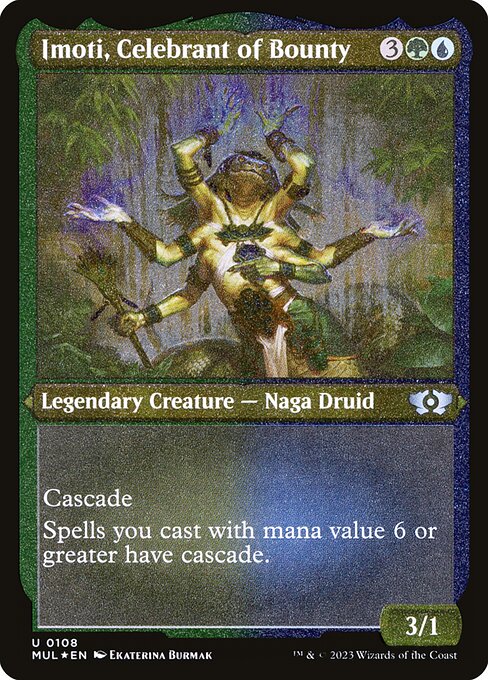
Most Imoti, Celebrant of Bounty decks are built like a ramp deck that happens to have cascade. That is exactly backwards. Imoti is a cascade engine that you feed with ramp, and the difference in how you sequence those priorities is the difference between a deck that fizzles on turn six and one that chains four spells off a single Treasure Cruise.
The card does two things. She has cascade herself at mana value 5, so she hits something with mana value 4 or less when cast, usually a ramp piece or a small interaction spell. That's a bonus, not the plan. The plan is her second line: every spell with mana value 6 or greater gets cascade. Every bomb. Every finisher. Every oversized Eldrazi. Each one arrives with a free spell stapled to it.
Here is the rule that shapes every deckbuilding decision: cascade reads printed mana cost, not the actual amount paid. Treasure Cruise is a mana value 8 spell even when you cast it for one mana through delve. That single rules interaction is responsible for the deck's most broken turns, and players who don't know it are building a fundamentally weaker version of this commander.
She is a 3/1 for five mana with no built-in protection. She dies to a stiff breeze. The deck has to function while she is off the table, so the draw engines, cost reducers, and big spells all need to work on their own. Simic identity gives you green ramp and blue card selection, but no black tutors or white board wipes. You win through volume and speed, not surgical precision. That constraint shapes every card choice from here on out, and the constraint is generative once you accept it.
The Plan: Build a Curve That Rewards Itself
The game plan is simple to describe and surprisingly hard to execute: ramp to six mana, cast one big spell, watch it become two, watch two become four. The tricky part is the deckbuilding discipline required to make that chain work consistently.
There is a concept every Imoti builder needs to name and internalize before adding a single card: the cascade trap. Every card in the mana value 3, 5 range is a card you might cascade into from a mana value 6+ spell instead of a payoff. Cascading into a Cultivate when you expected to hit Apex Devastator feels terrible. Not because Cultivate is bad, it isn't, but because it ends your chain, and ending your chain early is how you lose. This constraint shapes the entire deck. Accept it early.
Early game (turns 1 through 3), the deck has exactly one job: ramp. You need six mana by turn four. Acceleration spells are the absolute ceiling for utility pieces here. Anything at mana value 3 or higher that doesn't directly accelerate you to six is a liability.
Mid game (turns 4 and 5) is setup. Deploy Imoti or a cost reducer. These turns are not action turns. If Imoti gets removed on turn 5, rebuild and wait one more turn. The deck is patient in this window because it has to be.
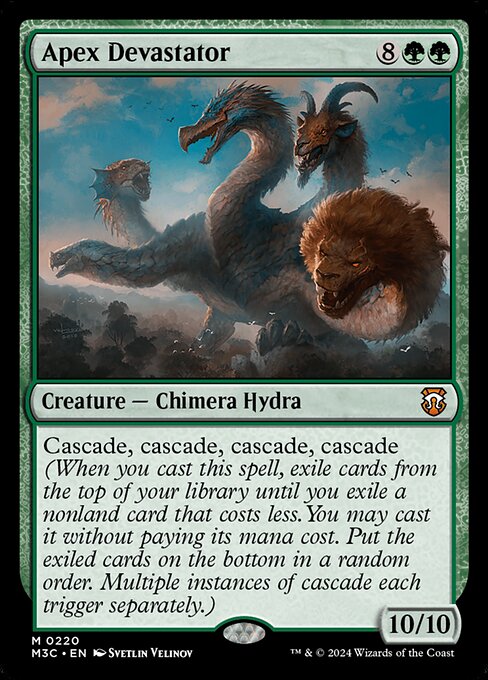
Turn six onward is where the game happens. A single Aminatou's Augury at mana value 8 cascades into something at mana value 7 or less. That hit likely triggers another cascade. Apex Devastator cascades four separate times off one spell. Temporal Trespass costs next to nothing through delve but cascades as an eleven-drop. One spell becomes a chain, the chain becomes a board, and the board ends the game. Every card in the list either contributes to that sequence or it doesn't belong.
The Ramp Package: Steep Early, Then Jump the Gap
The ramp package in Imoti is not just acceleration. It is the structural enforcer of the two-peak curve. Everything here belongs in the deck by staying under mana value 3 or by doing so much work at higher mana values that the cascade-trap cost is worth paying.
Mana value 2 is the hard ceiling for pure acceleration in most Imoti lists. Yes, that means Cultivate and Kodama's Reach at mana value 3 are cascade traps and should be cut in tighter builds. That will feel wrong the first time you do it. Do it anyway. The constraint is the design.
Skyshroud Claim and Entish Restoration are exceptions to the mana-value-3 rule. Skyshroud puts two Forests into play untapped, not tapped, that tempo difference is real, and it functions identically to a cheaper accelerant in practice. Entish Restoration is an instant that can grab three basics if you control a creature with power 4 or greater, which in this deck is almost always. Both justify the cascade risk.
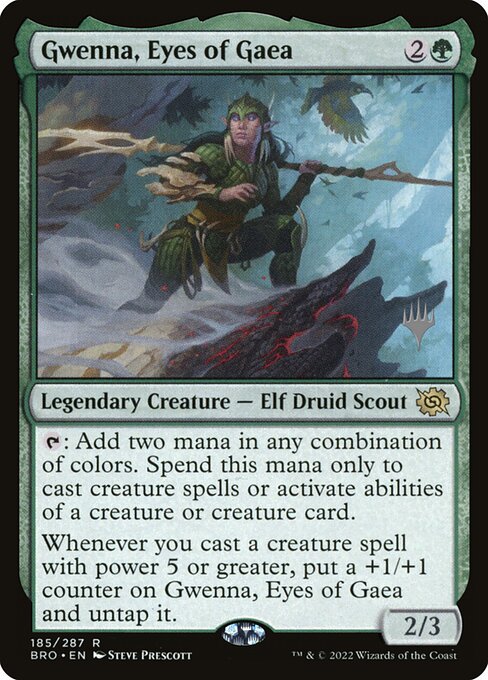
Gwenna, Eyes of Gaea taps for two green restricted to creature spells and untaps whenever you cast or put a creature with power 5 or greater onto the battlefield. She lets you jam Imoti or a big body a full turn early, and she grows as the deck does its thing. That kind of acceleration compounds fast when your curve is built around it.
Goreclaw, Terror of Qal Sisma and Krosan Drover represent the cost-reduction tier. Both shave significant mana off mana value 6+ creatures, converting a turn-seven bomb into a turn-five cast. They don't add mana, they close the gap. Surrak and Goreclaw and Thryx, the Sudden Storm layer additional reductions while granting trample and uncounterability respectively. These cards are not acceleration in the traditional sense, but in Imoti they serve that function: getting your payoffs to the table one to two turns earlier than your land count would otherwise allow.
Draw Engines: Cards That Pay You for Doing the Thing
The failure condition the draw package exists to prevent is this: you cast Imoti on turn three, jam a mana value 7 creature off cascade on turn four, and arrive at turn five with an empty hand and no follow-up. In a normal deck, casting three spells in one turn depletes your hand. In Imoti, casting three spells in one turn should refill it.
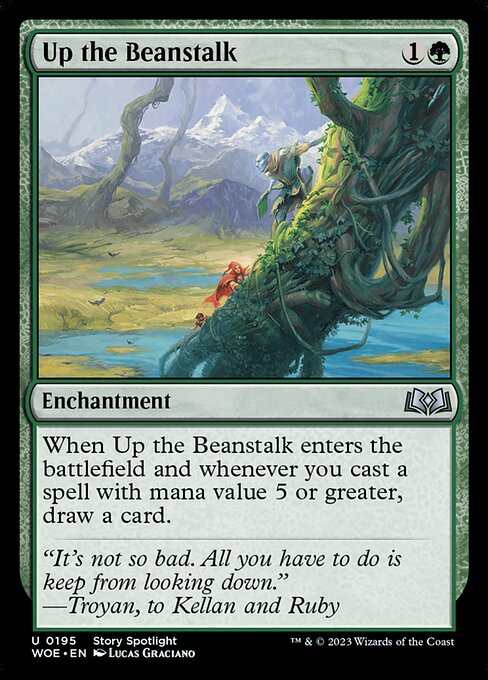
Up the Beanstalk is the golden pig of this draw suite. It enters and draws a card immediately, then draws for every mana value 5 or greater spell you cast, so every cascade hit draws you a card. Two mana, and it triggers off the free spells your cascade chains produce. No other draw engine in the deck does that kind of work for that little investment. This is a non-negotiable include.
Garruk's Uprising covers a different axis. Each creature with power 4 or greater that enters draws a card, so cascade hits that land creatures pay you even when those creatures don't hit the mana value 5+ threshold. It also gives your whole board trample. Three mana sits right at the cascade-trap ceiling, so this gets a pass on that technicality.
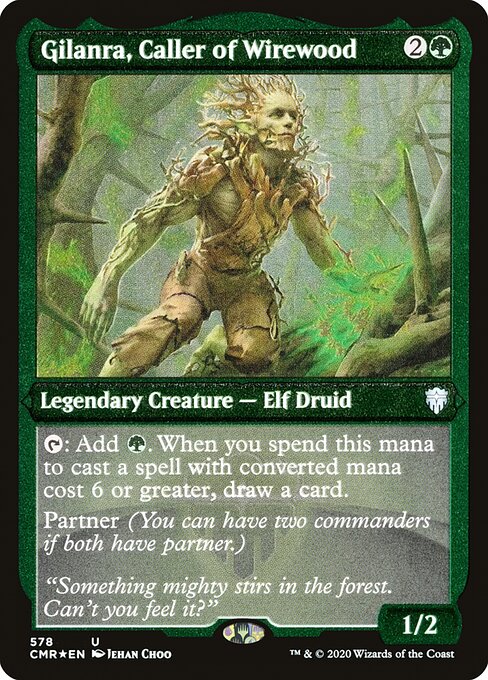
Gilanra, Caller of Wirewood draws a card whenever you spend her mana on a mana value 6+ spell, bridging ramp and draw in a single body. Treasure Cruise and Dig Through Time are the other non-negotiables: listed at mana value 8 on both, but delve drops them to a fraction of that cost, and they cascade into something mana value 7 or less while drawing three cards or selecting two. The draw and the chain for next to nothing. Run both.
Rishkar's Expertise is the haymaker. In a deck where your creatures regularly have power 8 to 12, this draws you eight to twelve cards and casts something free. It's technically mana value 6, triggering Imoti's cascade. Hit it off a free cascade and you draw your deck.
The Removal Suite: Answering the Board Without Polluting Your Curve
Here is an honest problem with Imoti: efficient spot removal lives in mana value 2 through 4, which is exactly the cascade-trap zone. The deck does not run the equivalent of a two-mana removal spell. This is a known, real weakness. If your meta has fast aggro commanders or combo that assembles on turn four, Imoti is going to struggle to interact, and you should know that going in.
The solution is removal baked into your mana value 6+ creatures, cards that answer the board when they arrive and trigger Imoti's cascade on the way in.
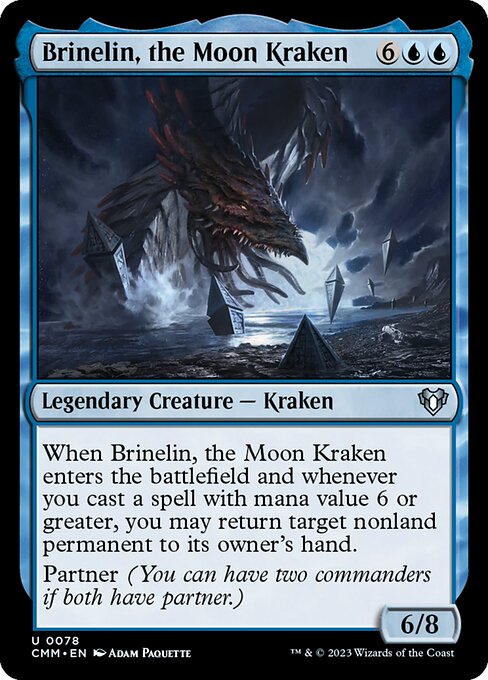
Brinelin, the Moon Kraken is the deck's repeating removal engine. Every mana value 6 or greater spell you cast bounces a permanent with lower mana value to its owner's hand. In a big-spell turn where you chain four spells, Brinelin generates four bounces. Chaining them while you're already winning clears the most dangerous things on the board at the same time.
Kogla, the Titan Ape fights a creature when it enters, then destroys an artifact or enchantment each time it attacks. Mana value 6, triggers Imoti, handles multiple threat types across multiple turns. That is what correct removal looks like in this deck: slow, expensive, attached to a body that does something else.
Terastodon destroys up to three noncreature permanents at mana value 8. The 3/3 tokens it hands your opponents are a real cost, that's not nothing. But cascading into Terastodon for free and keeping a 9/9 makes the exchange worth it in almost every board state where it matters.
Hullbreaker Horror is the most versatile answer in the suite: uncounterable, flash, and bounces spells or permanents every time a spell resolves on your side. Protection, removal, and disruption on one body. Drop it during someone else's turn and the table recalculates immediately.
Fierce Empath warrants inclusion despite the cascade-trap rule. Three mana, tutors any creature with mana value 6 or greater directly to hand. In a deck built on mana value 6+ creatures, it is effectively finding whatever removal creature or finisher you need in the moment. The cascade risk is real. The consistency payoff is worth it.
Your Win Conditions: How the Deck Actually Closes Games
Imoti does not win by assembling a two-card combo. She wins by cascading into enough power that the combined board state becomes insurmountable. Here are the three realistic ways that happens.
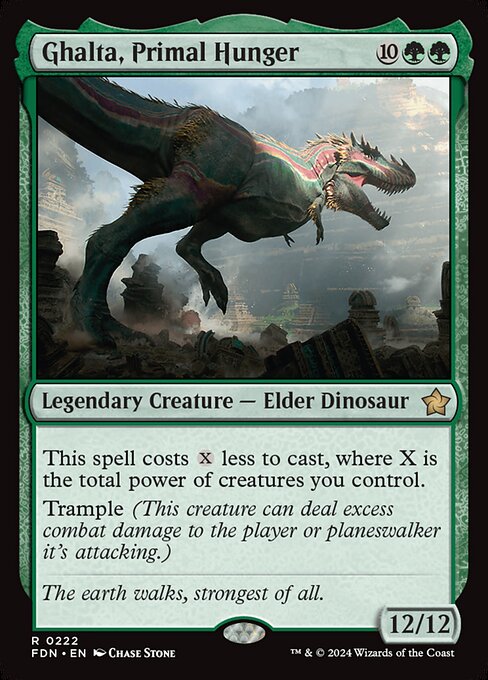
Combat with a pumped board. The cascade chain deploys Ghalta, Primal Hunger, Craterhoof Behemoth, and Goreclaw's trample grant in the same turn sequence. Ghalta costs essentially nothing in a deck full of large creatures, the total power you control subtracts from its twelve-mana cost. Craterhoof enters, pumps everything, grants trample. Multiple bodies with double-digit power and trample across a three-player pod ends the game in one combat step.
Extra-turn chains. Temporal Trespass has a mana value of eleven. Through delve it costs one or two mana. Cascade reads eleven, so it hits almost anything in the deck. Chain Temporal Trespass into another big spell, take your extra turn, cast another big spell with cascade, chain again. Two or three extra turns and the game is over before opponents can untap to respond. This is the most degenerate line the deck has, available for nearly nothing once the graveyard is loaded.
Cascade snowball through Apex Devastator and Annoyed Altisaur. The Devastator cascades four separate times off one spell. The Altisaur gets cascade from Imoti's grant and has native cascade, so casting one copy produces two separate triggers off a single mana value 7 spell. A turn where the Devastator lands four chains, each hitting a mana value 6+ creature, can put six to eight permanents into play at once.
Kodama of the East Tree functions as a secondary engine underneath all of this: every permanent entering the battlefield from cascade lets you put another permanent with equal or lesser mana value from your hand directly into play. Those hits become a chain of free permanents even without additional cascade triggers firing. Kodama turns the deck's volume into a free-permanent engine on top of everything else.
The Delve and Emerge Package: Cheating the Cascade Rule
This is the section that separates pilots who understand Imoti from pilots who have read her card text. Cascade reads the printed mana cost, not what you paid. Not what you could have paid. Not what you reduced it to. The number printed in the top right corner of the card. Every card in this package exploits that rule.
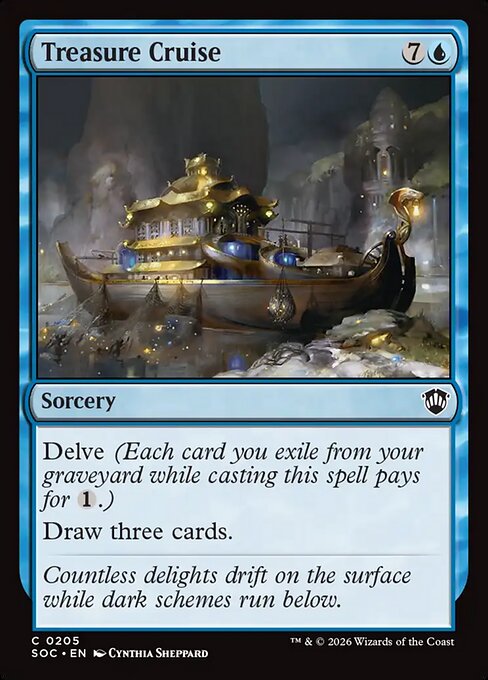
Treasure Cruise costs eight mana printed. Delve brings what you pay down to one. It counts as a mana value 8 spell for cascade, so Imoti cascades into something mana value 7 or less. One mana, three cards, and a free spell off the top. This is not a close call, Treasure Cruise is one of the two or three most important cards in the entire archetype.
Dig Through Time tells the same story at mana value 8: a couple mana after delve, but instead of draw-three you look at seven cards and keep two. More selective, slightly more expensive, still fires the full cascade sequence. Run both. For cascade purposes they function identically, but they attack the problem from different angles: raw draw versus targeted selection.
Temporal Trespass escalates the trick to an eleven. Printed mana value 11. Delve brings the actual cost down to almost nothing. Cascading off an eleven means Imoti can hit virtually anything in the library. Take an extra turn and do it again. The deck is not supposed to have this effect at this price, and that's exactly why it's here.
Wretched Gryff has a printed mana value of 7. The emerge cost can reduce what you pay to a single blue mana if you sacrifice a large enough creature. Draws a card on cast, flies, and registers with Imoti's cascade as a mana value 7 spell. Budget under fifteen cents and it performs like a premium include every time it hits the table.
Nulldrifter is the evoke payoff at mana value 7. Pay its evoke cost of two blue, it enters, draws two cards, then gets sacrificed. You drew two cards, triggered Imoti's cascade as a mana value 7 spell, and yes, the creature immediately dies, that's the deal, and it's still a good one. At a dime, it does honest work.
The Monstrous Vortex Layer: Discover on Top of Cascade
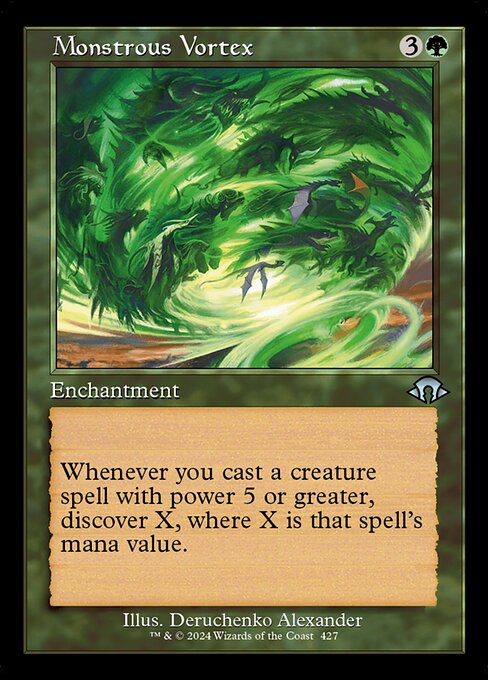
Here is a gotcha moment that most Imoti decks are not set up to take advantage of yet: Monstrous Vortex stacks a discover trigger on top of Imoti's cascade grant. In a deck where almost every creature has power 5 or greater, you are frequently getting two separate chain triggers off a single creature spell, cascade from Imoti and discover from Monstrous Vortex at the same time.
Discover differs from cascade in one key way: you can put the discovered card into your hand instead of casting it. That choice is enormous. Cascade forces you to cast what you hit, which can sometimes cascade into something awkward if the chain isn't set up right. Discover lets you pocket the piece for a later turn. Once cascade is already running, discover becomes a way to route cards where you actually want them rather than gambling on the chain.
Chimil, the Inner Sun is colorless, costs six mana, and makes all your spells uncounterable on its own, that protection has nothing to do with Imoti. What Chimil adds on top is a free look at your library every single end step, discovering 5 regardless of what else is on the battlefield. It keeps functioning through commander tax and removal without caring whether Imoti is in play. That's a persistent engine, not a support piece.
Annoyed Altisaur from Modern Horizons 3 deserves a second callout here: Imoti grants it cascade, and the Altisaur already has its own native cascade. One mana value 7 spell, two chain triggers off the same cast. Stack Monstrous Vortex on top of that and a single creature becomes three separate cascading events, which is exactly the kind of redundancy this layer is designed to exploit.
How to Build It: Budget Cascade vs. Fully Loaded
The budget build and the premium build of Imoti are not the same deck at different power levels. They are two different expressions of the same architecture, and the budget version is not worse, it is tighter.
In a budget build running $50 to $80, you replace Craterhoof Behemoth (runs you about twenty dollars) and Temporal Trespass with Artisan of Kozilek and Maelstrom Colossus. Artisan returns a creature from your graveyard on cast and carries annihilator 2, a win condition that grinds value across multiple turns rather than closing in one combat step. Maelstrom Colossus is a mana value 6 cascade trigger that costs next to nothing and fills the curve cleanly.
Budget constraints force a purer curve. You cannot lean on expensive tutors or high-priced finishers to paper over sloppy deckbuilding, so the bipolar mana value distribution has to be cleaner. That discipline produces a more consistent list. Scarcity sharpens the architecture.
The premium build adds Craterhoof for the instant-win combat turn, Temporal Trespass for extra-turn chains, and potentially Omniscience as a cascade hit that removes mana cost from every subsequent spell. Once Omniscience is on the battlefield and you are cascading, every hit casts for free. That is a different ceiling than the budget version, but it takes more money and a slightly different curve to support it.
The third direction worth naming is the Gilanra, Caller of Wirewood partner build. Gilanra acts as early ramp, draws a card whenever you spend her mana on a mana value 6+ spell, and opens a line where the command zone itself fuels your draw engine from turn two onward. The command zone doing double duty as ramp and draw is a different game plan entirely, and the Gilanra version passes the longevity check because her role changes as the game develops.
Maelstrom Wanderer is the commander comparison players always raise. It has double cascade natively at mana value 8 but locks you into three colors and cannot grant cascade to your other spells. Imoti scales better in a dedicated Simic list because the cascade grant applies to everything in your deck, not just one card. Wanderer is bigger and flashier. Imoti builds a better architecture.
Build this if you enjoy deckbuilding puzzles where one rules interaction, printed mana value versus paid mana value, makes you dramatically better than the average pilot. Build this if you want a deck where the constraint does the design work: where the bipolar curve forces every card choice to be deliberate, and where a fully loaded turn with Monstrous Vortex active and the graveyard stocked for delve is one of the most explosive sequences in Simic Commander. I have seen a four-player pod stare at an Imoti cascade chain on turn six and silently start doing math on how to stop what was clearly not going to be stopped.
Skip this if you want to interact meaningfully on turns 2 through 4, if your meta is heavy on fast combo that kills before turn 6, or if you dislike variance in your hit sequencing. The floor on Imoti without ramp discipline is a slow, clunky pile that gets outpaced by commanders with better early-game presence. The cascade trap is real and unforgiving: one bad curve construction and your sequencing ends on a three-mana sorcery instead of a seven-mana threat.
Spending big is optional here in a way it rarely is for competitive-leaning archetypes. Artisan of Kozilek is under fifty cents. Wretched Gryff is a dime. Annoyed Altisaur is around a dollar. Nulldrifter is a dime. These are cards that perform at a premium level and cost next to nothing. You do not need to spend big to build this right.
Imoti is not a "big stuff" deck that happens to have cascade. She is a cascade engine with a strict deckbuilding ruleset, and players who treat her as the former will always underperform players who treat her as the latter. The players who understand the mana value interaction, who cut their mana value 3 acceleration spells, who know that Treasure Cruise is secretly an eight-drop, those players are running a fundamentally different and better deck than everyone else at the table, and they built it for thirty dollars. Thinking harder than your budget produces better results than spending more money and thinking less. That is what Imoti rewards, and it is why she is worth building.
Your call. But at thirty-two cents for the commander herself, the cost of being wrong is not the concern.