Can Legendary Artifacts Be Commanders? What CR 903.3 Actually Says
Most players know one of the three eligibility categories. The other two are where LGS disputes happen.

The Word "Legendary" Is Doing Almost No Work Here
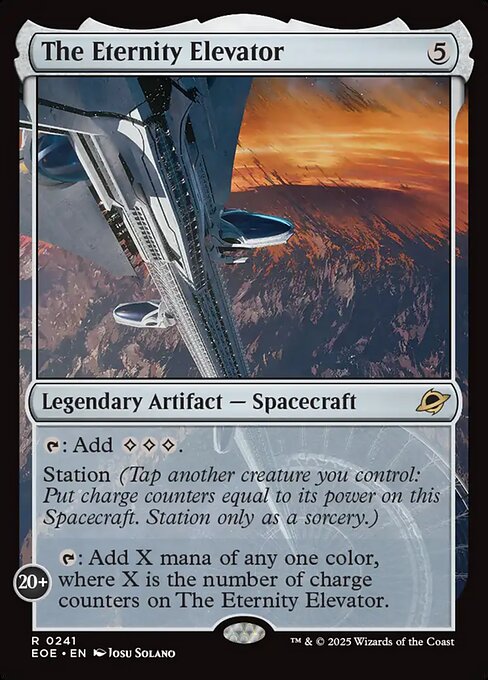
The concrete failure looks like this: you show up to a Commander night at your LGS with The Eternity Elevator sitting in the command zone. You read the type line. It says Legendary Artifact. Spacecraft. You figured that was enough. It isn't, and you find out mid-game in front of strangers who are now explaining the rules to you. The error happened at deckbuilding time; the consequence arrives publicly.
Most players have absorbed a simplified version of what makes something eligible to lead a deck: legendary cards can be commanders. That summary isn't wrong exactly, but it's missing two-thirds of the relevant information. "Legendary" is a prerequisite, not a sufficient condition. "Artifact" is irrelevant to eligibility entirely. CR 903.3 cares about three specific card-type combinations, and most players can name exactly one of them.
Wizards' own format overview pages have contributed to this by defaulting to creature-type framing in their introductory coverage, which trained an entire generation of players to treat creature-ness as the operative criterion. The rules have been updated. The introductory coverage has not kept pace. That gap is where LGS disputes happen.
Quick Answer
Under CR 903.3, a legendary artifact can be your commander if it meets one of three conditions: it is a Legendary Artifact Creature, it is a Legendary Vehicle (with or without a printed power/toughness box), or it is a Legendary Spacecraft with a printed power/toughness box. A legendary rock, legendary piece of equipment, or legendary enchantment-artifact fails all three. The "artifact" card type is doing zero eligibility work. Rules text that explicitly says "can be your commander" opens a fourth path, but that category is outside the scope of this article.
How the Rules Got Here: Three Eras of Commander Eligibility
Before 2022, the answer was simple and almost entirely accurate: your options were legendary creatures plus roughly 21 specific planeswalkers carrying explicit printed permission in their rules text. That population covered nearly everything. One era. Clean data.
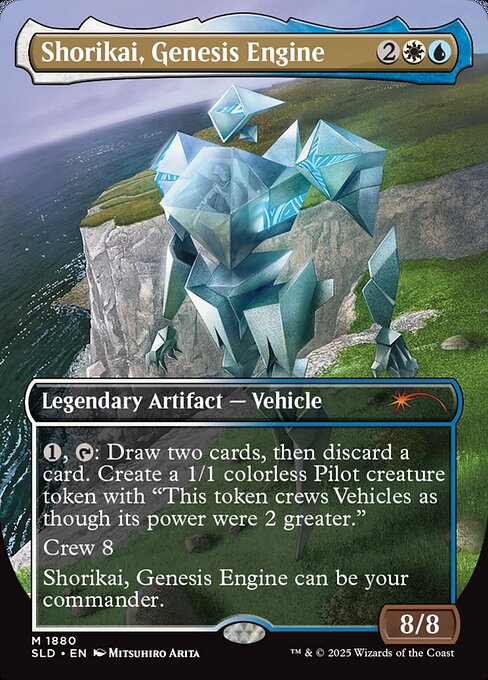
2022 introduced Shorikai, Genesis Engine. One card. It is a Legendary Artifact Vehicle, the first of its kind eligible to lead a deck, qualifying because it is a Vehicle. The eligibility criterion for Vehicles has never required a printed power/toughness box. That distinction matters, and I will come back to it.
The Edge of Eternities rules update extended eligibility to all legendary Vehicles and all legendary spacecraft carrying a printed power/toughness box, adding over 20 new options immediately. That is the current state of the rule.
The information problem is this: the plurality of articles covering whether a given artifact qualifies were written between 2022 and the Edge of Eternities update. They accurately reflect the Shorikai era. They do not reflect the current one. A player searching this question today has a high probability of landing on a two-step-old version of the rule. The correction is in CR 903.3. It is not in most search results. That asymmetry is the entire reason this article exists.
The Three-Tier Test: A Checklist That Takes Ten Seconds
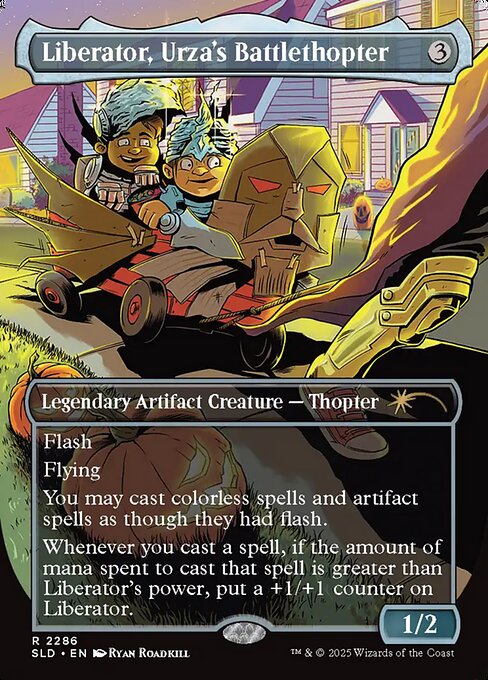
Run these three questions in order. One "yes" makes the card eligible.
- Q1: Does the card's type line include "Creature"? If yes, legal. This covers every legendary artifact creature in the game, regardless of other subtypes.
- Q2: Does the card's type line include "Vehicle"? If yes, legal. No further check required. Vehicles are eligible as commanders by virtue of being Vehicle cards.
- Q2b: Does the card's type line include "Spacecraft"? If yes, check for a printed power/toughness box. Box present: legal. No box: not legal.
- Q3: Does the card text include "can be your commander"? If yes, legal.
Applied to three cards from the allowed list:
Liberator, Urza's Battlethopter has "Artifact Creature" on its type line. Q1 hits immediately. Nothing else to evaluate.
Heart of Kiran is a Legendary Artifact Vehicle. Q2 makes it eligible. The printed 4/4 in its power/toughness box matters for gameplay, but it has nothing to do with eligibility. The Vehicle subtype is doing all the work here.
The Eternity Elevator: Legendary Artifact. Spacecraft. Q1 is no, Q2 is no, so Q2b applies, check for a printed power/toughness box. There is none. Not eligible.
Elbrus, the Binding Blade is worth walking through carefully. Its front face is a Legendary Artifact Equipment: not a Creature, not a Vehicle, not a Spacecraft, no relevant card text. Fails all three checks. The back face is a legendary Demon Creature, which sounds promising until you remember that front-face typing governs eligibility for double-faced cards under standard rules, and that back face never enters the conversation. Rule 0 is the only path in.
Artifact Creatures Are Legal. But Not Because They're Artifacts
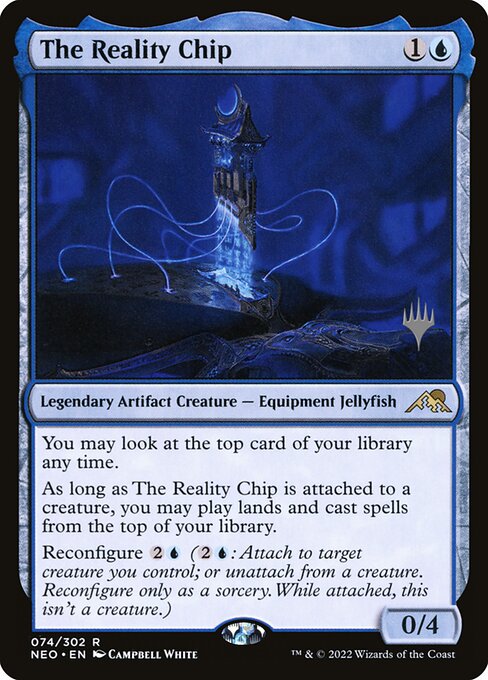
Start from first principles. The type line on The Reality Chip reads Legendary Artifact Creature. Equipment Jellyfish. The word doing actual eligibility work is Creature. Artifact does not appear in CR 903.3's conditions at all. It is not the operative term. Strip the artifact subtype out entirely and the card is still a valid commander because it is still a Legendary Creature.
This matters for Reconfigure specifically. When you activate Reconfigure and attach The Reality Chip to a creature, it stops being a creature on the battlefield, becoming an Equipment instead. Whether it qualifies to lead a deck is evaluated at deckbuilding time, not at the moment you make that choice. The card goes in the command zone as a Legendary Artifact Creature, and what happens to it during gameplay does not retroactively change whether it was legal to put there in the first place.
Urza, Lord High Artificer is eligible as a commander because he is a Legendary Creature. His text box is full of artifact payoffs, tapping artifacts for blue mana, the five-mana ability that shuffles your library and lets you play the top card for free that turn, but none of that is why he clears the bar. He clears it because "Creature" is on his type line. The artifact synergies are about power level, not legal standing.
Emry, Lurker of the Loch works the same way. Legendary Creature. Legal to command. The affinity clause and the mill-four ETB are why she's interesting as a commander, not why she qualifies as one.
Players who correctly understand that artifact creatures can be commanders sometimes generalize from that to assume other legendary artifacts work the same way. They don't. The category is a Legendary Creature that happens to be an artifact, not a legendary artifact that somehow gets creature-adjacent treatment.
The Eternity Elevator Confusion: When Wizards Moved the Goalposts
The Eternity Elevator is the cleanest case study for how a rules announcement creates an information asymmetry that outlasts the correction.
The timeline: Wizards announced, in the initial Edge of Eternities coverage, that legendary spacecraft would be eligible as commanders. That statement reached a large population of players. Then a clarification arrived: a legendary spacecraft with a printed power/toughness box is eligible. The Eternity Elevator has no printed power/toughness box. It is a Legendary Artifact, a Spacecraft with a Station ability and a conditional mana tap. It is not eligible under the clarified rule.
Corrections propagate more slowly than original announcements in MTG coverage, this is not speculation, it is the observable pattern across every rules update cycle. Players who read the first wave of Edge of Eternities spoiler coverage got one answer. Players who checked after the clarification got a different answer. The gap between those two populations is exactly where LGS disputes happen, and exactly where someone shows up with The Eternity Elevator in the command zone having done reasonable due diligence and still gotten it wrong.
The contrast is instructive. RMS Titanic is a Legendary Artifact. Vehicle. Eligible commander. Skysovereign, Consul Flagship is a Legendary Artifact, Vehicle with a printed 6/5. Also eligible. Both clear the Vehicle bar without any power/toughness check required. The Eternity Elevator needed to be a Spacecraft with a printed power/toughness box to join them. It has neither. Find the power/toughness box on any Spacecraft you are evaluating. If it is not there, the card is not eligible.
Rule 0 Covers the Rest. With a Catch
The conventional wisdom is correct as far as it goes: Commander is a social format, your playgroup can agree to anything, and Rule 0 covers a lot of ground. But "correct as far as it goes" is doing significant load-bearing work in that sentence.
Rule 0 requires explicit pre-game consent. Assuming consent is not the same as having it. With your regular pod, people who have played with you for two years and know your decks, a mutual understanding might reasonably exist without a formal negotiation. Sit down at an LGS Commander night, a game store event, or a pod of strangers, though, and there is no pre-existing understanding, no baseline assumption, and no shortcut that replaces a thirty-second conversation before anyone shuffles. Showing up with The Eternity Elevator or the primary face of Elbrus, the Binding Blade as your general at a public event and citing Rule 0 is not invoking a rule. It is asking for a favor after the game has started, which is a meaningfully worse position to be in.
The cards that most often need Rule 0 conversations: legendary rocks, legendary equipment like Elbrus's binding side, legendary ships without p/t. These are the cards that feel like they should be eligible, they have flavor, they have power, they read like build-arounds, but they fail the CR 903.3 checklist. The practical script before shuffling up: "I want to run [card] as my commander, does everyone agree?" That conversation takes fifteen seconds and eliminates every dispute before it starts.
Knowing which CR 903.3 category your commander falls into also tells you when you need that conversation. Passes the checklist, no conversation required beyond normal social courtesy. Fails it, Rule 0 is the only path. The distinction is binary.
The Ruling in One Sentence, and the Build Style That Breaks It
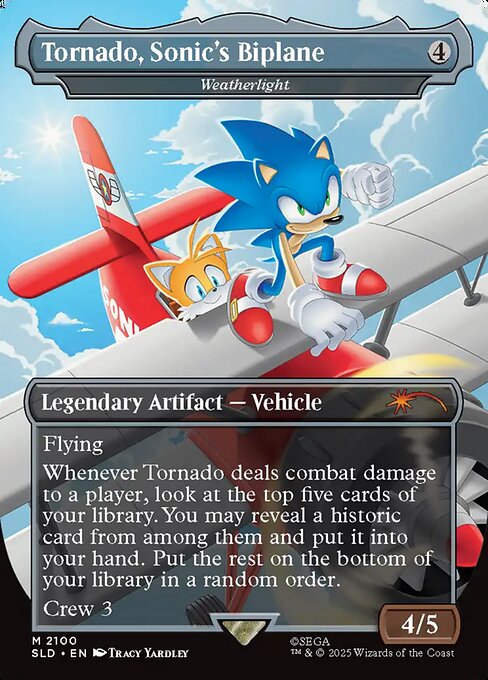
The complete answer fits cleanly: a legendary artifact is a valid commander if its type line includes Creature, if it is a Vehicle, or if it is a Spacecraft with a printed power/toughness box, and a fourth path exists via explicit card text, which is its own separate mechanism. That is the whole rule. CR 903.3 is not ambiguous. The confusion in the community is a coverage and communication failure, and those require different solutions.
The Eternity Elevator's exclusion is a design-communication error. A legendary spacecraft printed without a p/t box was always going to create exactly this situation once spacecraft became commander-eligible. The rules made a sensible distinction: spacecraft that function as creatures have p/t boxes, spacecraft that don't function as creatures don't. But printing a flagship entry for the type in the same release that introduced the eligibility rule, without a p/t box, was an avoidable education problem. The gameplay asymmetry may have been intentional. The confusion was not.
The ten-second check works like this: read the type line left to right, Legendary [card type], [subtype]. A Creature subtype clears it immediately. Vehicle does the same. Spacecraft sends you to the p/t box, and either it's there or it isn't. Weatherlight, The Indomitable, RMS Titanic are all Vehicles, all eligible, no further evaluation needed. The Eternity Elevator is a spacecraft without a p/t box, which puts it on the wrong side of that line.
The build style where conventional wisdom consistently breaks down: pure artifact-tribal players whose ideal commander is a legendary mana rock or a piece of legendary equipment. These players need Rule 0 conversations, not rules workarounds. The rule is not wrong for excluding those cards. Knowing that before deckbuilding is the difference between a clean game and an awkward mid-game correction.