Best New Commanders from Secrets of Strixhaven
All 20 new legendary creatures from Secrets of Strixhaven ranked worst to best, with honest takes on which commanders are sleepers, which are traps, and why

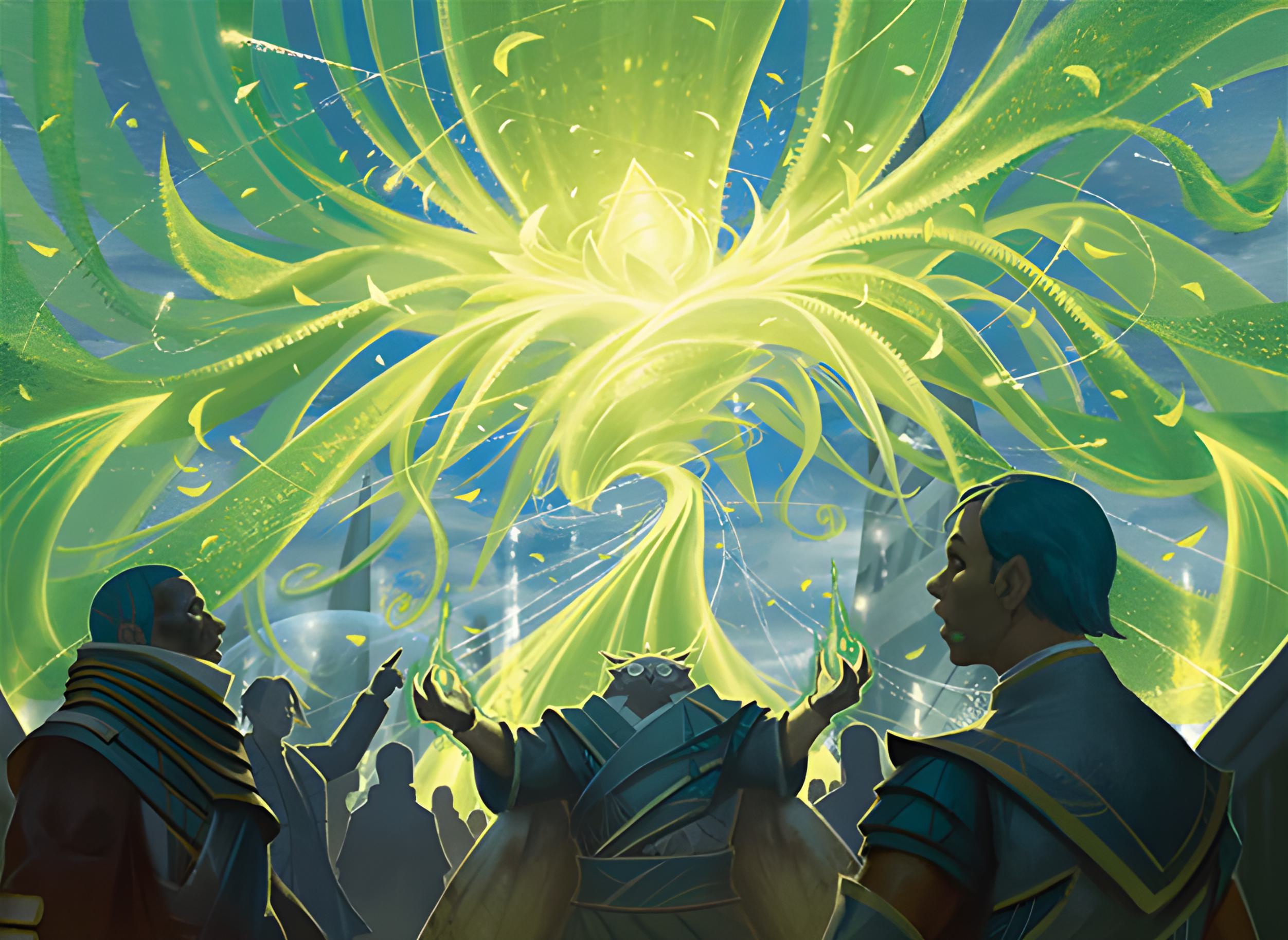
Secrets of Strixhaven brought back the college Elder Dragons, a pile of returning-student legends, and one commander so good it immediately made Harmonic Prodigy a $15 card. Not all twenty are worth your time, but a few are genuinely among the best commanders printed in years.
How We're Ranking These Commanders
Elder Dragons, two-drop legends, everything from Secrets of Strixhaven is here, ranked worst to best: #20 is the biggest disappointment in the set, #1 is the commander you should actually build.
Popularity is a data point, not the verdict. A 126-deck commander with a broken unique effect outranks a 4,000-deck commander that's just fine. The criteria are power ceiling, how uniquely the card enables a focused strategy, and how much genuine gameplay depth lives inside the card. Some of these are genuinely bad and this article is going to say so. Others are sleepers that the community is massively sleeping on. Let's get into it.
Orysa, Tide Choreographer (#20).

Page, Loose Leaf (#19).

Nita, Forum Conciliator (#18)

Aziza, Mage Tower Captain (#17) has the same structural problem: tap three untapped creatures to copy an instant or sorcery. Spellslinger decks don't run enough creatures to reliably tap three. Go-wide creature decks don't care about copying spells. The deckbuilding tension pulls in two directions and resolves into an awkward hybrid that does neither thing well.
Of the three,
Mica, Reader of Ruins (#16)

Moseo, Vein's New Dean (#14)

Zimone, All-Questioning

Magic has printed a lot of strange card text over the years. Banding. Lure. That one card that cares about the number of times you've shuffled. But "create a token if you control a prime number of lands, sized to that prime number" might be the most charmingly unhinged trigger condition I have ever read. A 0/0 Fractal sized to how many lands you have, but only if that land count hits 2, 3, 5, 7, 11, 13, 17, 19, 23, 29, or 31. The concept is great. The execution is a frustrating engine to rely on.
The dead zones are the problem. No trigger at 4 lands. No trigger at 6, 8, 9, 10, 12, 14, or 15. In a typical mid-game where you're hitting five to ten lands, you'll get triggers at 5 and 7, then go cold for five straight land drops. When the trigger fires at 11 or 13 lands, you're making a huge Fractal, but you're also deep enough in the game that a single 11/11 rarely closes things out on its own.
Deekah, Fractal Theorist pairs naturally here: every instant or sorcery cast creates another Fractal token via magecraft, which gives you board presence between the prime-number triggers. Seedborn Muse untaps your lands on each opponent's turn, which doesn't directly help the land-count trigger but does let you activate abilities repeatedly and hold up interaction. The issue is that this competes for a Simic slot with Zimone, Infinite Analyst, which is a much more consistent engine. Zimone All-Questioning works in the 99 of land-matters builds just fine. As a commander, she's too inconsistent to recommend confidently.
Deceptively mid ceiling.
Muddle, the Ever-Changing

There is a specific silence that falls over a pod when someone taps their three-mana otter and says "I'm going to become a copy of that Torrential Gearhulk, and it has myriad." The silence isn't confusion, it's everyone realizing simultaneously that they have no answer prepared for this.
Muddle is the funniest commander in the set and also a genuinely powerful one. Whenever any instant or sorcery resolves, Muddle becomes a copy of any nonlegendary creature you control until end of turn, and it picks up myriad. So it attacks as that creature, then the myriad tokens also attack every other opponent. Target Mulldrifter? Your Muddle attacks as a 2/2 flyer with myriad, creating a copy attacking each opponent. That's draw-two triggers for every opponent you're swinging into. Target Torrential Gearhulk? Each myriad token recasts an instant from your graveyard as it attacks. For a four-mana commander, that's pretty cracked.
The build tension is real, though. You need high-value nonlegendary creatures to copy, which pulls against the spell-heavy shell that makes Muddle trigger consistently. The myriad tokens exile at end of combat, so you're not building a persistent board, the value is per-attack, every attack. That's still a lot of value, and the right 99 makes it work, but assembling that 99 is the actual puzzle this commander asks you to solve.
Witherbloom, the Balancer

Yes, it costs eight mana. Yes, BG is not a spellslinger color pair. Yes, building around a card that requires creatures in play to reduce spell costs while also wanting to cast big spells that often involve those same creatures creates a real tension. The weaknesses are real, but none of them close the door on the card.
With six or more creatures in play, Witherbloom costs exactly {B}{G}. Six creatures in a Golgari creature shell is a modest board state by turn four or five. And affinity for creatures on your spells means Exsanguinate, Genesis Wave, Torment of Hailfire, and Finale of Devastation all get the same discount. You run enough creatures to reduce your commander to a couple pips, and now your X-spells are casting for a fraction of their face cost. Exsanguinate for X=8 becoming dramatically cheaper with ten creatures in play is not a fair transaction.
Where it falls apart: creature counts fluctuate. Wraths happen. You drop below the threshold right when you want to fire off the big instant or sorcery. And BG doesn't have the spell redundancy to rebuild the engine quickly after a wipe. The dream build here leans into Beledros Witherbloom for untap effects and Dina, Soul Steeper for drain payoffs, a creature-dense, life-drain-fueled shell that casts free haymakers once the board fills up. The upside is high. The floor is rougher than players admit. Just don't pretend it's consistent.
Deceptively high ceiling.
Killian, Decisive Mentor
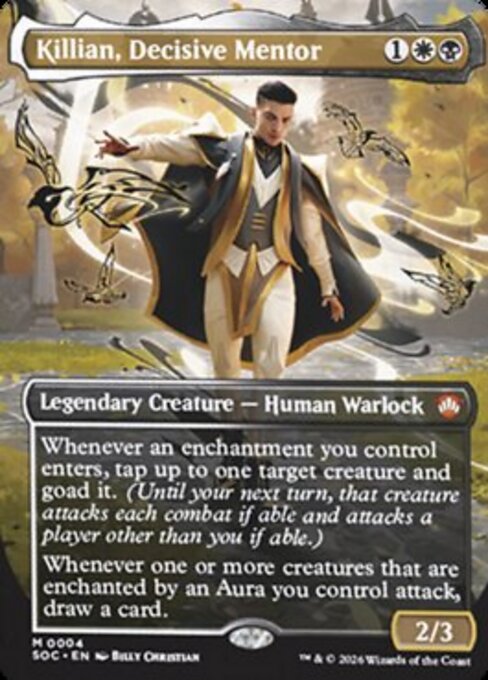
Sram, Senior Edificer draws a card when you cast an Aura. Kor Spiritdancer draws a card when you cast an Aura. Killian draws a card when an enchanted creature attacks, which is strictly slower than the on-cast trigger, but that's not the comparison that matters. Neither Sram nor Kor Spiritdancer taps your opponent's Blightsteel Colossus and makes it attack someone else.
The goad effect on enchantment ETB is unique in a way that's hard to replicate elsewhere. Every time an enchantment enters under your control, you tap a creature and goad it. Ghoulish Impetus enchants an opponent's creature, goads it as the Aura enters, and then goads it again whenever that creature attacks, and if it dies, the Aura returns to the battlefield. Eriette of the Charmed Apple makes enchanted creatures unable to attack you. Pearl-Ear, Imperial Advisor reduces the price of your enchantment spells. The BW enchantress infrastructure is deep and it builds around Killian in a way where every piece is pulling in the same direction, not just "pile of Auras."
In a four-player game, if you have enchanted creatures on three different opponents, Killian draws you up to three cards per attack step. That's not a slow draw trigger. It's the kind of engine that quietly takes over a game while your opponents are busy hitting each other. You want a mix of Auras that hit your own creatures for the power buff and Auras that hit opponent creatures for the political control. Pearl-Ear handles the cost efficiency side. The build is more interesting than the card suggests.
Underplayed political powerhouse.
Lorehold, the Historian
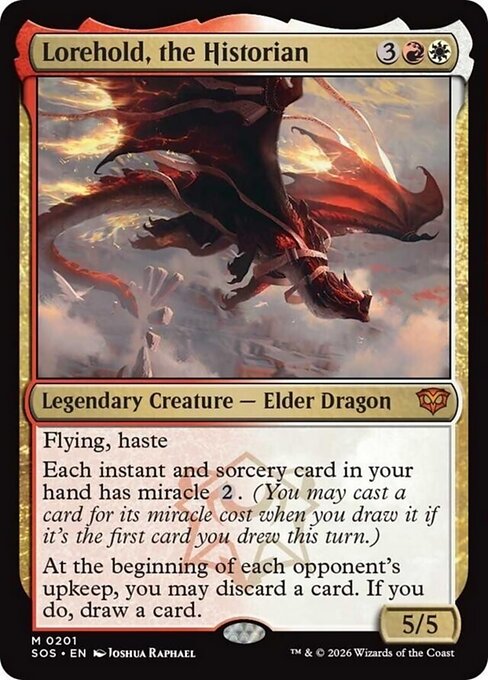
It's your opponent's upkeep. Lorehold lets you discard a card and draw a card. Then your next opponent's upkeep arrives. Same thing. Three loots each round in a four-player game, each one creating a window where the card you just drew has miracle two. Every. Single. Instant. And. Sorcery.
Let that sink in. Time Stretch has miracle two. You draw it, you have priority, it costs two mana right now on someone else's upkeep. Savage Beating has miracle two, cast it during your turn for one mode (double strike or an extra combat phase), pay the entwine cost of one generic and one red to get both. Mnemonic Deluge has miracle two: exile a spell from a graveyard, copy it three times, cast the copies without paying their mana costs. That's a nine-mana sorcery as a two-mana miracle target.
You need a high density of instants and sorceries, ways to hold up two mana on opponents' turns for the miracle windows, and enough loot redundancy to keep cycling through the library fast. Five-mana 5/5 with flying and haste is a real body that pressures life totals. The miracle engine is more powerful than its current reputation suggests, and churning through a loot every upkeep means you're rarely stuck holding bricks. Lorehold snowballs out of control fast if nobody answers it. Surprisingly cracked.
Silverquill, the Disputant

Free casualty 1 on every instant and sorcery is one of the strongest single lines of text on a commander in this set. Full stop.
Casualty 1 copies the spell if you sacrifice a creature with power 1 or greater. Any 1/1 token qualifies. And this is where the engine gets busted: Sedgemoor Witch creates a Pest token every time you cast or copy an instant or sorcery. Monastery Mentor creates a Monk token with prowess every time you cast a noncreature spell. Both of these are in BW. Cast a spell, make a token, use that token to copy the next one via Silverquill's casualty, and the copy triggers Sedgemoor Witch again. Every spell is now two spells. Every copy makes another creature. The loop is self-sustaining as long as you have cards to cast.
Shadrix Silverquill creates Inkling tokens on your combat trigger, giving you more casualty fodder. Will of the Mardu creates warrior tokens equal to the number of creatures a player controls, copy it and suddenly you have a wave of bodies. BW also has access to the best tutors, wraths, and reanimation in the format, which means the spell suite is dense and consistent.
The 4/4 flying vigilance body is almost irrelevant at this point. A five-mana 4/4 that doubles every spell you cast is just busted. The community knows this is good but isn't building it at the rate it deserves. Self-sustaining spell machine.
Zimone, Infinite Analyst
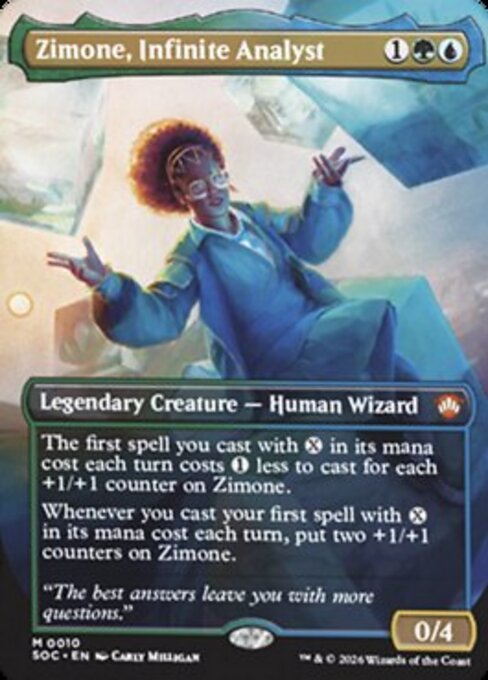
X-spell decks are one of the oldest Commander archetypes in the format. Pump X mana into something enormous, win. Simple. Clean. The problem has always been that X-spell commanders are usually just mana doublers or cost reducers that do their thing passively and don't interact with the game in interesting ways. Zimone breaks that pattern.
She's a two-mana 0/4 that puts two +1/+1 counters on herself every time you cast your first X-spell each turn. Then she costs one less to cast those X-spells per counter on her. After two X-spells across two turns, she has four counters. Your third X-spell costs four less. Your fourth costs six less. Pull from Tomorrow for X=7 becoming effectively free is not hypothetical, it's the turn-four or turn-five game state if you've been casting one X-spell a turn from the jump.
Unbound Flourishing is the all-star companion: it doubles the value of X for permanent spells AND copies instant or sorcery X-spells. With Zimone's discount, you're casting X-spells for dramatically less while getting doubled payoffs. Hydroid Krasis draws cards and gains life on cast, not on resolution, which means it still triggers through counters. Walking Ballista scales with counters. Hardened Scales puts the counter accumulation into overdrive. She's online at two mana before any opponent is ready for her, and by turns four or five the deck is just cracked.
She only triggers once each turn, so no chaining in a single sitting, but the exponential growth compounds fast enough that it doesn't matter. Run Zimone in Simic.
Quintorius, Loremaster

There is a feeling you get when you fire off a haymaker from Quintorius's activated ability and watch it go to the bottom of your library instead of your graveyard. Not relief. Not celebration. Something closer to satisfaction at a system working exactly as designed. Because it's coming back. It always comes back.
The engine is cleaner than it looks: at the beginning of each end step, Quintorius exiles a noncreature nonland card from your graveyard and creates a 3/2 Spirit. Every end step, without fail. Then you can spend one red, one white, tap Quintorius, and sacrifice a Spirit to cast whatever's exiled without paying its mana cost, and when that spell would hit the graveyard, it goes to the bottom of your library instead. You draw it again. You bin it again. Quintorius exiles it again. The cycle is resilient because it doesn't rely on your graveyard staying intact, the bottom-of-library bounce sidesteps graveyard hate entirely.
Savage Beating cast without paying its mana cost every two or three turns is game-ending in a combat-focused RW build. Will of the Mardu doubles your creature count and then some. Underworld Breach reloads the graveyard if Quintorius can't keep up with exile demand. The Spirit tokens build pressure alongside the free-cast engine, so you're threatening both a combat win and a spell engine at the same time. Competes with Quintorius, Field Historian for the Elephant Cleric slot, but Loremaster is the stronger commander by a significant margin.
Rootha, Mercurial Artist

Turn four. You have Rootha out. You cast Cryptic Command. Before it resolves, you activate Rootha: pay two mana, return Rootha to your hand, and copy the Cryptic Command on the stack. Choose new targets for the copy. Both resolve. You've countered two spells, drawn two cards, and bounced two permanents, or any combination, for a total of five mana. Then you recast Rootha for three mana. Your opponent untaps and has nothing.
That's the card. The bounce-to-hand is the price, and that price is what makes Rootha nuts. She resets. Cast her again. Next turn, she's available for another activation. Against interaction-light pods, you can chain this across multiple turns with cost-reduction effects and fast mana, generating a new copy of your best spell every single cycle. Fierce Guardianship with a commander in play becomes a free counter; copy it and you have two free counters. Underworld Breach gets her spells back from your bin to do it all over again.
The activation only costs two generic mana. In a deck with rocks and rituals that generates five-plus mana each cycle, Rootha is copying spells on a near-free basis. The community keeps writing about this commander, 46 separate pieces of content, but the actual build numbers haven't caught up to that interest. That's the signature of a sleeper the community respects but hasn't fully committed to. Build this. It goes off faster than opponents expect, and the board reset angle from bouncing Rootha gives you a pseudo-protection tool baked into the casting cost. Deceptively cracked.
Quandrix, the Proof

Six mana, needs protection, legendary creature. And yet: Quandrix gives every instant and sorcery you cast from your hand cascade. Not once. Not "the first one." Every. Single. Spell.
In a UG shell running Cryptic Command, Time Stretch, Mnemonic Deluge, and Seedborn Muse, each spell during your turn generates a free spell costing less. Then Seedborn Muse untaps your lands on each opponent's turn, giving you mana to cast spells during those windows, which also cascade. You're effectively drawing and casting two spells for every one. The deckbuilding puzzle is building your spell suite so cascade hits are consistently useful, which means cutting low-value spells below your average cost and making sure your cheaper spells are still worth resolving.
The 6/6 flying trample body is also a real clock. A 6/6 in the air is threatening on its own before you ever fire off a cascading spell. Protecting Quandrix is the ask, but Fierce Guardianship costs nothing with a commander in play and Simic has counterspell backup. Food Chain with Eternal Scourge or Misthollow Griffin is live here too for the combo-inclined: the engine generates infinite mana for creature spells, which you can funnel into something like Finale of Devastation at an absurd X value, even if it doesn't chain cascade triggers directly. This card doesn't get enough respect at any power level. The ceiling is very high.
Zaffai and the Tempests

This card is broken and nobody is talking about it. Once each of your turns, you may cast any instant or sorcery from your hand without paying its mana cost. Not "reduced cost." Not "if conditions are met." Without paying a single mana. Any one.
The floor is casting Cryptic Command without paying for it every turn. Four mana of value for zero investment. The upside is Time Stretch at no cost, two extra turns, no mana, just a seven-mana commander sitting on the battlefield. Mnemonic Deluge without paying mana: exile a spell from your graveyard, copy it three times, cast the copies without paying mana costs. In a UR shell with counterspell backup to protect Zaffai and recursion to keep loading up your hand with expensive spells, this becomes a game-ending engine by turn six or seven.
You want a high density of high-value instants and sorceries: the more expensive the spell you're casting without cost, the more mana advantage you're generating each turn. A hand full of four-and-five mana spells with Zaffai out is like having seven or eight extra mana to spend. UR has all the tools: cantrips to find the free-cast targets, counterspells to protect the commander, and enough spell recursion to reload after each free cast.
126 decks. That is a deeply embarrassing number for this effect. If you want to show up at a table with something nobody has seen built correctly, this is it. A free spell every turn will eventually be solved, and the player who builds it first will surprise every pod they sit down with. Biggest sleeper in the set.
Prismari, the Inspiration

Prismari is in play on turn seven. You fire off a cantrip. That cantrip now has storm, because Prismari gives every spell you cast storm, full stop. Two spells already this turn means the cantrip copies itself twice. Then comes Cryptic Command with four spells on the count. Four copies. You're countering four spells, drawing four cards, tapping every creature on the board four times over. Then Thousand-Year Storm. Your brain does not survive this.
Storm on every instant and sorcery is the complete sentence. Universal storm on a commander is the kind of text that ends games, warps tables, and makes opponents realize they should have killed it three turns ago. Ward, pay 5 life is genuinely protective in a multiplayer game: one opponent paying five life is tolerable, but two opponents paying five life each to kill Prismari means someone is at fifteen life before combat. At four players, killing this is a negotiation, not a decision.
Storm-Kiln Artist generates a Treasure for each copy that goes on the stack; in a high-storm-count turn, that's ten or twelve Treasures from a single spell chain. Galazeth Prismari taps artifacts to cast spells, turning your Treasure pile into raw mana. Early cantrips and rituals build the storm count, then the expensive haymakers land when the copies will actually be worth something. The seven-mana cost is real, but UR ramp spells and Treasures get there faster than you expect.
Under 3,000 decks is embarrassing. Storm on every spell should put this in the top 200 commanders in the format. It's not there yet. Build it now before everyone figures it out. Criminally underplayed.
Veyran, Voice of Duality

You drop Veyran on turn three. You watch your opponents read the card. You watch the moment where they get to "that ability triggers an additional time" and you see it register. The one at the end of the table with the Rhystic Study deck slowly puts down his mug. The Sultai player looks at the board. Nobody attacks you that turn. That's when you know the card is doing its job.
Veyran doubles every triggered ability from your permanents whenever you cast or copy a spell. Not just Veyran's own magecraft. Everything. Guttersnipe deals 2 damage to each opponent each spell, with Veyran out, that's two triggers, 4 damage total. Archmage Emeritus draws one card per spell, with Veyran, that's two triggers, 2 cards. Storm-Kiln Artist makes one Treasure per spell, with Veyran, two Treasures. Young Pyromancer makes one 1/1 per spell, with Veyran, two tokens.
And then there's Harmonic Prodigy. Harmonic Prodigy adds an additional trigger instance for Wizard and Shaman abilities. Veyran adds one. Guttersnipe is a Goblin Shaman. With all three in play, Guttersnipe triggers three times per spell, dealing 6 damage to each opponent on every cast. That closes a game in one or two turns from a full life total.
Multiple Veyrans via Helm of the Host or Mirror Box are additive: per the official ruling, two Veyrans cause abilities to trigger three times total, three Veyrans cause abilities to trigger four times total. Linear, not exponential. But even the additive version with a pair of Veyrans and Harmonic Prodigy running gets Guttersnipe to four triggers. That's 8 damage per opponent. Per spell. At instant speed.
I've cast a single cantrip on turn five with Veyran, Harmonic Prodigy, and Guttersnipe in play and watched a player go from 27 life to 3. Three opponents. Three. One cantrip. The table went quiet in a way I have only experienced a handful of times. That is the card working. That is why Harmonic Prodigy is $14.99.
Cheaper than any other top commander in this set by a significant margin. A real threat that grows as a combat attacker. The card you build around that rewards tight construction with explosive payoffs. No questions.
The Rest of the Field
Seven other Strixhaven legendaries are technically eligible for a top-20 list and didn't make it past the bottom tier. Here's the quick verdict on each:
- Orysa, Tide Choreographer — A combat-trigger commander whose ability rarely lines up with how Commander games actually play out. Skip unless you're committed to a deeply specific tap-cheat shell built around her.
- Page, Loose Leaf — Reads like a value engine, but the conditional cost on the back side fires too rarely to anchor a deck. Better as a 99-card inclusion in spellslinger builds than at the helm.
- Nita, Forum Conciliator — Worse Rootha, Mercurial Artist. Copies spells with conditional cost that makes the copying clunky. The focused-copy game plan never materializes.
- Aziza, Mage Tower Captain — Same problem as Nita: copy effects gated by conditions that rarely line up in real games. The mage-tribal angle is too narrow to carry the deck.
- Mica, Reader of Ruins — Third in the awkward-copier trio. The ruins/lands angle adds friction without enabling a coherent plan.
- Blech, Loafing Pest — A counter-distribution payoff that asks for Pests, Bats, Insects, Snakes, and Spiders all on the table. The tribal range is oddly narrow and the types don't overlap naturally. Real deckbuilding work, inconsistent payoff, no built-in life gain to feed its own trigger.
- Moseo, Vein's New Dean — Pest commander on a similar shelf to Blech without the broader tribal upside. Pick one or the other; you don't need both.
Best Payoffs for Secrets of Strixhaven Commanders
If you're building any of the top eight commanders in this article, these are the cards you start with.
Storm-Kiln Artist is a four-mana Dwarf Shaman that makes a Treasure every time you cast or copy a spell. In Veyran that becomes two Treasures. In Prismari during a high storm-count turn, it's ten Treasures. It also buffs itself for each artifact you control, becoming a legitimate attacker when your Treasure pile is full. Run this in every red spellslinger build without exception.
Archmage Emeritus draws one card per spell cast or copied. With Veyran out, it draws two. In any UR or mono-blue shell, this is Rhystic Study that doesn't require your opponents to cooperate. It just draws cards every single time you do the thing you're already doing. All-star in every deck from Veyran to Quandrix to Prismari.
Two mana for a 1/3 with prowess sounds like a Limited card. Harmonic Prodigy is not a Limited card. It adds a trigger instance for every Wizard and Shaman ability, and with Veyran already doubling those triggers, Prodigy stacks another on top. The single best support piece for Veyran specifically, though any deck leaning hard on Wizards or Shamans wants it too. The price tag reflects it.
Sedgemoor Witch and Monastery Mentor together form the token backbone for Silverquill. Sedgemoor makes a Pest off each spell cast or copied, which triggers Silverquill's casualty and feeds Sedgemoor again off the copy. Monastery Mentor makes a prowess Monk token off every noncreature spell. Both have menace or ward. Both snowball exponentially once casualty starts doubling your spell count each turn.
Thirty-two cents. Guttersnipe costs thirty-two cents and deals 2 damage to each opponent for every spell. Veyran bumps that to 4. Veyran plus Harmonic Prodigy bumps it to 6, which is 18 total damage across three opponents from a single cast. The upside on this thing is filthy and it's been sitting in bulk bins for years.
Cards That Just Missed: Honorable Mentions
Lorehold, the Historian almost cracked the top eight. Three loots each round plus miracle two on every spell is more powerful than most players realize. The player who tunes a dedicated miracle list with correct mana and instant-speed interaction is going to have a genuinely degenerate deck. If someone solves the build, it outperforms its rank here.
Muddle, the Ever-Changing easily takes the title of funniest commander in the set and "funny" has a way of translating to "wins games people weren't prepared for." A pod that doesn't know what Muddle does will not respect it until it becomes Torrential Gearhulk with myriad and draws a card for every opponent. Then they'll respect it.
Nita, Forum Conciliator belongs in a chaos-politics build. Casting opponents' spells against them using your mana is a compelling fantasy, and in a pod full of graveyard-heavy decks the activated ability has real targets. The activation is rough, sorcery speed, creature sacrifice, a full two mana, but the gimmick is genuinely fun and occasionally game-winning in the right pod.
The Verdict on Secrets of Strixhaven
The biggest failure in this set is not a bad commander. It's a great commander being ignored. Prismari, the Inspiration gives every spell you cast storm. That effect should be driving a top-tier build with thousands of decks and a reputation as a kill-on-sight commander. It has under 3,000 decks. That's wrong. The community is sleeping on it and someone is going to run it at a pod near you, copy their first cantrip four times, and make everyone regret not respecting it earlier.
The card people overreact negatively to is Witherbloom, the Balancer. Yes, it costs eight mana. Yes, the color pair is awkward for spellslinger. But affinity for creatures genuinely scales, the floor with six creatures is a two-drop, and the payoffs, free Genesis Waves, free Torment of Halifires, are real. It's not as clunky as the reputation suggests when you're in the right shell.
And Zaffai and the Tempests will eventually be solved. A free instant or sorcery each turn is game-breaking text that nobody has cracked properly yet. Build it correctly around high-value targets, counterspell protection, and spell recursion, and it becomes the most broken deck at any table it sits down at. The 126 is temporary. The upside is not.
Build Veyran, Voice of Duality if you want to win. Build Zaffai if you want to surprise everyone at the table.